MEDIA

What Makes a Business Task a Good Automation Candidate?
A good automation candidate is frequent, clearly defined, measurable, and safe to interrupt. It uses information the business can reliably access, produces a recognizable result, and has an owner who can handle exceptions. The best candidate is not always the task people dislike most; it is the task whose normal path can be improved without hiding uncertainty or creating unacceptable consequences.
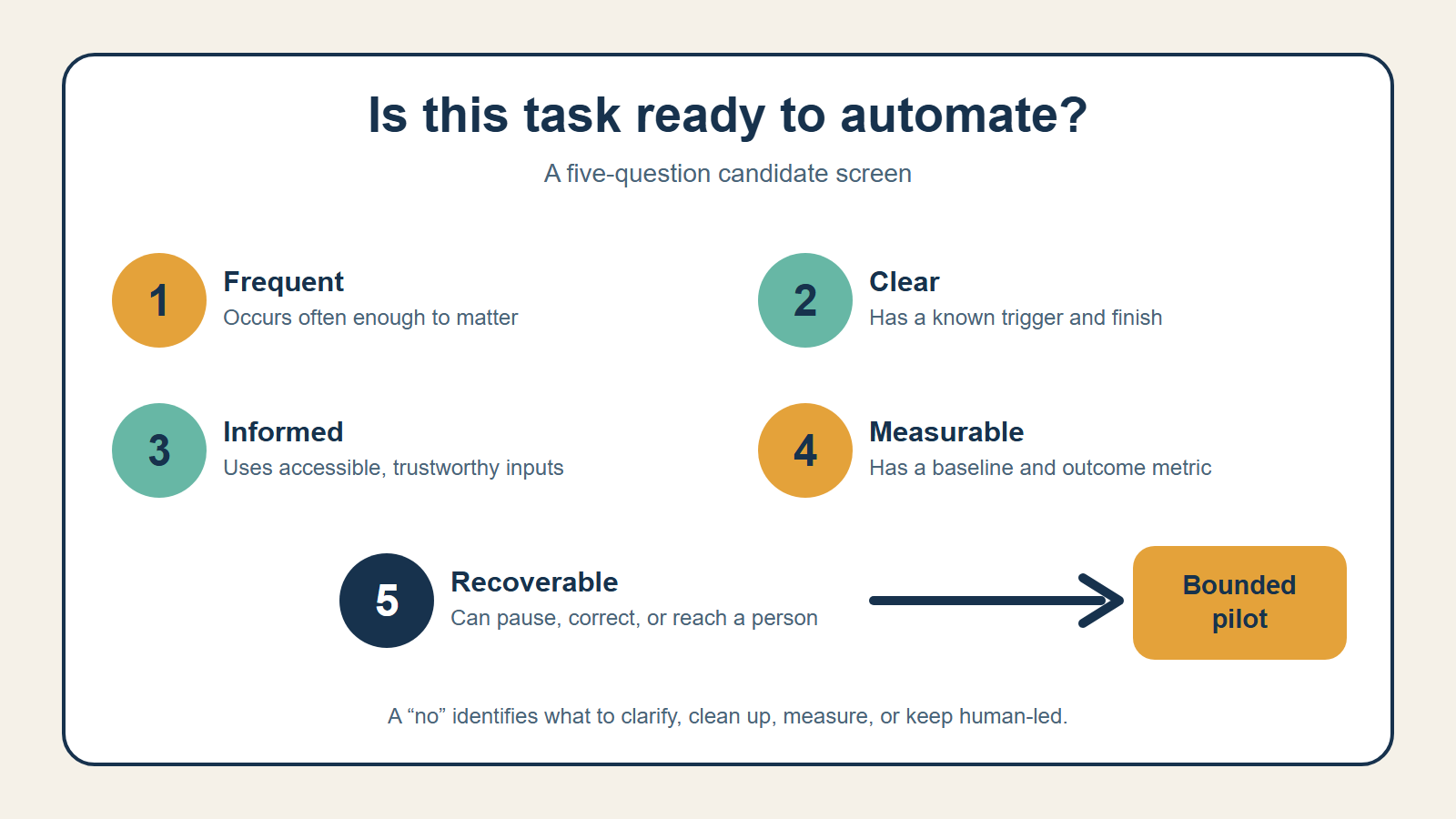
Use this five-question screen before comparing tools:
- Does the task happen often enough to matter?
- Can someone describe the trigger, normal steps, and finished result?
- Are the required inputs available and reasonably trustworthy?
- Can success be measured against the current process?
- Can a person safely review, correct, or resume the work when it goes off course?
Signs of a strong candidate
Strong candidates usually repeat in a similar form. Examples include routing an incoming inquiry, checking whether a record contains required fields, assembling a report from approved sources, sending a reminder after a defined interval, or creating a first draft for human review.
Look for these characteristics:
- Meaningful volume: the task occurs often enough for reduced delay or effort to compound.
- Stable boundaries: the business knows what starts the work and what “done” means.
- Limited variation: most cases follow a normal path, while unusual cases can be identified.
- Accessible inputs: the system does not need to hunt across conflicting sources for critical facts.
- Observable outcomes: the team can compare cycle time, correction rate, backlog, cost, or another result.
- Recoverable mistakes: errors are visible and can be corrected before causing serious harm.
- Named ownership: a person is accountable for policy, exceptions, and maintenance.
NIST’s AI Risk Management Framework emphasizes defining a system’s intended purpose, deployment context, business value, limitations, and metrics. Its companion playbook also recommends considering non-AI alternatives and keeping the scope narrow enough to manage. Those principles apply even when the planned automation is simple.
Warning signs of a weak candidate
A task is usually a poor starting point when its rules are disputed, the information is unreliable, or the cost of a mistake is hard to contain. Be cautious when:
- every case depends on nuanced judgment;
- employees use undocumented workarounds to finish the job;
- important facts live only in memory or scattered messages;
- the task creates legal, financial, safety, or customer commitments;
- nobody owns the outcome after launch;
- the proposed benefit cannot be measured; or
- the only plan for unusual cases is “the AI will figure it out.”
Some weak candidates can become stronger after the business clarifies policy, cleans up inputs, or narrows the scope. Others should remain human-led or use conventional rules. See When Not to Use AI: Nine Tasks Better Left to Rules or Humans for that distinction.
A quick scoring method
Give each of the five questions a score from zero to two: zero means “not yet,” one means “partly,” and two means “yes, with evidence.” A high total is useful, but it does not override a serious warning. One unacceptable consequence or missing authority boundary can disqualify a task even when it is frequent and measurable. Write one sentence of evidence beside every score. That small discipline separates a genuine operating case from enthusiasm about a product demo.
Compare the task, not the excitement around it
Consider two common requests:
| Task | Candidate quality | Why |
|---|---|---|
| Route website inquiries to the correct queue | Strong | The trigger, destinations, and exception path can be defined; routing time and corrections are measurable. |
| Negotiate custom customer contracts autonomously | Weak | The work involves consequential commitments, changing context, and authority that is difficult to bound. |
The first task may use fixed rules, AI classification, or a hybrid. The qualification decision comes before the technology decision. As the U.S. Small Business Administration notes in its small-business AI guidance, practical uses can include sorting messages by task and routing calls—but each business still needs to protect sensitive information and verify outputs.
Start with a bounded pilot
Choose one input type, one team, or one action. Preserve the current fallback, require review where consequences are meaningful, and record the baseline before launch. A useful pilot answers a business question: did response time fall, did fewer cases need rework, or did the backlog shrink without increasing risk?
For a more detailed comparison method, read How to Choose Your First Business Process to Automate. You can also explore the AI Agents & Automation hub.
Readers building a coordinated operating system can learn more about The AI Agent Entrepreneur, Volume I. The book’s implementation sequence and working materials go beyond this public screening checklist and are not reproduced here.
Use a short disqualification check
Before scoring benefits, ask whether the process has an owner, a stable finish condition, accessible source data, and a recoverable failure path. A “no” does not permanently reject automation; it identifies the prerequisite work. Fixing ownership or data quality first is often faster than building around a process that nobody can consistently explain or verify.