MEDIA
Deterministic Automation vs. AI Agents: Which Should Handle the Job?
Use deterministic automation when code can define the correct steps and outcome. Use an AI agent when a bounded goal genuinely requires interpreting ambiguous information, choosing among approved actions, and adapting to intermediate results. Keep a person in control when the work depends on accountability, relationships, novel judgment, or consequences that the business should not delegate.
Most reliable business systems are hybrids. Code controls the workflow, permissions, calculations, state changes, and validation. A model handles a narrow interpretation task. A person approves consequential decisions and owns exceptions. The design question is therefore not “automation or agent?” for the whole process. It is “what should decide each step?”

The difference in plain English
Deterministic automation follows an explicit path. Given the same validated state and inputs, it applies the same rules. That makes it predictable, testable, inexpensive at scale, and suitable for fixed operations such as calculations, permissions, schedules, routing rules, required-field checks, and status transitions.
An AI agent uses a model, instructions, context, and tools to pursue a goal. It can interpret language, compare messy evidence, select a permitted tool, examine the result, and choose a next step. That flexibility helps when the path cannot be fully specified in advance. It also introduces variability, cost, new failure modes, and a larger monitoring burden.
Microsoft’s current agent-workflow guidance describes this as a spectrum. A deterministic pipeline is predictable but has no AI reasoning. A tool-using agent is flexible but less predictable. Most production applications place explicit workflow structure and validation around the individual steps that benefit from model reasoning.
Do not confuse complexity with ambiguity
A task can be technically complex yet fully rule-based. Calculating tiered pricing, reconciling thousands of transactions, or evaluating a long eligibility matrix may require substantial software, but an agent is unnecessary if the correct result can be encoded and tested.
A task can also be simple for a person but difficult to specify with rules. Determining whether a short customer message expresses a cancellation, complaint, billing question, or ambiguous mix may require interpretation even though the action itself is small.
Use these definitions:
- Complexity is the number of steps, dependencies, cases, or calculations.
- Ambiguity is uncertainty about meaning, context, evidence, or the appropriate next step.
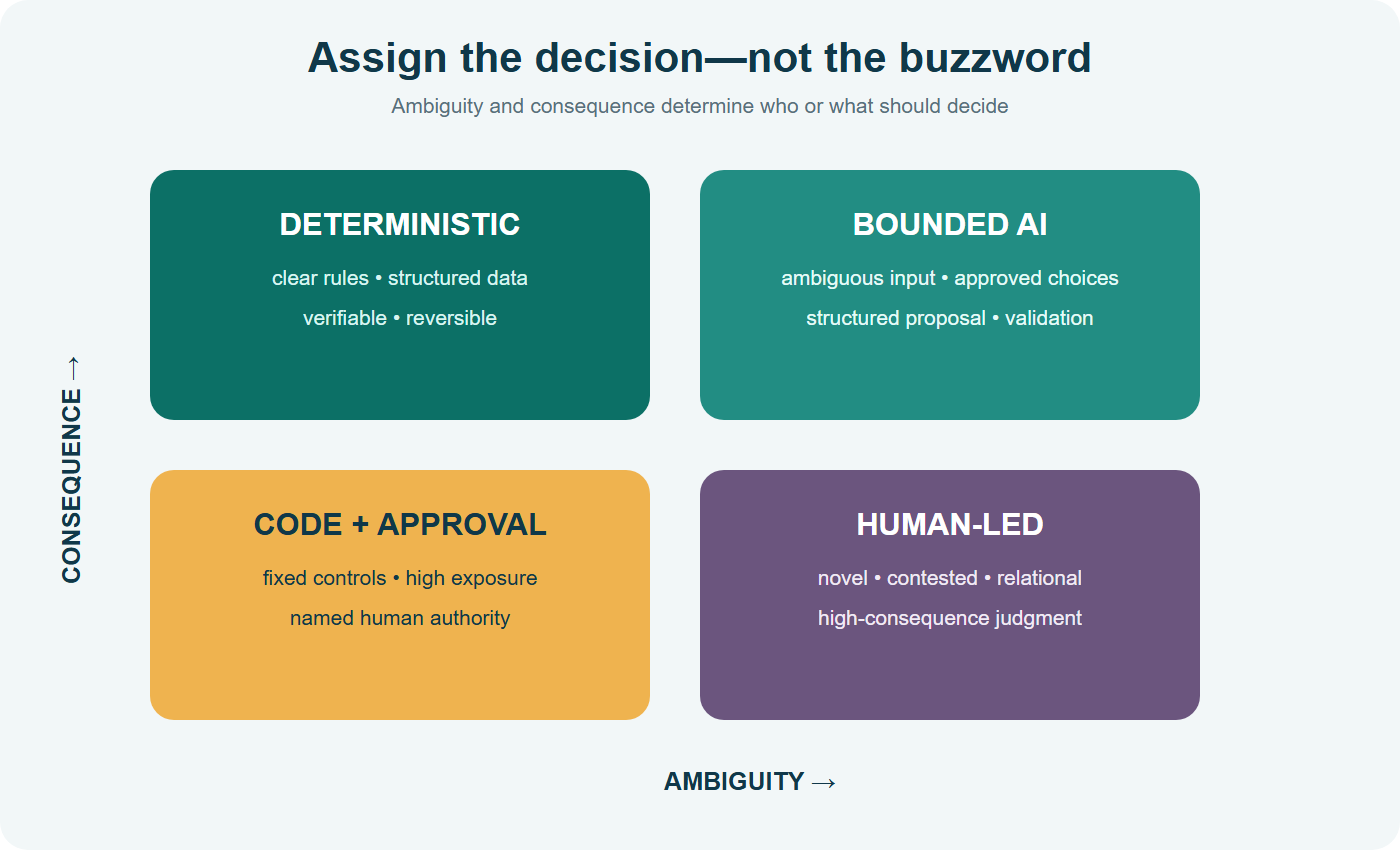
- Consequence is the harm or commitment that can follow a wrong decision or action.
Complexity alone favors better engineering. Ambiguity may justify AI. Consequence determines how much authority and human control are appropriate.
Use deterministic automation for fixed truth and fixed policy
Code should handle a step when the business can state the correct operation in rules and verify the result against an authoritative source. Strong candidates include:
- checking that required fields exist and match a schema;
- calculating prices, taxes, dates, thresholds, or service levels;
- enforcing permissions, spending caps, allowlists, and recipient restrictions;
- routing by known values;
- polling a job or record status;
- scheduling recurring work;
- creating an idempotency key and preventing duplicates;
- moving an item through allowed states;
- comparing a returned value with the expected value; and
- triggering fixed notifications or alerts when a threshold is crossed.
Do not use a model-turn wrapper to imitate these operations. A language model adds latency, cost, variability, and a new dependency without adding useful judgment. Deterministic portions should continue operating when model access is disabled.
The fact that a rule set is long does not make it “intelligent.” If the policy is knowable, implement it transparently and test the edge cases.
Use an AI agent for bounded interpretation and adaptive choice
An agent becomes useful when the workflow must handle unstructured information or choose among several legitimate paths based on context. Examples include:
- classifying an unusual customer request that does not match simple keywords;
- extracting relevant facts from varied documents;
- comparing a request with multiple sources and identifying conflicts;
- drafting a response tailored to approved evidence and tone;
- planning research across permitted sources;
- choosing which diagnostic tool to call based on the observed result; or
- preparing a recommendation when the inputs cannot be reduced to fixed fields.
The word bounded matters. Define the goal, available context, tools, permissions, stop conditions, output structure, validation, evidence, and escalation route. An agent should not grant itself access or expand the purpose of the task because a prompt sounds urgent.
AI is most valuable when it converts ambiguity into a structured proposal that deterministic controls or a person can evaluate. For a broader capability comparison, see Chatbot, Automation, or AI Agent?.
Keep people responsible for human work
Some work should remain human even if a model can generate a plausible answer. Keep people in control when the task primarily requires:
- accepting responsibility for a business or customer outcome;
- negotiating a commitment or resolving a conflict;
- building trust through an ongoing relationship;
- balancing values or interests not captured in a rule;
- handling a novel, high-consequence, or contested case;
- exercising professional judgment under legal or ethical duties;
- changing the objective, policy, or acceptable risk; or
- deciding whether a system should be commissioned, restricted, paused, or retired.
Human control is not achieved by adding an approval button to every item. The reviewer needs authority, relevant evidence, time, a clear decision, and a safe default. Human-in-the-loop roles should be defined precisely.
Evaluate each step with six questions
1. Can the correct answer be stated as a rule?
If yes, prefer code. A rule may be complicated, but it remains testable and explainable. If qualified people routinely disagree because meaning or context matters, a model-assisted proposal or human decision may fit better.
2. Are the inputs structured and authoritative?
Structured fields from a system of record favor deterministic logic. Emails, calls, contracts, images, and varied documents may require extraction or interpretation. Even then, use code to validate the model’s structured output.
3. Must the path adapt after each result?
A known sequence with explicit branches is a workflow. An agent may help when the appropriate next tool or question cannot be enumerated economically. Limit the available choices and define when the loop stops.
4. What is the consequence of error?
Drafting an internal summary is easier to reverse than sending a legal notice, changing payroll, closing an account, or purchasing inventory. Greater consequence calls for stronger deterministic gates, narrower authority, better evidence, and human approval.
5. Can the result be verified?
If the final state can be checked against an authoritative system, the workflow can verify completion. If quality requires judgment, define a rubric, sampling plan, or reviewer. A system that cannot detect a bad outcome should have less authority.
6. Who owns exceptions and maintenance?
Every design has exceptions. Agents also require model, instruction, context, tool, and evaluation maintenance. If the business cannot staff the review queue and lifecycle work, choose a simpler design.
A four-zone assignment model
| Task characteristics | Best starting assignment | Example |
|---|---|---|
| Clear rules, structured data, reversible action | Deterministic automation | Validate an order and create a project record |
| Ambiguous input, bounded choices, verifiable output | AI inside a deterministic workflow | Classify a request, then route by validated category |
| Ambiguous path, approved tools, low-to-moderate consequence | Bounded agent with monitoring | Research approved sources and prepare a cited brief |
| Novel judgment, relationship, contested or high-consequence outcome | Human-led work with software support | Negotiate an exception or decide a disputed account action |
Start in the most controlled zone that can create value. Move toward greater agent discretion only when operating evidence supports it.
The strongest pattern: deterministic shell, AI core
A practical hybrid often looks like this:
- Code receives the event and assigns a correlation identifier.
- Code validates required fields, identity, permissions, limits, freshness, and duplicates.
- A model performs one named judgment, such as classification, extraction, comparison, or drafting.
- Code validates the output against a schema, allowed values, policy, and current authoritative state.
- A person reviews when consequence, novelty, uncertainty, or exposure crosses a threshold.
- Code executes a narrowly scoped, idempotent action.
- Code verifies the authoritative system reached the intended state.
- The system records evidence and routes exceptions to an owned queue.

This pattern uses AI where interpretation creates value while preserving reliable execution. Microsoft’s durable agent guidance similarly distinguishes workflows whose code controls the execution path from agent loops in which a model decides which tools to call and when to stop.
Example: customer service triage
Imagine an incoming service email.
Deterministic intake checks the sender, customer identifier, attachment type, account status, and duplicate message ID. An AI step extracts the issue, requested outcome, relevant product, and ambiguity flags into a fixed schema. Code rejects unsupported values, checks policy and service tier, and assigns a provisional route. A person reviews threats, disputed facts, vulnerable-customer indicators, high financial exposure, or low-confidence cases. Code creates the ticket and verifies its queue and priority.
Using an agent for the entire process would make permissions, routing, and state changes less predictable. Using only rules would struggle with varied language. The hybrid preserves both interpretation and control.
Example: invoice exception handling
Code can match vendor, purchase order, amount, currency, dates, tax fields, and prior payment status. A model may interpret a free-form explanation or compare varied line-item descriptions. Code then applies tolerance rules and prevents duplicate payment. A person approves policy exceptions or suspicious changes to bank information.
The agent does not need permission to pay. It may only structure the ambiguous evidence and recommend a reason code. Authority remains with deterministic controls and the named approver.
Example: account research
An agent can search permitted sources, follow relevant leads, compare claims, and prepare a cited account brief. Code should enforce source allowlists, time and usage limits, required sections, citation presence, and the destination. A salesperson decides whether and how to use the brief in a relationship.
This is more agentic because the research path varies. It is still bounded by purpose, sources, budget, evidence, and human use.
Cost and maintenance change the answer
Deterministic automation usually costs more to specify at the beginning when the rules are numerous, but it is inexpensive and consistent at scale. Agents can handle variation without encoding every branch, but each run may incur model and tool cost, and quality requires ongoing evaluation.
Compare:
- design and integration effort;
- model, tool, and infrastructure usage;
- human review and exception time;
- testing and evaluation;
- observability and incident response;
- vendor and model change;
- security and permission management;
- error and recovery cost; and
- the value of flexibility when inputs change.
Do not use an agent merely because it is quicker to demo. A brittle prototype can shift large costs into production review and repair. Reliable automation has hidden maintenance work, and agents expand that surface.
Common architecture mistakes
Letting the model enforce policy. Put limits and permissions at the execution boundary in code.
Using AI for arithmetic or status checks. Fixed operations should be deterministic.
Encoding ambiguity into hundreds of fragile rules. Use a bounded interpretation step when language and context genuinely vary.
Giving the agent broad tools for convenience. Expose only the actions needed for the approved goal.
Retrying external actions blindly. Use idempotency, verify state, and escalate ambiguity.
Using a human as a decorative backstop. Design a real review decision with evidence and capacity.
Measuring only technical success. Verify the business and customer outcome.
Choosing one architecture for every workflow. Assign technology step by step.
A pre-build assignment checklist
For every step, document:
- the input and authoritative source;
- whether the step is fixed logic or interpretation;
- the expected structured output;
- acceptable uncertainty and error consequence;
- the assigned decision-maker: code, model, or person;
- information and action permissions;
- validation before and after the step;
- approval and escalation conditions;
- retry, duplicate prevention, and recovery behavior;
- evidence required to reconstruct the result; and
- the measure that will show whether the assignment works.
Then test the deterministic workflow with model access disabled. Fixed validation, polling, scheduling, state management, and alerts should still operate. Separately test the AI step against representative normal, ambiguous, adversarial, and out-of-scope cases.
Choose the least variable design that works
The best architecture is not the one with the most agency. It is the least variable design that can handle the real ambiguity in the work while meeting the outcome, risk, cost, and operating requirements.
When uncertain, begin with the model producing a structured recommendation rather than taking action. Compare its proposals with actual decisions, track disagreement and exceptions, and use that evidence to improve the workflow. Greater authority is a later operating decision, not a feature that must be enabled at launch.
Use rules for what the business already knows. Use AI for the interpretation it cannot specify economically. Use people for accountability and human judgment. Connect the three with explicit states, controls, evidence, and ownership.
For selection at the task level, see What Makes a Good Automation Candidate?. For safe execution and recovery, continue with How to Design an AI Workflow That Fails Safely.
Review the boundary after incidents and material changes. If a judgment step becomes stable and testable, move it into deterministic code; if a rule accumulates unavoidable ambiguity, isolate the interpretation and keep its authority constrained.
Explore more practical guidance in the AI Agents & Automation hub.
Sources and further reading
- Microsoft Agent Framework: Workflows
- Microsoft Learn: Agentic application patterns
- Microsoft Learn: Agent Skills versus workflows
- AWS Prescriptive Guidance: Understanding agentic AI economics
- AWS Prescriptive Guidance: Strategic foundations for agentic AI
Build the right division of labor
Agentrepreneur: Building Your AI Agent Business in 28 Days goes deeper into operating an agent-enabled company. This article provides a public architecture lens; the book helps owners turn the division among code, models, and people into a managed business system.