MEDIA

What Does Human-in-the-Loop Actually Mean?
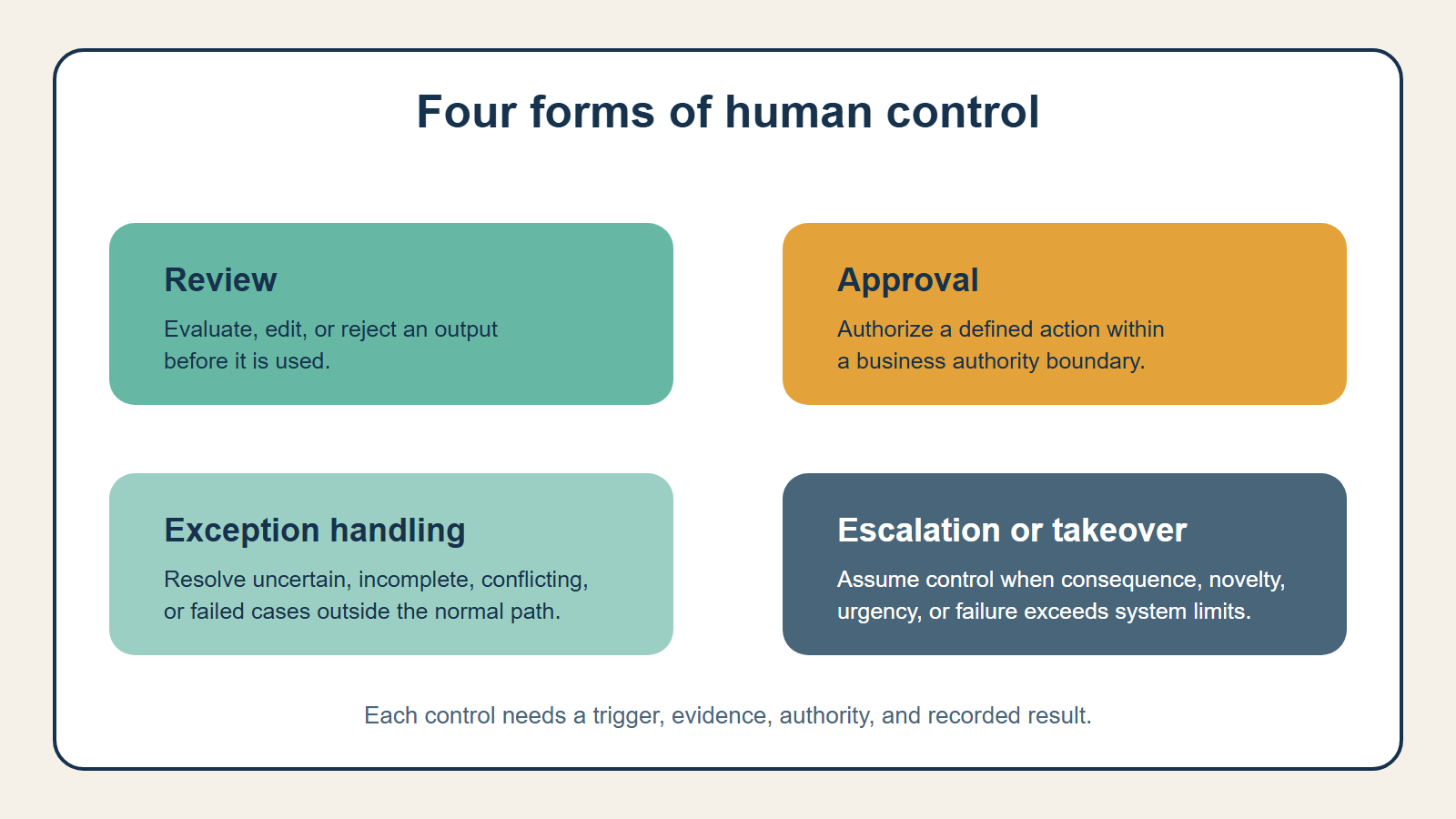
Human-in-the-loop means a person performs a defined control inside an AI-enabled workflow: reviewing information, approving an action, resolving an exception, or taking over when conditions exceed the system’s authority. It does not simply mean that an employee is somewhere nearby or can check results later.
An effective design answers four questions:
- What event requires a person?
- What evidence does that person receive?
- What decision or action can the person take?
- How is the result recorded and measured?
If those answers are missing, “human-in-the-loop” is a slogan rather than an operating control.
Four different forms of human control
The terms below are often blended together, but they solve different problems.
Review
A person evaluates an AI output before it is used. Review may cover correctness, completeness, tone, policy alignment, or supporting evidence. The reviewer can edit or reject the output, but may not authorize the final business action.
Example: an employee checks an AI-generated customer-service draft before it reaches the approval queue.
Approval
A person decides whether a proposed action may proceed. Approval protects a defined authority boundary such as external communication, spending, account changes, contractual language, or use of sensitive information.
Example: a manager approves a proposed refund above a set threshold.
Exception handling
The normal workflow routes uncertain, incomplete, conflicting, or failed cases to a person. The handler resolves the case, corrects the input, chooses an allowed alternative, or sends the work to a specialist.
Example: an inquiry matches two service regions and enters an exception queue instead of being assigned automatically.
Escalation and takeover
A person assumes control because the consequence, novelty, urgency, or system condition exceeds the automation’s operating limits. Escalation can also follow a customer request or repeated failure.
Example: a service agent takes over after the system detects a safety concern or cannot verify the customer’s identity.
Human-in, human-on, and human-out of the loop
The U.S. Government Accountability Office describes three broad approaches. In a human-in-the-loop arrangement, a person retains control and makes the final decision. In a human-on-the-loop arrangement, the system operates while a person supervises and can intervene. Human-out-of-the-loop means the system operates without active human supervision for that task.
None of the labels is automatically right or wrong. The appropriate choice depends on purpose and consequence. A low-risk internal formatting task may not need case-by-case review. A consequential external action may require explicit approval even if the model’s measured accuracy is high.
NIST’s AI Risk Management Framework calls for human-oversight processes and human-AI roles to be defined, assessed, documented, and connected to organizational policy. That makes oversight a design decision—not an afterthought attached to the interface.
Match the control to the consequence
Use stronger human control when an error is difficult to reverse, affects people outside the company, creates a financial or legal commitment, uses sensitive data, or depends on unusual context.
| Workflow condition | Possible control |
|---|---|
| Low-risk, reversible internal output | Sample-based review and monitoring |
| External message with approved content | Review before sending or approval for flagged cases |
| Spending or account change | Explicit approval with limits and evidence |
| Missing, conflicting, or low-confidence input | Exception queue |
| Novel, high-consequence, or prohibited condition | Stop and escalate to a named owner |
Avoid using model confidence as the only trigger. A system can be confidently wrong, and some vendors’ confidence scores do not measure the business consequence. Combine technical signals with business rules: customer status, amount, data sensitivity, action type, policy exception, and reversibility.
Design the reviewer’s job
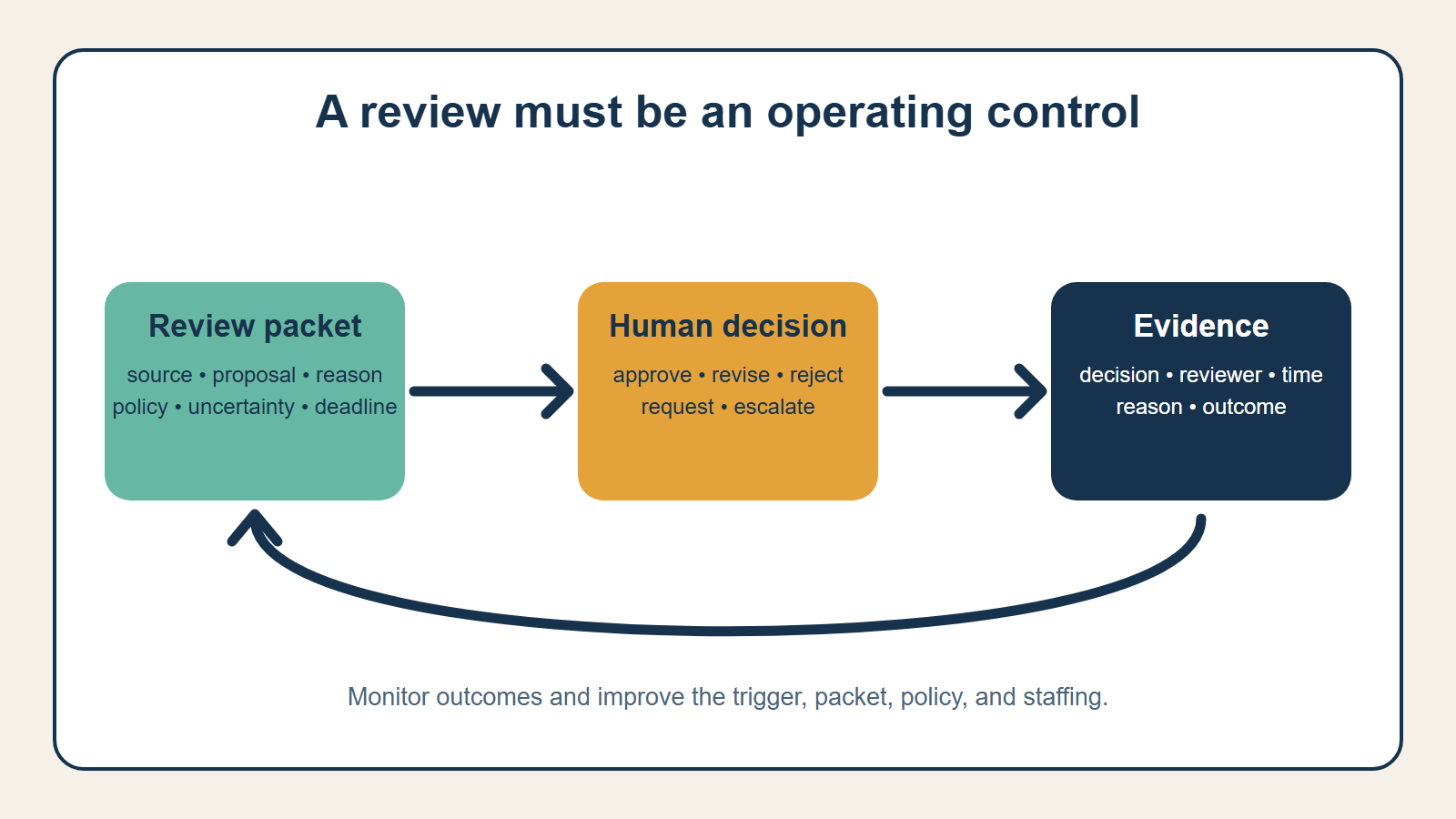
Human review fails when the person lacks time, context, authority, or a clear standard. Define the review packet:
- original source material;
- AI output and proposed action;
- relevant policy or approved reference;
- reason the case requires review;
- known uncertainty or missing information;
- deadline and consequence of delay; and
- allowed decisions: approve, edit, reject, request information, or escalate.
Do not make the reviewer rediscover the entire case across multiple systems. The control must be operationally feasible at expected volume.
Watch for rubber-stamping
Requiring a click does not guarantee meaningful oversight. Reviewers may approve by habit when queues are large, explanations are weak, or the system is usually right. The risk increases when the interface places the proposed answer first and hides the source.
Measure review quality, not just review completion. Useful indicators include:
- percentage of outputs changed or rejected;
- time spent per review by case type;
- corrections found after approval;
- appeals or customer complaints;
- exception backlog and age;
- disagreement between independent reviewers; and
- reasons for override or escalation.
Very low intervention can mean excellent performance—or ineffective review. Sample approved cases independently and compare the result.
Avoid turning people into a bottleneck
A universal approval requirement can erase the value of automation. Segment the workflow by consequence. Allow bounded, reversible cases to proceed with logging and sampling; require approval for defined thresholds; and stop prohibited or unknown cases.
Staff the control for peak volume and absences. Set service-level expectations for review and a fallback when the queue grows. If the business cannot supply timely human capacity, the automation’s permitted scope should shrink.
The cost belongs in the business case. How to Calculate the ROI of AI Automation explains why review and exception handling are recurring operating costs, not free safeguards.
Choose full review, targeted review, or sampling
Not every control requires the same coverage. Use full review when every action has meaningful consequence, the workflow is new, or the business lacks evidence about performance. Use targeted review when business rules can reliably identify higher-risk cases, such as large amounts, sensitive records, unusual requests, new customers, or policy conflicts. Use sampling to detect drift and hidden errors among low-risk cases that normally proceed automatically.
The methods can work together. A pilot might review every case for two weeks, then require approval for flagged cases while independently sampling routine approvals. Increase coverage after a vendor change, policy update, incident, or shift in the input population.
Document how the sample is selected. Reviewing only convenient or successful cases creates false reassurance. Include random cases plus deliberate samples from important segments, exceptions, and recent changes. Define what finding triggers broader review, a temporary stop, or a return to full approval. Oversight should be able to become stronger when evidence deteriorates—not remain fixed because the initial workflow diagram said “human in the loop.”
Assign authority and accountability
Name the person or role that owns the policy, the operator who handles cases, and the leader who can change thresholds. Reviewers need authority to stop the workflow without penalty when evidence is insufficient.
Record the source, proposal, decision, reviewer, time, and reason. Logs should support investigation without collecting unnecessary sensitive information. Review access and retention with appropriate legal, privacy, security, or industry advisers.
GAO’s accountability framework emphasizes defining procedures for human supervision according to system purpose and potential consequences. It also connects oversight with governance, performance measurement, and continued monitoring. A person in the process is only one part of accountability.
A practical test
Before launch, hand representative cases to the designated reviewers and observe the work. Can they identify why the case reached them? Can they verify the important facts? Do they know what they may approve? Can they find the policy? Does the system preserve their reason?
Include ambiguous and failure cases, not just clean examples. If reviewers cannot perform the control under realistic conditions, redesign the workflow before expanding it.
Test the control when AI is unavailable
The business should still know what to do when the model, integration, or vendor is unavailable. Run a short exercise with AI output disabled. Can staff identify pending cases, use the approved manual path, preserve evidence, and restart without duplicating actions?
This test separates the human control from the technology it supervises. It also reveals whether the supposed reviewer is actually dependent on an AI summary that hides the original facts. Define which work may wait, which work returns to a manual process, and who authorizes recovery. A human-in-the-loop design is stronger when the loop still has a safe operating path during an outage.
Continue with How to Set Approval Rules for AI-Assisted Work and What Is an Exception Queue—and Why Does Automation Need One?, or return to the Governance, Safety & Reliability hub.
Readers building a coordinated operating system can explore The AI Agent Entrepreneur, Volume I. The book’s implementation sequence and working materials go beyond this public oversight guide and are not reproduced here.