 MEDIA

How to Set Approval Rules for AI-Assisted Work
Set approval rules according to the consequence of the action, not simply whether AI helped produce it. Require stronger review when work is hard to reverse, creates financial or legal exposure, communicates externally, uses sensitive information, changes access or records, affects people, or falls outside normal conditions. Let low-consequence, reversible work proceed with sampling and monitoring.
“A human must approve it” is not a complete control. The rule must say which events require approval, who has authority, what evidence the reviewer receives, what they must check, how long they have, and what happens when they reject, edit, or do nothing.

Start with the action, not the output
An AI-generated draft sitting in a private workspace has limited effect. Sending it to a customer changes the risk. A classification suggestion may be easy to correct; using it to deny access or change a financial record may not be.
Map the full workflow:
- what information the system reads;
- what it creates or recommends;
- which systems or people receive the result;
- which action follows;
- who may be affected; and
- how the action can be detected, paused, corrected, or reversed.
Approval belongs at the last practical point before consequence, not automatically after every model response. Upstream validation can prevent bad inputs, while downstream monitoring can detect patterns that individual reviewers miss.
Score seven approval factors
Use a simple low, medium, or high rating for each factor.
Consequence
What happens if the result is wrong? Consider harm to customers, employees, reputation, revenue, contractual commitments, safety, compliance, and business continuity.
Reversibility
Can the action be undone quickly and completely? A private draft is easy to discard. A public statement, deleted record, released payment, changed permission, or missed deadline may be difficult or impossible to reverse.
External exposure
Does the work leave the organization? Customer messages, marketing claims, filings, proposals, social posts, and partner instructions deserve controls that internal brainstorming does not.
Sensitive data
Does the workflow access personal, confidential, financial, health, employee, credential, or regulated information? Approval does not cure unauthorized access, so apply access controls before review.
Authority and value
Can the action spend money, grant access, accept terms, change a price, commit inventory, alter a system of record, or bind the organization? Set explicit limits by action and amount.
Uncertainty
Is the input incomplete, contradictory, outside the test set, or dependent on judgment? Do not rely only on a model’s self-reported confidence. Use observable conditions, validation results, and comparison with known cases.
Novelty
Is this a normal case or an unusual combination of customer, data, request, location, product, exception, or instruction? Route novel cases to a person until the organization has evidence for a safe rule.
Use four control levels
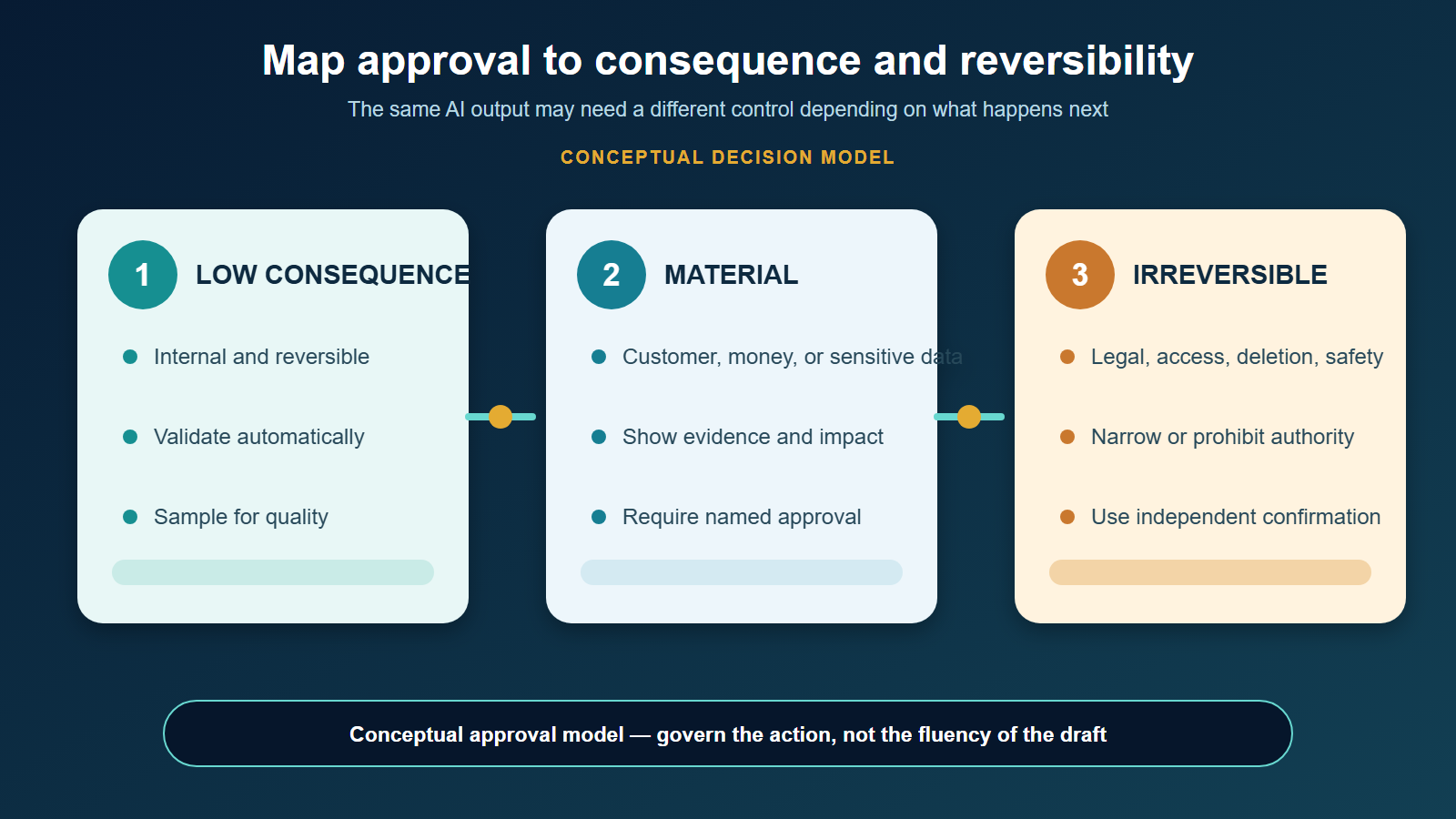
| Level | Typical use | Control pattern |
|---|---|---|
| 1. Assist | Brainstorming, private drafts, summaries for an informed user | User decides whether to use the result; periodic quality sampling |
| 2. Verify | Structured extraction, internal updates, reversible routine work | Deterministic validation plus sample or exception review |
| 3. Approve | External communication, meaningful record changes, moderate spend | Named reviewer approves with evidence before execution |
| 4. Restrict | High-consequence, legally sensitive, irreversible, or prohibited actions | AI may prepare information, but authorized specialists decide or the action is blocked |
One workflow may use several levels. The system can automatically collect documents, ask a person to approve a customer-specific exception, and block a prohibited action entirely.
Define triggers in observable terms
Useful triggers can be implemented and tested:
- payment or discount exceeds a stated amount;
- recipient is outside an approved domain;
- message contains a complaint, threat, cancellation, legal claim, or safety issue;
- required fields are missing or conflict;
- record includes a protected or sensitive category;
- user requests deletion, access, correction, or account recovery;
- action changes permissions, credentials, or system-of-record status;
- result fails a format, policy, source, or calculation check;
- case is outside approved products, regions, languages, or hours; or
- the system, vendor, model, or policy version changed since validation.
Where a condition is fixed, implement it directly in code. Do not ask a model to decide whether a dollar amount exceeded $500 or whether a required identifier is blank. Use model judgment only for the identified interpretation, then constrain the next action with deterministic rules.
Give the reviewer enough evidence
An approval screen should show the proposed action, source information, important transformations, policy or rule applied, validation results, affected customer or record, financial or access impact, relevant history, and the reason the case was escalated.
The reviewer should be able to approve, edit, reject, request information, or send the case to a higher authority. Record the decision, reviewer, time, version, reason, and final action. Do not bury the important difference in a wall of generated explanation.
NIST’s AI Risk Management Framework recommends defining and documenting human oversight, tracking overrides and adjudication, and recording accountable go/no-go decisions. A recent NIST identity-management design note for agents likewise describes risk thresholds that trigger review by the correct authority, while warning that excessive escalation can create consent fatigue.
Avoid rubber-stamp approval
If reviewers approve nearly every case in seconds, the control may be ceremonial. Common causes include too many low-risk alerts, missing context, unclear authority, production pressure, and no feedback from prior decisions.
Measure:
- approval, edit, rejection, and escalation rates;
- time to decision;
- repeat reasons for escalation;
- disagreements among reviewers;
- incidents that passed approval;
- cases delayed beyond the service target; and
- changes made after reviewer feedback.
Use those measures to improve the workflow. Automate deterministic checks that reviewers repeatedly perform, narrow triggers that create noise, and strengthen evidence for cases that remain consequential.
Set timeouts and safe defaults
Every approval queue needs a deadline and a safe response to inaction. Options include hold, expire, cancel, continue through a manual process, or escalate to a backup. The default should reflect consequence; silence should not quietly authorize an irreversible action.
Document after-hours coverage, unavailable approvers, queue ownership, duplicate requests, and how an approved action is kept from executing twice. For failure containment and recovery, see How to Design an AI Workflow That Fails Safely when available.
Separate request, review, and execution where it matters
For higher-consequence actions, avoid letting one person request, approve, and execute the same transaction without independent evidence. Separation can be lightweight: a sales employee prepares a discount, a manager approves amounts beyond the employee’s limit, and deterministic code confirms that the executed price matches the approved record.
The approver should not merely repeat the requester’s work. Give the reviewer a defined question and authority. A finance reviewer may confirm amount, account, documentation, and budget; a privacy reviewer may confirm purpose, access, and retention; a communications reviewer may check factual support, audience, tone, and commitments.
Record delegation rules when the primary approver is unavailable. Temporary authority should have a scope, limit, start, end, and audit trail. Shared inboxes and group approvals may improve coverage, but they should still capture which authorized person made the decision.
Test the rules with scenarios
Before launch, create cases for normal work, boundary amounts, missing data, conflicting instructions, sensitive records, unusual recipients, permission failures, repeat actions, vendor outages, and attempts to bypass the control. Confirm both sides: safe work should not be trapped unnecessarily, and consequential work should not slip through.
Repeat the test when the workflow, model, integration, policy, product, or authority limit changes. Maintain a manual bypass for continuity, but require an authorized person and record its use.
A practical approval-policy template
For each action, document:
- approved purpose and scope;
- control level and rationale;
- deterministic validations;
- escalation triggers;
- primary and backup approvers;
- evidence shown to the reviewer;
- allowed decisions and authority limits;
- timeout and safe default;
- decision and execution records;
- monitoring measures and review cadence; and
- change, incident, and decommissioning procedure.
Start with What Human-in-the-Loop Actually Means and The Small-Business Guide to AI Risk. For operations, continue with The Hidden Maintenance Work Behind Reliable Automation or return to the Governance, Safety & Reliability hub.
Readers building a coordinated operating system can explore The AI Agent Entrepreneur, Volume I. The book’s implementation materials go beyond this public approval framework and are not reproduced here.
Test the approval path with uncomfortable cases
Walk through a request that arrives late, lacks evidence, exceeds a limit, affects a sensitive customer, or reaches the approver while that person is unavailable. Confirm that the reviewer can see the relevant source, reject the proposal, request correction, and escalate without losing the work. Approval is credible only when the difficult path is usable under real operating pressure.


