 MEDIA

Why Clean Business Data Matters Before You Add AI
Clean business data matters because an AI system can only work with the information it can access, interpret, and trust. If customer records are duplicated, policies conflict, product details are stale, or important decisions live only in employee memory, AI will retrieve the wrong context faster—not create a reliable source of truth.
You do not need perfect data before every AI experiment. You do need data that is fit for the specific task: sufficiently complete, current, consistent, authorized, and traceable for the consequences involved.
“Clean” means fit for purpose
Data quality is contextual. A misspelled company name may be harmless in an internal brainstorming list but costly in a customer contract. A two-day-old inventory count may be acceptable for trend analysis and unacceptable for promising same-day delivery.
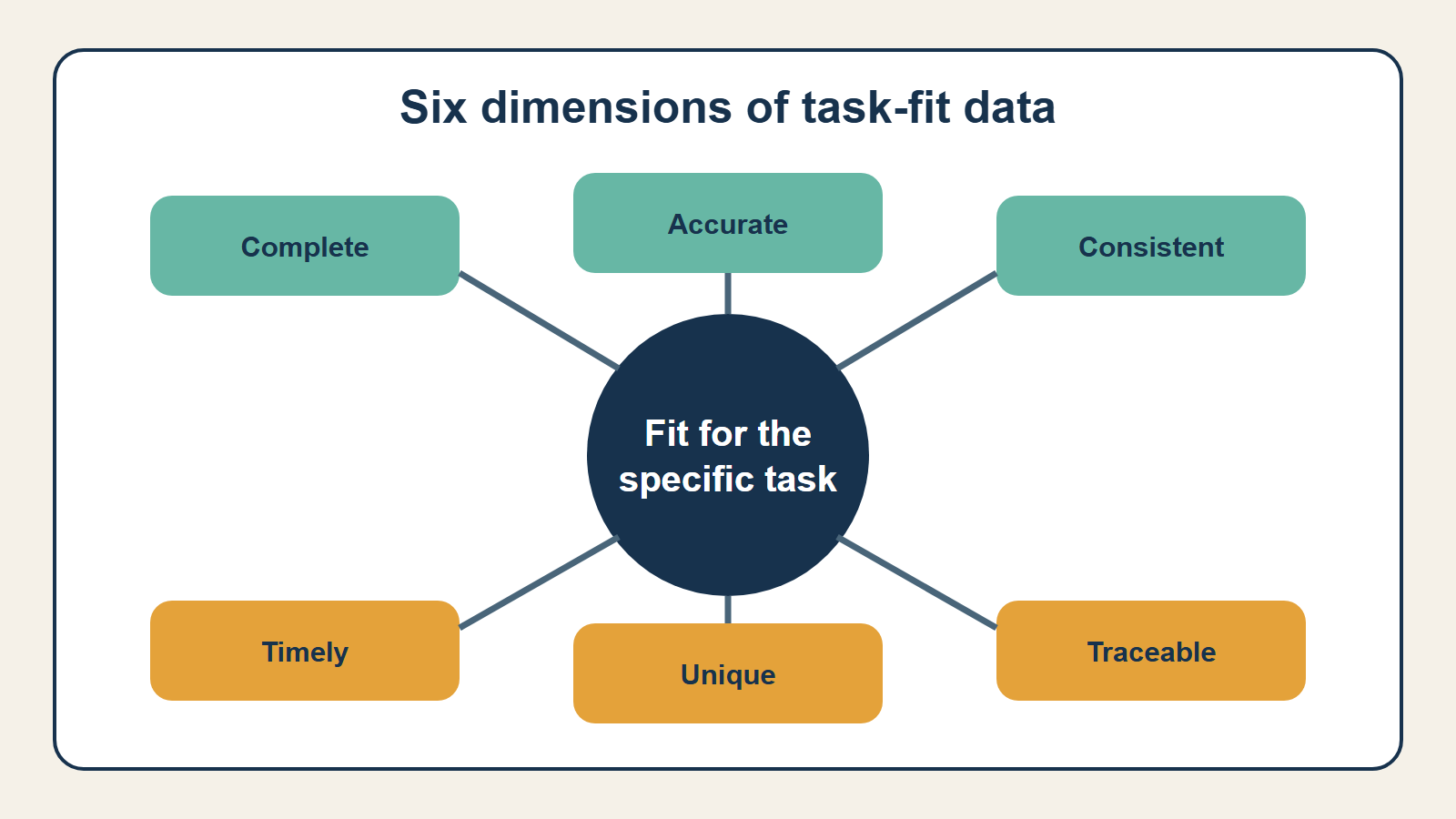
Assess six dimensions:
- Completeness: Are the fields and records required for the task present?
- Accuracy: Do values match the real customer, product, transaction, or policy?
- Consistency: Do systems use compatible definitions and formats?
- Timeliness: Is the information current enough for the decision?
- Uniqueness: Can the business distinguish one entity or event from duplicates?
- Provenance: Can a reviewer identify the source, owner, and update history?
NIST’s AI Risk Management Framework calls for documenting data availability, suitability, and representativeness. Its playbook asks organizations to examine known errors, noise, redundancy, collection timeframes, adequacy, relevance, and whether data still reflects the operating environment. For a small business, these questions translate into practical controls over the information an AI tool sees.
Five ways poor data breaks AI-enabled work
1. Missing data creates confident gaps
If a service record lacks warranty status, the system may answer from a general policy when the individual case requires an exception. AI can sometimes detect a blank field, but it cannot reliably reconstruct a fact the business never captured.
Define required inputs and a missing-data path. The safe response may be to ask a person, request information from the customer, or stop the workflow.
2. Duplicates create conflicting identities
The same customer may appear under two email addresses, a former company name, and a misspelled record. One profile shows an unresolved complaint while another appears clear. An AI assistant retrieving only one record can produce an incomplete answer.
Choose how the business identifies customers, vendors, products, and transactions. Preserve source records while creating an approved method for matching or linking them.
3. Stale information turns yesterday’s truth into today’s mistake
Prices, inventory, staff assignments, approval limits, product availability, and policies change. A document can be accurate when written and unsafe months later.
Add an owner, effective date, and review interval to consequential information. When possible, retrieve volatile facts from the operational system of record rather than copying them into static reference documents.
4. Inconsistent definitions corrupt comparisons
One team may define a “qualified lead” as any completed form while another requires budget and decision authority. A report can combine both labels and still look polished. AI does not remove the underlying semantic conflict.
Create a short business glossary for high-value terms. Record the definition, owner, source field, and exceptions. This is operating alignment, not a data-science project.
5. Inaccessible knowledge creates invisible blind spots
Important context often lives in inboxes, private spreadsheets, chat threads, or employee habits. The AI tool may lack permission to retrieve it—or the business may grant broad access without understanding what else becomes visible.
Map where the information lives and who is allowed to use it. Access should be task-specific. The related guide What Information Should an AI Agent Be Allowed to See? covers least-access decisions.
Audit one workflow, not the entire company
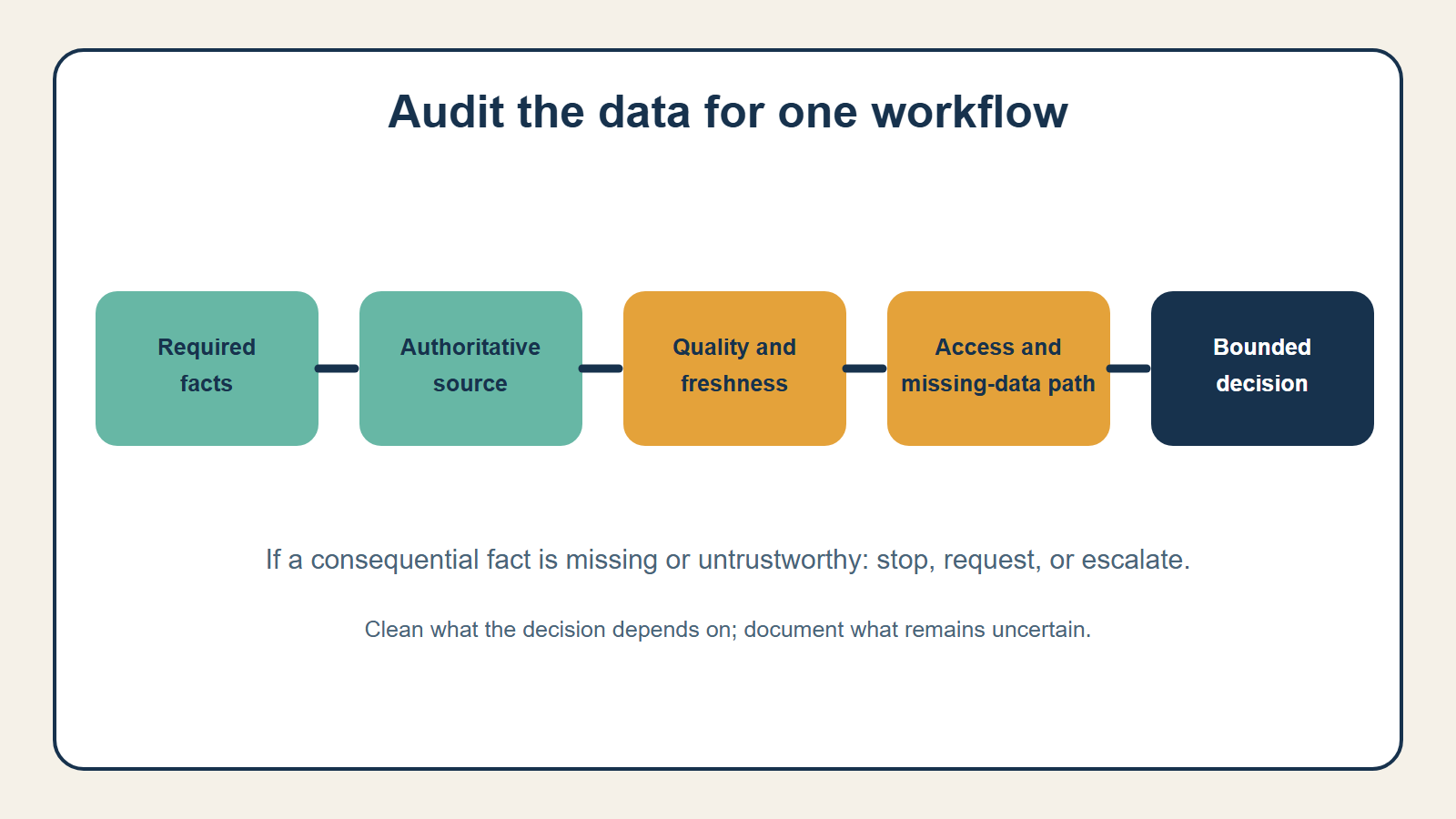
Begin with the process selected for the pilot. List every fact needed to complete its normal path and handle its common exceptions.
| Question | Evidence to collect |
|---|---|
| What facts are required? | Required fields, documents, policies, and calculated values |
| Where is each fact authoritative? | Named system, table, document, or owner |
| How current must it be? | Maximum acceptable age or effective-date rule |
| What conflicts occur? | Duplicate keys, inconsistent labels, competing documents |
| Who may access it? | Role, purpose, and any sensitive-data restriction |
| What happens when it is missing? | Stop, request, escalate, or use an approved default |
Sample real cases, including failures and edge conditions. A tidy demo dataset can hide the variations that dominate daily work. NIST notes that accuracy testing should use realistic data representative of expected conditions; the same principle applies to a small-business pilot.
Fix the highest-consequence problems first
Do not launch an endless cleanup project. Prioritize issues using three questions:
- How often does the issue appear in the target workflow?
- How damaging would a wrong or missing value be?
- How easily can the system or a person detect it before action?
Correct high-frequency, high-consequence, hard-to-detect problems first. A formatting inconsistency that the workflow normalizes may need little attention. A stale approval limit that authorizes external spending deserves immediate control.
Useful corrections include required-field validation, controlled vocabulary, duplicate detection, document ownership, effective dates, automated freshness checks, and an exception queue. Preserve an audit trail when merging or correcting records; cleanup should not erase useful history.
Three examples of task-fit cleanup
Customer-service drafting
The system needs the customer’s current account, product, service history, and the effective policy. Begin by linking duplicate customer records, identifying the authoritative policy library, and marking superseded documents. It is less important to standardize every old marketing file that never enters the support workflow.
Weekly operating reports
The workflow needs stable definitions, reporting periods, and ownership for each metric. Resolve whether “open,” “completed,” and “overdue” mean the same thing across systems. Preserve the source timestamp so readers know whether two numbers describe the same moment. Cosmetic differences in free-text notes can wait unless the report summarizes them.
Lead routing
The system needs a unique inquiry, valid contact method, requested service, geographic or account rules, and the current assignment table. Validate required fields at intake, maintain one approved routing list, and send ambiguous cases to review. A perfect company-wide customer profile is unnecessary for the first routing pilot.
These examples illustrate the principle: clean what the decision depends on, document what remains uncertain, and stop the automation when a consequential fact cannot be trusted. Expanding the scope without expanding the data controls only spreads the same problem across more cases.
Separate source truth from AI-generated material
AI outputs can become new business data: summaries, classifications, drafts, extracted fields, and recommendations. Label them as generated or reviewed. Do not silently overwrite the authoritative record with an unverified inference.
A practical pattern keeps four elements distinct:
- the original source;
- the AI-generated interpretation;
- the human or automated validation result; and
- the final approved business record.
That separation makes correction possible and supports later investigation. It also prevents a generated summary from being retrieved as if it were the original policy or customer statement.
Define ongoing ownership
Data quality declines as the business changes. New products, employees, vendors, fields, and policies introduce fresh ambiguity. Assign an owner for each consequential source and define who can approve structural changes.
Monitor a small set of workflow-specific indicators: missing required fields, duplicate rate, records beyond the freshness limit, conflicting values, retrieval failures, and corrections after AI output. Review the pattern, not just individual errors.
Clean data is not a one-time prerequisite that ends when the AI launches. It is part of operating the workflow reliably.
Write a minimum data contract
Before the pilot, document the few rules every case must satisfy. Name the required fields, authoritative source, maximum age, permitted values, access role, and missing-data response. Also record which generated fields require review before they can update a business system. This “data contract” can be a one-page table; it does not require a new platform.
Test the contract against representative cases and revise it when an exception reveals a real policy gap. Keep version history so the team can explain which rules applied to an earlier decision. The contract gives operators, vendors, and reviewers a shared definition of acceptable input instead of leaving quality to intuition.
Continue with Business Data Map: Where Your Most Valuable Context Actually Lives and Structured vs. Unstructured Business Data: What Owners Need to Know, or return to the Data, Context & Business Memory hub.
Readers building a coordinated operating system can explore The AI Agent Entrepreneur, Volume I. The book’s implementation sequence and working materials go beyond this public data-readiness audit and are not reproduced here.
Before commissioning the workflow, rerun the same representative records through the cleaned path and compare the accepted outcomes with the baseline. Cleaning is complete only when the downstream process can reliably use the result.


