MEDIA
Your Business Data Is Not a Prompt: Building Reliable Memory for AI Agents
A prompt is a temporary instruction. Business memory is the governed system that supplies an AI agent with the right facts, rules, history, permissions, and evidence for a particular task. Copying a company handbook, customer export, and months of chat into a large prompt does not create memory. It creates an expensive, hard-to-audit bundle in which old facts, conflicting policies, sensitive records, and untrusted instructions may look equally important.
Reliable memory begins outside the model. It has authoritative source systems, documented ownership, access controls, version and freshness signals, retrieval rules, citations, feedback, retention, and deletion. The model receives a task-specific context package; it does not become the database of record.
That distinction matters because an agent can sound certain even when its context is incomplete, stale, irrelevant, or malicious. Better prompting may improve wording. It cannot repair missing governance.

A prompt and a memory system solve different problems

A prompt answers, “What should the model do in this turn?” A memory system answers, “Which information is appropriate, authoritative, current, and permitted for this task—and how can we prove where it came from?”
| Prompt | Governed business memory |
|---|---|
| Temporary instruction and context | Persistent information managed across tasks |
| Written for one request or workflow step | Organized for many approved uses |
| Usually evaluated as one block of text | Retrieved by relevance, scope, permission, and time |
| May contain unsupported claims | Preserves source, owner, version, and citation |
| Disappears or becomes chat history | Has retention, correction, and deletion rules |
| Guides model behavior | Supports business truth without replacing source systems |
Retrieval-augmented generation, usually called RAG, is one way to supply relevant business content to a model. It combines search or retrieval with generation so an answer can be grounded in private or current sources. RAG is useful, but an index is not governance. If the source collection contains obsolete documents, mixed permissions, or hostile instructions, fast retrieval can deliver the wrong material more efficiently.
The five layers of useful business memory
Think of memory as layers with different responsibilities.
1. Authoritative records
These are systems of record: the CRM, accounting platform, order database, approved policy library, product catalog, support system, and signed agreements. They own facts and transactions. The agent should query or reference them under defined permissions rather than maintain a competing copy as “what it remembers.”
Not every authoritative record belongs in model context. A customer-service agent may need order status and a shipping policy, but not payroll, all customer records, or the full contract archive. Apply the least-access approach to agent information.
2. Approved knowledge
This layer contains curated explanations, procedures, FAQs, definitions, examples, and decision guidance derived from authoritative sources. It is optimized for retrieval and human understanding. Each item should identify an owner, source, intended audience, approval state, effective date, review date, and sensitivity.
Approved knowledge is not merely “everything in the shared drive.” Drafts, duplicates, personal notes, and outdated exports should be excluded or clearly labeled.
3. Task context
This is the small, purpose-built package assembled for the current run: the user request, relevant records, applicable policy, workflow state, permitted tools, and finish condition. It should be as small as practical and structured so the agent can distinguish instructions, evidence, and user-supplied content.
Good context answers five questions:
- What task is being performed?
- Which entity, customer, case, or period is in scope?
- Which sources are allowed and most authoritative?
- What actions and disclosures are permitted?
- What evidence must accompany the result?
4. Working state
Working state records what is happening in a workflow: task ID, status, completed steps, pending decisions, tool results, retry count, deadlines, and escalation. This should be structured application state, not a model’s informal recollection of the conversation.
When the agent resumes after a failure, it should read the current state and continue deterministically. That is safer than asking a model to infer what probably happened from a transcript.
5. Learning and feedback
Corrections, reviewed examples, evaluation results, incidents, customer feedback, and recurring exceptions help improve the system. Feedback should not automatically rewrite authoritative knowledge. It enters a review queue where an owner can confirm whether the source, process, retrieval rule, prompt, or model needs to change.
This separation prevents one unusual interaction—or one malicious input—from becoming permanent organizational “memory.”
Seven properties that make memory reliable
Authority
For each fact type, declare the source of truth and precedence. If the website, proposal template, and CRM disagree about pricing, which one wins? The system needs a deterministic answer or an escalation—not a model preference.
Provenance
Preserve where information came from, who created or approved it, what transformations occurred, and which version was retrieved. NIST’s AI RMF Playbook specifically points organizations toward documenting sources, origins, transformations, dependencies, constraints, and metadata.
Freshness
Record effective dates, review dates, expiration, and update frequency. “Recent” depends on the use: a legal policy might change annually, inventory by the minute, and an open support case with every message. Stale items should expire, be demoted, or trigger verification.
Scope
Attach business meaning: customer, product, region, department, workflow, contract, and time period. Scope prevents a valid rule for one context from being misapplied to another.
Permission
Retrieval must enforce the user’s and agent’s access at query time. Do not retrieve sensitive content and hope the prompt tells the model not to reveal it. Permissions also apply to writing: an agent allowed to read a customer record is not automatically allowed to change it.
Relevance and sufficiency
The retrieval layer should select the few sources needed to answer the question and reveal when evidence is incomplete. More context is not always better. Irrelevant content consumes budget, weakens attention, and creates more opportunities for conflict.
Correctability
People need a visible way to correct a fact, trace downstream use, rebuild an index, and verify that the old version no longer appears. Deletion must cover derived copies, caches, embeddings, and exports where applicable—not only the original file.
Match the memory type to the question
Different business questions need different retrieval methods. A single vector database should not become the universal doorway to every fact.
Structured operational facts
Balances, order status, inventory, dates, permissions, and workflow state belong in structured systems with typed fields and deterministic queries. Retrieve the exact record under access control. Do not ask a language model to locate a number in a narrative export when the database already holds the current value.
Policies and explanatory knowledge
Procedures, manuals, contracts, and FAQs can benefit from keyword, semantic, or hybrid search. Preserve headings and document structure, filter by effective date and audience, and provide citations. Retrieval should return the relevant section rather than merely the most semantically similar paragraph.
Event history
Customer contacts, approvals, changes, and incidents form a timeline. The model may summarize the events, but timestamps, actors, and original records should remain intact. Summaries are views of history, not replacements for it.
Preferences and personalization
Preferences need explicit scope and a way to change or forget them. Distinguish a durable preference—such as an approved communication channel—from an inference such as “this customer probably likes short answers.” Store inferences cautiously, label them, and do not let them silently become facts.
Skills, examples, and evaluated patterns
Approved examples can demonstrate tone, format, or handling of known cases. They should be curated and tested, not harvested automatically from every prior output. A polished but incorrect response is a poor example no matter how often it has been reused.
Choosing the memory type also clarifies the tool. Exact records call for database or API access; approved documents call for retrieval; temporary workflow state calls for a task store; reviewed examples call for a controlled library. The language model sits above these services and interprets bounded evidence. It should not flatten them into one unstructured “brain.”
Assign ownership before adding technology
Reliable memory is an operating responsibility. Name a business owner for each source, a technical steward for ingestion and retrieval, and an approver for consequential corrections. Define who responds when information conflicts, when access appears too broad, or when a deletion request arrives.
The owner should be able to answer:
- Which workflows use this source?
- What is the expected update and review cadence?
- Who can see the original, the index, and generated answers?
- How will downstream teams learn that a rule changed?
- What is the rollback or recovery path after a bad update?
Without ownership, memory slowly becomes a data attic: useful items mixed with obsolete, duplicated, and sensitive material. Technology can index the attic. It cannot decide what the business should trust.
The governed memory lifecycle
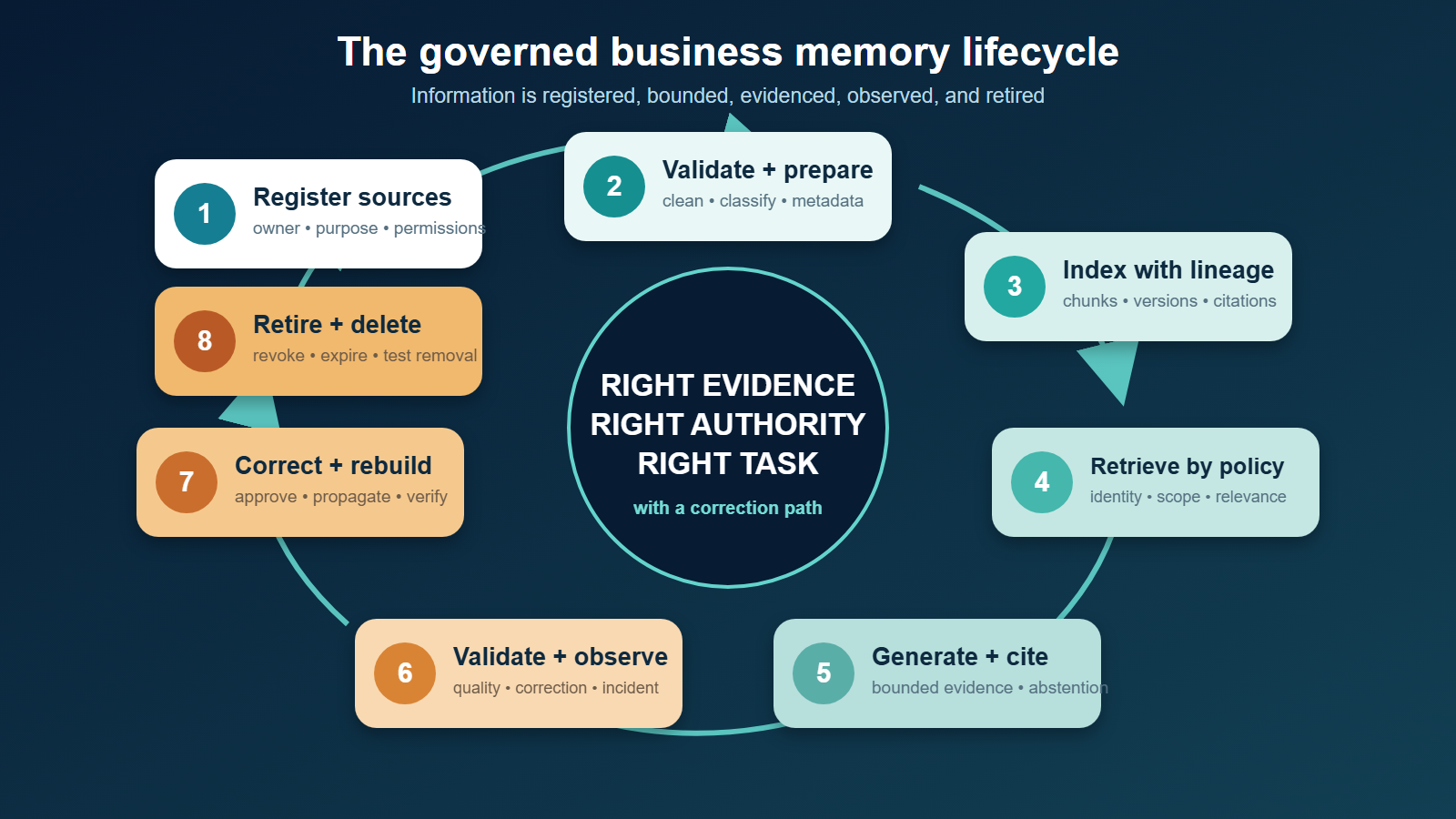
1. Register sources
Create a source catalog before connecting repositories. Record the owner, purpose, data classes, approved uses, permission model, update behavior, and authoritative status. This exposes conflicts before ingestion hides them inside an index.
2. Validate and prepare
Remove unsupported file types, duplicates, obsolete material, secrets, and content outside the approved scope. Preserve titles, URLs, dates, identifiers, and access metadata. Clean business data for AI means task fitness, not cosmetic tidiness.
3. Index with metadata
Break long content into useful retrieval units and attach metadata needed for filtering, citation, versioning, and deletion. Keep the relationship to the original source. Microsoft notes that an index can retain titles, URLs, and filenames that improve citation quality.
4. Retrieve under policy
Filter by identity, role, workflow, customer, jurisdiction, date, and approval state before ranking semantic relevance. A highly similar document is still wrong if the user cannot access it or it applies to a different contract.
5. Assemble bounded context
Label system instructions, user input, retrieved evidence, and tool results distinctly. Treat retrieved and external content as data, not instructions. Set size limits and prefer concise evidence over dumping whole documents.
6. Generate with evidence
Ask for citations or record references where facts matter. Require the agent to say when evidence is missing or conflicting. A plausible answer without support should not be converted into a business fact.
7. Validate, observe, and improve
Check output format, permissions, citations, confidence conditions, and action limits. Measure which sources were retrieved, whether the answer was grounded, and what humans corrected. Microsoft describes retrieval quality as a bottleneck that should be evaluated separately from the final response.
8. Retire and delete
Remove expired content, revoke sources, rebuild affected indexes, clear caches, and verify that retrieval no longer returns retired information. Keep the audit evidence required by the business without retaining sensitive content forever.
Common memory failures—and the control for each
| Failure | What happens | Primary control |
|---|---|---|
| Context dumping | Too much irrelevant content obscures the task | bounded retrieval and token budgets |
| Stale truth | Old policy or pricing appears current | effective dates, expiry, and source checks |
| Duplicate authority | Several versions conflict | declared source precedence and deduplication |
| Permission leakage | User receives another person’s or team’s data | identity-aware filtering before retrieval |
| False recall | Model states an unsupported detail confidently | citations, abstention, and source validation |
| Silent writeback | Generated text becomes an official record | validated writes and explicit approval |
| Memory poisoning | Untrusted content changes behavior or future context | quarantined ingestion, trust labels, review |
| Orphaned deletion | Original is removed but derived copies remain | lineage, rebuild procedures, deletion tests |
Security deserves special attention. OWASP warns that retrieved documents can contain indirect prompt injections and that RAG does not eliminate the risk. Limit agent privileges, separate instructions from retrieved data, sanitize and quarantine untrusted content, validate outputs, and require human approval for consequential actions. The best defense is not a sentence telling the model to ignore attacks; it is an architecture that limits what a compromised model can access and do.
What should become durable memory?
Use a simple admission test before preserving information:
- Purpose: Which approved future task needs it?
- Authority: Who owns it, and what source can confirm it?
- Sensitivity: Who may read, change, export, or delete it?
- Lifespan: When does it expire or require review?
- Correction: How can a person challenge and fix it?
- Evidence: Can the system cite the record used?
Do not make every conversation durable. Casual phrasing, unverified claims, emotional reactions, and one-time requests can pollute later work. Store the minimum durable fact needed, with consent and purpose, in the appropriate business system. Keep transcripts only when there is a justified operational, legal, or quality reason.
A practical first implementation
Start with one question family, such as “What is the approved return policy for this order?” or “What is the current status of this customer case?” Then:
- name the authoritative sources and owner;
- define the user and agent permissions;
- assemble a small approved corpus with metadata;
- create 25–50 representative questions, including conflicts and missing evidence;
- test retrieval separately from answer quality;
- require citations and safe abstention;
- log corrections, stale-source incidents, and permission failures; and
- rehearse correction, revocation, and deletion.
Track a compact scorecard: retrieval relevance, citation correctness, grounded-answer rate, abstention quality, stale-source rate, permission violations, human correction rate, response latency, and cost per successful answer. A high answer rate is not success if the system answers questions it should refuse.
Connect these measures to the AI Command Center so memory quality is operated over time. Also document the workflow before automating it; otherwise the memory system will faithfully retrieve information for a process no one has defined.
Explore more practical guidance in the Data, Context & Business Memory hub.
Sources and further reading
- Microsoft: Retrieval-augmented generation and indexes
- Microsoft: RAG evaluators
- NIST AI RMF Playbook: Manage
- NIST AI Risk Management Framework 1.0
- OWASP: Retrieval-Augmented Generation Security Cheat Sheet
- OWASP: Prompt Injection
Build memory the business can trust
The durable goal is not an agent that remembers everything. It is a business that can supply the right evidence, under the right authority, for the right task—and can correct or remove it when reality changes.
Agentrepreneur: Building Your AI Agent Business in 28 Days goes deeper into the operating system that supports agent-enabled work. This article explains the governance principles around memory without reproducing the book’s implementation design.