MEDIA

Is Your Business Ready for AI Agents? 12 Signs to Check First
Your business is ready to explore an AI agent when you can name a specific outcome, describe the work well enough to recognize success, provide reliable context, limit the system’s authority, and assign a person to own its performance. You do not need perfect data or a large technology team. You do need enough operating discipline to know when the agent is helping—and when it needs to stop.
The short answer: readiness is not a yes-or-no judgment about the whole company. A business may be ready to use an agent for one narrow, reversible process while being unprepared to delegate a sensitive or customer-facing decision. Evaluate the use case, not the hype.
The 12 signs at a glance
- You can state the business outcome in one sentence.
- The current workflow has a recognizable beginning and end.
- Someone owns the process today.
- The business can define a correct or acceptable result.
- The required information is available and reasonably current.
- Common exceptions are known.
- Permissions can be kept narrow.
- High-consequence actions can require approval.
- The work occurs often enough to justify setup and maintenance.
- You can measure more than activity.
- A person has time to supervise the first version.
- The business can pause, correct, and recover from mistakes.

1. You can state the outcome in one sentence
“Use AI in customer service” is a direction, not an operating goal. “Prepare a sourced first draft for routine warranty questions within five minutes” is specific enough to design and test.
A useful outcome identifies the work, the intended beneficiary, and the observable improvement. If the team cannot agree on that sentence, adding an agent usually creates more experimentation than value.
2. The workflow has a beginning and an end
You should be able to point to a trigger—an inquiry arrives, an invoice becomes overdue, a meeting ends—and a stopping condition. The agent also needs to know when the normal path has ended and an exception has begun.
The workflow does not need to be perfectly documented. It does need enough shape that inputs, major decisions, outputs, and handoffs are visible. If work succeeds only because one employee remembers a dozen undocumented workarounds, document the process before automating it. Start with How to Document a Workflow Before You Automate It.
3. One person owns the process
Every candidate workflow needs a named business owner. That person defines acceptable performance, resolves policy questions, reviews exceptions, and decides whether the system should continue.
Technical support can maintain an integration, but it cannot own the business consequences. NIST’s AI Risk Management Framework emphasizes documented roles, responsibilities, and accountability. For a small business, that can be lightweight: one accountable owner, one backup, and a clear escalation path.
4. You can recognize a good result
An agent cannot be evaluated against “seems helpful.” Decide what makes an output correct, complete, timely, useful, or safe.
For a lead-triage agent, that might include routing accuracy, time to assignment, missed high-priority inquiries, and the percentage of cases requiring human correction. For a drafting agent, quality might include factual accuracy, required elements, tone, and reviewer effort.
If reasonable people would disagree about success on every case, keep the agent in an advisory role until standards improve.
5. The required information is usable
Agents need access to approved business context: policies, product details, customer history, inventory, schedules, or other records relevant to the job. That context should be identifiable, permissioned, and current enough for the consequence of the task.
You do not need to clean every file in the company. You do need to know which source is authoritative when two records disagree. If customer terms live across old PDFs, private inboxes, and employee memory, the first project may be a data map rather than an agent. See Why Clean Business Data Matters Before You Add AI.
6. Common exceptions are known
Readiness improves when the team can name the cases that break the normal path: incomplete information, disputed invoices, unusual pricing, angry customers, requests from unverified identities, or conditions outside policy.
The agent does not need to solve every exception. It needs to detect enough uncertainty to route the case to the right person without losing it. Unknown edge cases will still appear; the goal is an operating habit for capturing and learning from them.
7. Permissions can be kept narrow
The safest first agent can read and act only where its job requires. A drafting assistant may need approved reference documents but not payment credentials. A scheduling assistant may need calendar availability but not an entire customer database.
Broad access is not a shortcut to readiness. It hides unresolved design decisions. Define what the agent may read, create, change, send, spend, or delete—and default to the smallest useful permission set. What Information Should an AI Agent Be Allowed to See? goes deeper on this question.
8. Consequential actions have checkpoints
External messages, payments, refunds, publication, contractual commitments, sensitive-data changes, and irreversible actions deserve stronger controls than an internal summary.
Human-in-the-loop should mean more than “a person is somewhere nearby.” Specify which action requires review, who can approve it, what evidence the reviewer sees, and what happens when no one responds. The related guide What Does Human-in-the-Loop Actually Mean? separates review, approval, exception handling, and escalation.
9. The work justifies ongoing care
An agent has setup and operating costs: integration, testing, supervision, usage, vendor changes, documentation, and maintenance. A task performed twice a year may not repay that effort unless its value or urgency is unusually high.
Look for work with meaningful frequency, avoidable delay, repeated coordination, or consistent decision patterns. Compare the total cost of the agent with simpler alternatives, including a checklist, template, software feature, or deterministic automation.
10. You can measure outcomes, not just output
“The agent processed 500 messages” describes activity. It does not show whether customers received accurate answers, employees saved time, or important cases were missed.
Choose a small baseline before deployment: current cycle time, error rate, backlog, cost per case, customer response time, or reviewer effort. Then track the new system against the same measure. NIST’s guidance connects measurement to the actual deployment context; a score that does not reflect the business use case can create false confidence.
11. Someone can supervise the first version
The first weeks of use will reveal missing context, surprising inputs, unclear policies, and integration problems. A business that has no time to review results is not ready for unattended operation.
Assign a supervisor who can inspect samples, address exception patterns, update documentation, and decide when authority should expand—or contract. The goal is not permanent micromanagement. It is evidence-based trust.
12. You can stop and recover
Before an agent acts, know how to pause it, revoke access, correct a record, recover from a failed action, and preserve a useful log of what happened. Reversible work is a better starting point than a workflow where one mistake is expensive or impossible to unwind.
NIST’s AI RMF organizes responsible use around governing, mapping context, measuring performance and risk, and managing what is found. Those ideas translate into a practical small-business question: if the system behaves differently than expected, can the owner see it, contain it, and make a reasoned decision about what happens next?
A simple readiness scorecard
| Rating | Meaning | Recommended next move |
|---|---|---|
| 10–12 signs | Strong candidate | Run a bounded pilot with explicit measures and approval rules. |
| 7–9 signs | Promising but incomplete | Strengthen the missing process, data, ownership, or recovery conditions first. |
| 4–6 signs | Premature for agentic action | Use AI for research or drafting while the operating foundation improves. |
| 0–3 signs | Problem definition needed | Clarify the business problem before selecting technology. |
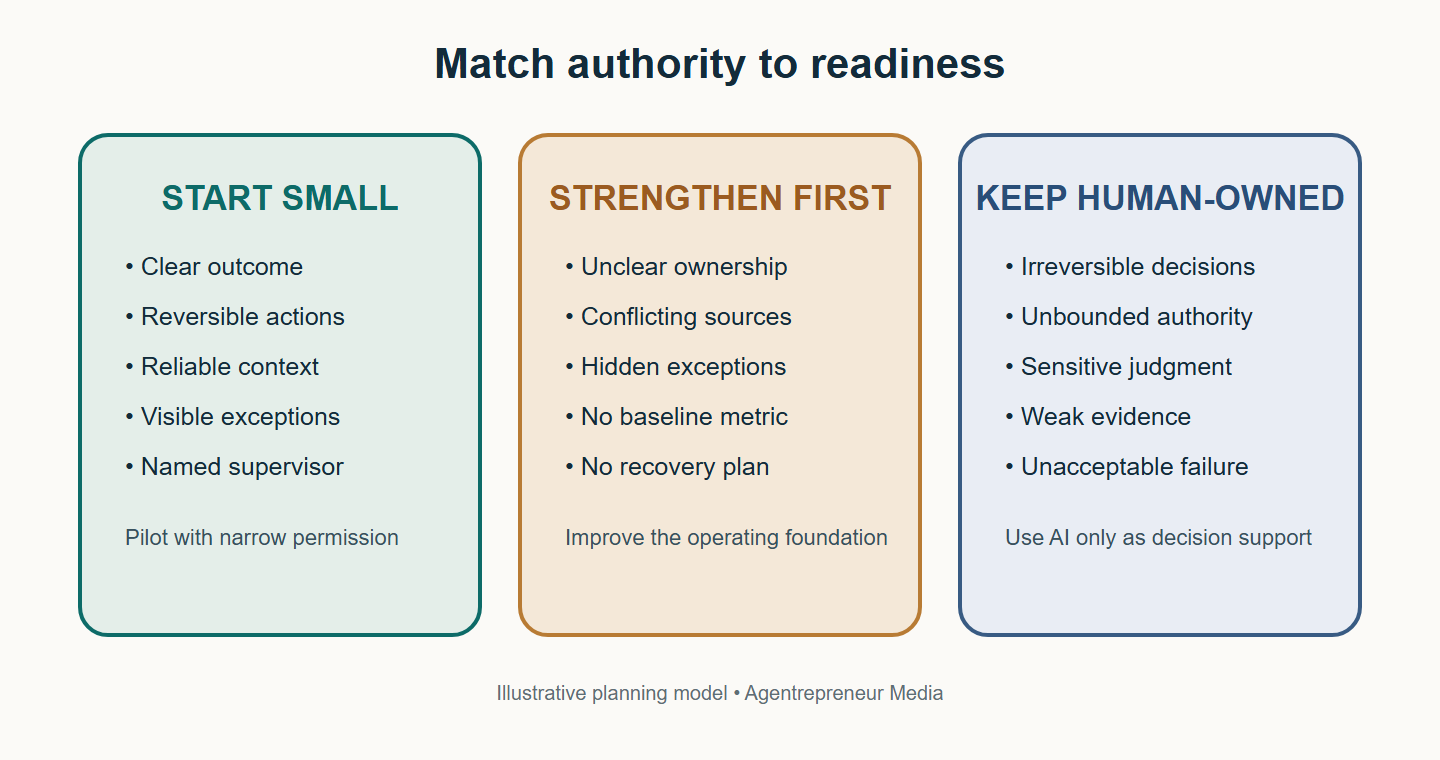
This is a planning aid, not a compliance assessment. One missing control can outweigh a high total score when the task involves money, regulated decisions, sensitive data, safety, or public commitments.
Readiness is the ability to manage the system—not merely the ability to connect it.
What to do with your result
Choose one workflow and answer the 12 signs with evidence. Note the missing conditions and classify each as a blocker, a pilot safeguard, or an improvement that can wait. If the use case remains attractive, design the smallest test that can produce a measurable result without granting unnecessary authority.
For broader context, read AI Agents for Small Business: What They Can—and Cannot—Do and continue through the AI Entrepreneurship & Strategy hub.
Readers who want the full coordinated system can explore The AI Agent Entrepreneur, Volume I. The book provides a guided operating journey and implementation materials that this public readiness screen intentionally does not reproduce.