MEDIA

AI Agents for Small Business: What They Can—and Cannot—Do
AI agents can help a small business gather information, sort incoming work, draft materials, watch for important changes, coordinate steps across software, and complete narrowly authorized actions. They are most useful when the desired outcome is clear but the exact path varies from case to case.
They cannot take responsibility for the business, guarantee that every conclusion is true, repair a broken process simply by being added to it, or safely make every consequential decision without oversight. The best operating model combines deterministic software for fixed steps, AI for bounded interpretation, and people for authority, exceptions, and accountability.
The short answer: An AI agent is useful when it reduces the amount of attention required to move familiar work forward while making uncertainty and exceptions more visible. It becomes dangerous when activity is mistaken for judgment or capability is mistaken for permission.
Key takeaways
- AI agents are strongest at bounded work that combines information gathering, interpretation, and action.
- A chatbot responds; an agent can pursue a defined outcome through tools and multiple steps.
- Predictable work often belongs in conventional automation rather than an AI agent.
- Customer-facing, financial, sensitive, or irreversible actions need stronger controls and human checkpoints.
- The owner remains responsible for permissions, data quality, performance standards, and consequences.
- Start with a business outcome and a measurable definition of success—not with a tool looking for a use.
What is an AI agent in a small business?
An AI agent is software that can receive a goal or signal, interpret the situation, choose among permitted actions, use connected tools, examine the result, and continue until it reaches a stopping condition or needs help.
That makes an agent different from two familiar alternatives:
- A chatbot waits for a person to ask a question and normally returns an answer.
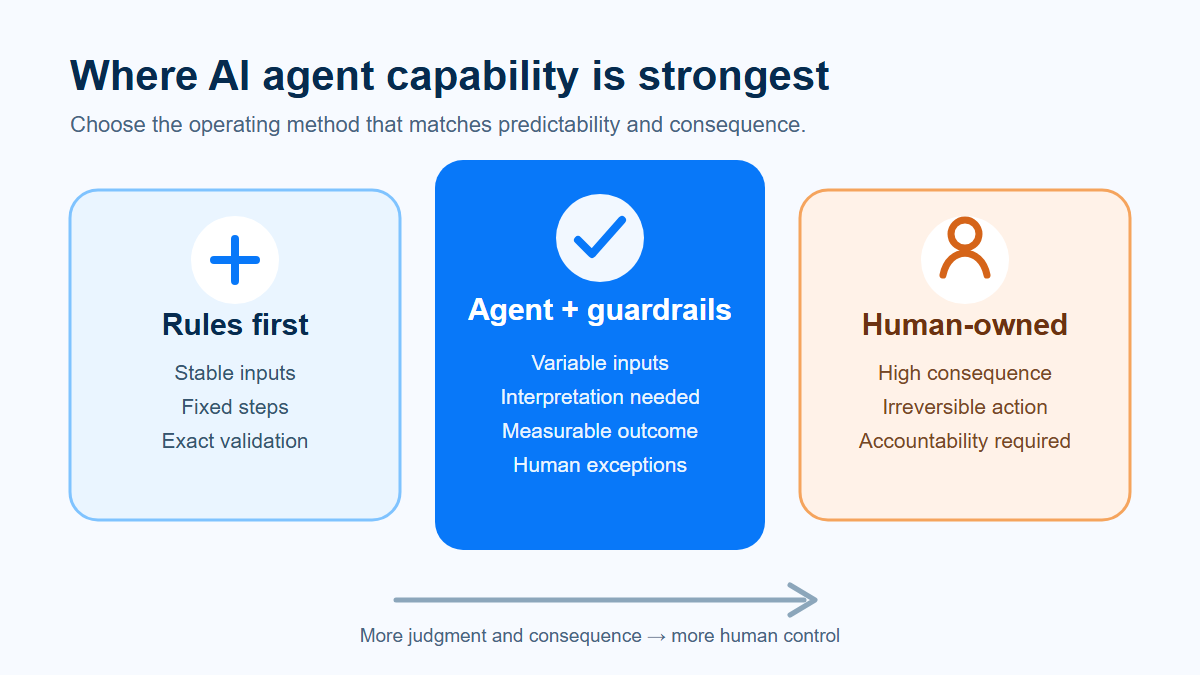
- Traditional automation follows a path defined in advance: when this happens, perform these exact steps.
- An AI agent can decide which permitted step is appropriate next when the input or path is not completely predictable.
The boundary is not always neat. Many useful business systems are hybrids. Code can collect a form submission, check required fields, calculate a price, write to a database, and schedule a reminder. An AI model might interpret a free-text request or classify an unusual message. A person might approve a high-value proposal before anything is sent.
That division matters. Anthropic’s guidance on building agents recommends adding agentic complexity only when it improves outcomes, and notes that autonomy brings higher cost and the possibility of compounding errors. In other words, the goal is not the most autonomous system. It is the simplest dependable system that fits the work.
What AI agents can do well
The U.S. Small Business Administration describes practical AI uses that include analyzing business data, handling repetitive work, supporting content development, brainstorming, and improving customer service. Agents extend those capabilities by connecting interpretation to tools and a controlled sequence of actions.
1. Triage and route incoming work
An agent can examine inquiries, support tickets, form submissions, documents, or internal requests and apply a useful first classification. It might identify the likely topic, urgency, account, product, or responsible team and then route the item to the correct queue.
This is valuable when the input is variable but the possible destinations are known. The agent should not quietly discard uncertain cases. Low-confidence, contradictory, or sensitive items belong in an exception queue for review.
2. Retrieve and assemble business information
An agent can search approved knowledge sources and assemble relevant material for a person or a downstream workflow. A service company might use one to locate the appropriate policy, customer history, product instructions, and open work order before an employee responds.
Retrieval is not the same as truth. The system still needs authoritative sources, access rules, freshness controls, and citations or links that let a reviewer verify important claims.
3. Draft routine materials
Agents can prepare email responses, meeting summaries, product descriptions, internal updates, support notes, proposals, and other first drafts. The benefit is not simply faster writing. A well-designed workflow can also gather the correct context, apply a template, check required elements, and send the draft to the right reviewer.
External communications deserve more control than internal working notes. A plausible sentence can still contain the wrong promise, price, deadline, policy, or tone.
4. Monitor defined signals
An agent can watch approved sources for conditions that merit attention: a high-priority customer message, an overdue task, unusual order behavior, a supplier change, a negative review, or a metric that needs interpretation.
Monitoring works best when code performs the fixed collection and threshold checks. AI should be reserved for the part that genuinely requires judgment, such as summarizing a cluster of related events or explaining why an exception may matter.
5. Coordinate work across tools
When properly integrated, an agent can gather information from one system, prepare an update for another, create a task, request approval, and record what happened. This can reduce the copy-and-paste work that accumulates between email, calendars, customer systems, documents, and project tools.
Every connection expands the system’s reach. Each tool therefore needs a defined purpose, minimum necessary permissions, validated inputs, and a record of actions.
6. Complete bounded, reversible actions
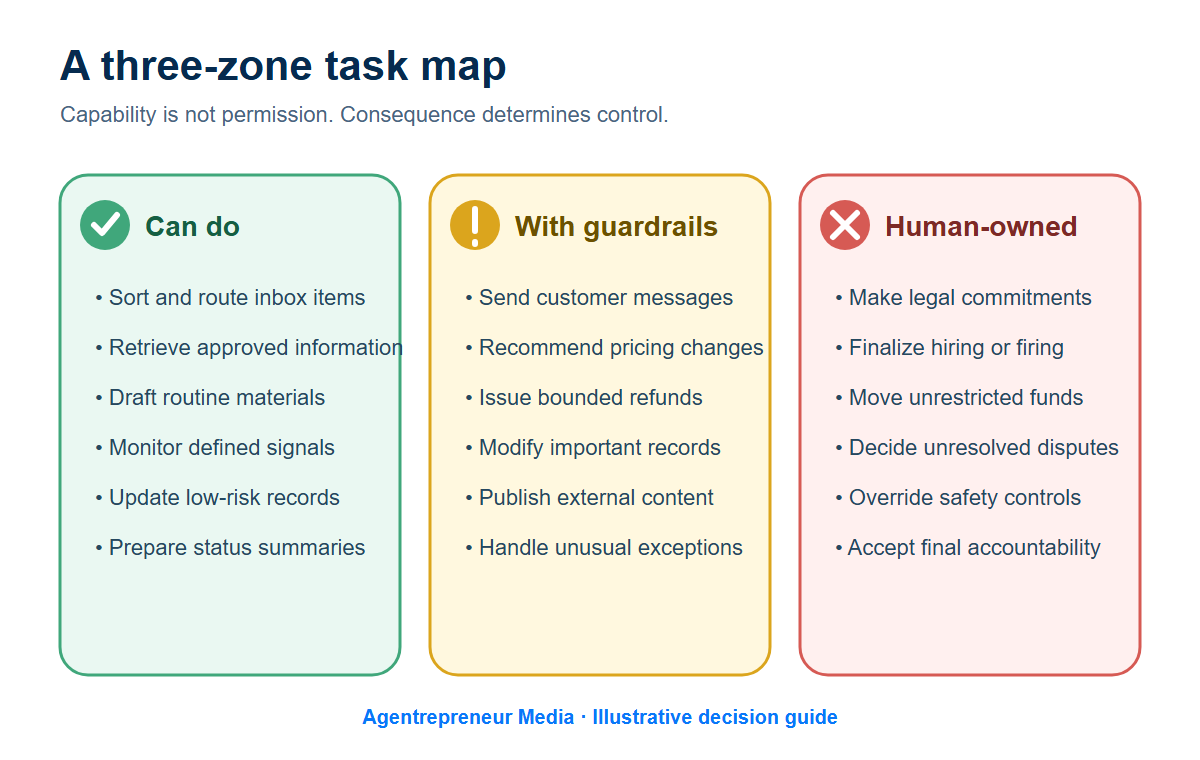
Some actions can be delegated when their limits are explicit. Examples include proposing meeting times, assigning an internal category, updating a noncritical status field, creating a draft task, or issuing a refund below an approved threshold after required checks pass.
The safest delegated actions are easy to verify, inexpensive to reverse, and unlikely to surprise a customer or owner.
A practical capability matrix
| Business need | What an agent can contribute | What still needs control |
|---|---|---|
| Customer inquiries | Classify, retrieve approved information, prepare a reply | Identity checks, unusual cases, promises, refunds, final send rules |
| Sales follow-up | Summarize activity, draft personalized follow-up, create tasks | Claims, pricing, discount authority, contact preferences |
| Operations | Monitor queues, prepare status updates, route exceptions | System-of-record validation, ownership, recovery procedures |
| Finance support | Collect documents, categorize items, explain variances | Bookkeeping controls, payments, tax treatment, final approval |
| Marketing | Research themes, create variants, prepare campaign assets | Brand review, factual claims, rights, customer data, publication |
| Management | Assemble evidence, identify patterns, prepare options | Strategic judgment, tradeoffs, commitments, accountability |
What an agent needs from the business
Buying access to a capable model does not supply the operating context that makes an agent dependable. The business still has to provide four things.
- Trusted context: The agent needs approved sources for policies, products, customers, terminology, and current conditions. More data is not automatically better; relevant, current, permissioned data is.
- Appropriate tools: Each connection should support a defined job. Giving an agent broad access simply because an integration is available increases complexity and consequence without proving value.
- Operating boundaries: The system needs explicit rules for what it may read, recommend, change, send, spend, or publish—and the conditions that require approval.
- Feedback and evidence: Owners need records of inputs, actions, outcomes, corrections, and exceptions so they can determine whether performance is improving or merely producing more activity.
These requirements explain why the same model can appear impressive in one business and unreliable in another. The difference is often not raw intelligence. It is the quality of the surrounding system. Clear ownership, usable data, narrow permissions, and observable outcomes give the agent something stable to work within.
They also create a fair way to evaluate it. Instead of asking whether the agent seems smart, the owner can ask whether it completed the intended work, stayed within authority, exposed uncertainty, and reduced the total effort required.
What AI agents cannot responsibly own
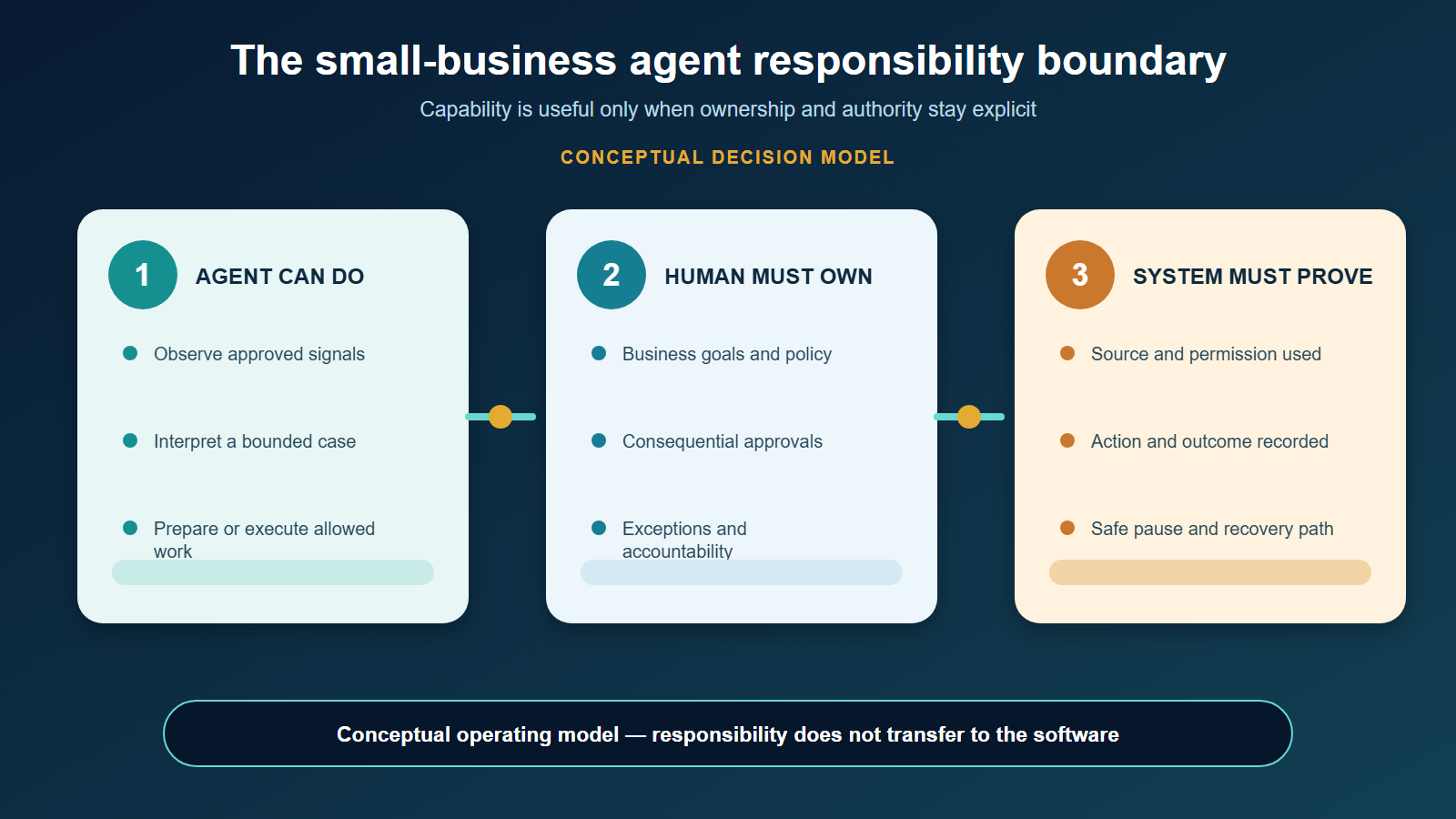
An agent may produce output that resembles a decision, but resemblance is not accountability. Several limits remain important regardless of how polished the interface appears.
They cannot guarantee accuracy
Generative systems can produce confident statements that are unsupported or wrong. NIST identifies confabulation and information-integrity risks and warns that people may defer too readily to increasingly convincing AI output. More fluent output can increase trust without increasing correctness.
Important claims therefore need verification against authoritative sources. The required level of checking should rise with the consequence of an error.
They cannot resolve unclear authority
If employees disagree about who may approve a refund, change a price, contact a customer, or access a file, connecting an agent will not settle the question. It may simply allow the uncertainty to travel faster.
Authority must be assigned by the business. The system can enforce approved boundaries, but it should not invent them.
They cannot compensate for a broken process
Agents often expose process problems that people previously worked around: missing fields, inconsistent naming, undocumented exceptions, duplicate systems, unclear ownership, and stale information. Those are management and process-design issues.
Automating around them may produce more volume without better outcomes. Sometimes the highest-value decision is to simplify the work before adding AI.
They cannot safely hold unlimited permission
An agent with access to email, customer records, payments, shared files, and publishing tools has a large potential impact. A mistaken interpretation, malicious input, compromised credential, or faulty integration can become an external action.
Access should be narrow, actions should be logged, sensitive changes should require approval, and an owner should be able to pause the system quickly. Learn more in How to Keep an AI Agent from Acting Beyond Its Authority.
They cannot replace human accountability
An owner cannot delegate responsibility by saying that the model made the decision. People choose the tool, approve its access, define the operating rules, and decide how much review is sufficient.
NIST frames trustworthy AI around qualities including validity, reliability, safety, security, resilience, accountability, transparency, privacy, and fairness. Those are properties of the whole sociotechnical system—not merely the model.
An agent is useful when it reduces uncertainty for the owner—not when it hides uncertainty behind activity.
Five questions that reveal whether a task fits
Before choosing software, evaluate the work itself.
- Is success observable? Someone should be able to tell whether the result was correct, timely, complete, or useful.
- Are the permitted actions clear? The system needs explicit limits, not an assumption that it will “use good judgment.”
- Can exceptions reach a person? Uncertain cases need a visible destination and an accountable owner.
- Is the action proportionate to the evidence? Weak or ambiguous evidence should not trigger a high-consequence action.
- Can the business recover? Reversal, correction, replay, and audit records matter when software acts rather than merely advises.
A task that fails these questions is not necessarily impossible. It may need process work, better data, smaller permissions, or a different division between code, AI, and people.
Three small-business examples
A service inquiry
An agent can identify the requested service, retrieve the relevant service area and availability rules, create a lead record, and prepare a response. It should escalate unclear locations, unusual commitments, complaints, and requests involving sensitive information. A person can approve the final response until performance is well understood.
An overdue invoice
Code can calculate that an invoice is overdue. An agent can assemble the account history and draft a courteous reminder using an approved tone. It should not invent a payment arrangement, threaten consequences, or send a message when the account is disputed. Those conditions need defined rules or human review.
A weekly operating review
Code can collect counts, costs, failures, and response times. An agent can summarize notable patterns and prepare questions for management. It should link back to the underlying records, distinguish observed facts from interpretation, and avoid claiming a trend when there is not enough history.
These examples share an important pattern: deterministic components handle facts and fixed operations; AI handles bounded interpretation; people retain consequential authority. For a deeper comparison, see Deterministic Automation vs. AI Agents: Which Should Handle the Job?.
The real small-business advantage
Large organizations can absorb inefficiency through staffing and specialization. A small business has less room for repeated coordination, scattered context, and preventable delay. A well-designed agent can help preserve attention by preparing work, moving routine cases forward, and presenting exceptions clearly.
That does not create a business that runs itself. It creates a business in which scarce human judgment is applied more deliberately.
The strongest reason to adopt an agent is therefore not that it appears autonomous. It is that a defined part of the operation becomes more responsive, measurable, and manageable. If the system cannot show what it did, why it acted, what remains uncertain, and who owns the next decision, more autonomy is unlikely to help.
Where to go next
If the concept is new, continue with What Is an AI Agent Entrepreneur? and Why Most AI Automations Fail After the Demo. The AI Entrepreneurship & Strategy hub will collect the full reading path as the series grows.
For readers who want the coordinated system rather than isolated articles, _The AI Agent Entrepreneur, Volume I_ explores the deeper operating philosophy and guided build journey. The book goes beyond this article by connecting the decisions, sequence, and implementation materials into one complete experience.
A practical boundary for the first agent
For the first deployment, write down one sentence each for what the agent may read, what it may propose, what it may change, and what must always go to a person. That compact authority statement makes vendor comparisons, testing, access reviews, and incident decisions far more concrete. Expand authority only after accepted outcomes demonstrate that the existing boundary is working.