MEDIA

Five Questions to Ask Before Buying an AI Agent Tool
Before buying an AI agent tool, ask five questions: What measurable outcome will it improve? Can it prove that result on your real work? What happens to your data? Who owns the ongoing controls? How can you leave? If a vendor cannot answer these questions clearly and in writing, pause the purchase.
An impressive demonstration can hide the work required to operate a tool safely. Use this checklist before a trial, contract, or annual commitment. The goal is not to eliminate uncertainty. It is to reveal the assumptions, responsibilities, and costs that the sales presentation leaves out.
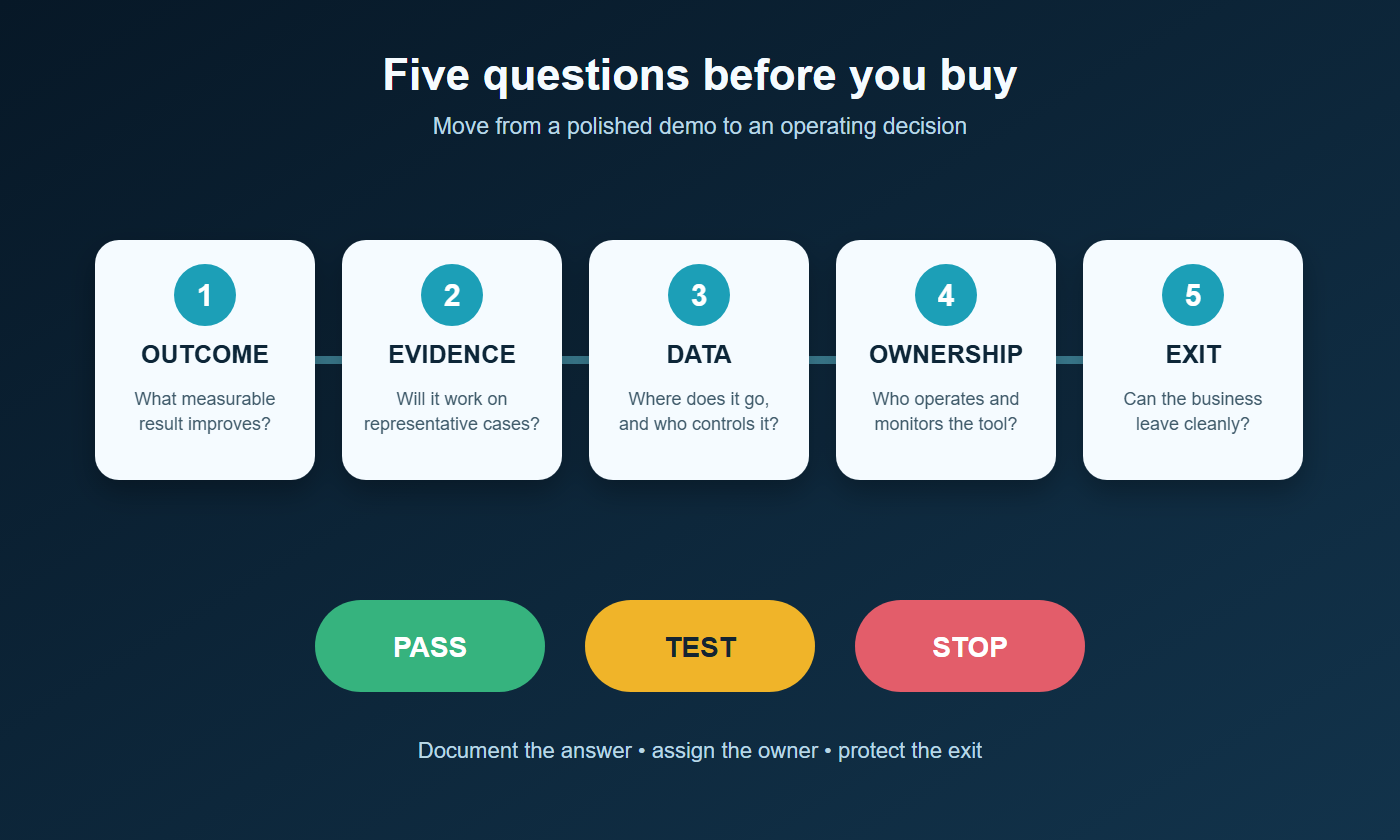
1. What exact business outcome will improve?
Name one workflow, its current baseline, and the result you expect. “Save time with AI” is not testable. “Reduce the median time to prepare a first-pass customer brief from 45 minutes to 20, while keeping manager corrections below 10 minutes” is.
Record:
- the users and workflow in scope;
- the baseline time, cost, backlog, or error rate;
- the quality threshold that must still be met;
- the decisions and actions the tool may take; and
- the result that would justify renewal.
If the team cannot define the outcome, return to How to Choose Your First Business Process to Automate before evaluating products.
2. Can the vendor prove it on representative work?
Ask for a reversible trial using realistic, properly protected examples. Include ordinary cases, incomplete inputs, conflicting instructions, unusual formats, and situations that should go to a person. Measure useful outputs, corrections, human review time, failures, and total cost—not only model speed.
The U.S. Small Business Administration recommends trials, low-risk terms, manageable complexity, integration fit, and evidence from businesses with comparable needs. NIST likewise recommends testing and documenting third-party AI systems rather than assuming a supplier’s general claims will transfer to your context.
3. What happens to our data and records?
Get written answers about what the product collects, where information goes, who can access it, how long it is retained, whether it is used to improve models, and how deletion works. Include prompts, uploaded files, connected-system data, outputs, logs, and human support access.
Ask whether the tool supports:
- role-based access and separate administrator privileges;
- encryption and appropriate authentication;
- configurable retention and deletion;
- audit or activity records;
- data export in a usable format; and
- notification of security or material product changes.
Match the controls to the consequence of the use. A drafting assistant using public marketing copy does not need the same review as a tool connected to customer, employee, financial, or regulated records. See The Small-Business Guide to AI Risk for a practical risk screen.
4. Who owns operation when the demo is over?
A vendor may operate the platform, but your business still owns how it is configured and used. Name the people responsible for access, instructions, integrations, testing, approval boundaries, monitoring, incident response, training, renewals, and exceptions.
Also ask what the vendor commits to provide: support hours, service expectations, change notices, security documentation, product-roadmap information, and a way to report vulnerabilities or harmful behavior. CISA’s small-business vendor guidance treats supplier assessment as an ongoing risk-management activity, especially when cloud services receive logical access to business systems.
5. How do we leave without disrupting the business?
Before signing, test the exit path. Confirm contract length, cancellation terms, price-change rules, data-export formats, deletion timing, integration shutdown, and what happens to configurations and logs. For a critical workflow, identify a manual fallback or alternative provider.
An exit plan also improves the buying decision. If the product works only after months of undocumented configuration, depends on one consultant, or cannot return your records in usable form, its real switching cost is much higher than the subscription price.
Use a simple pass, test, or stop decision
Rate each question before approving the purchase:
| Decision | Meaning | Next action |
|---|---|---|
| Pass | The answer is documented and acceptable | Include it in the operating record |
| Test | The claim can be verified in a bounded trial | Assign an owner and success measure |
| Stop | The answer is missing or outside risk tolerance | Do not connect data or commit funds |
One “stop” on sensitive data, authority, security, or business continuity should outweigh several attractive features. For a deeper comparison of ownership models, read Build vs. Buy: Should You Customize an AI Agent or Use SaaS?, or browse the AI Entrepreneurship & Strategy hub.
Readers designing a broader operating system can explore The AI Agent Entrepreneur, Volume I. The book’s implementation materials go beyond this public purchasing checklist and are not reproduced here.
Ask for evidence, not only a demonstration
Request a trial using representative cases, including incomplete inputs, ambiguous requests, permission failures, and the situations that require escalation. Record what the vendor can prove about logs, export, access, recovery, and support. A polished happy-path demonstration is useful for orientation, but it is not evidence that the tool can operate inside your real constraints.
Name the internal owner who will review the evidence and make the purchase decision. Vendor answers have little value if nobody is accountable for interpreting the gaps.