MEDIA

The Small-Business Guide to AI Risk—Without the Legal Jargon
For a small business, managing AI risk means making a few practical decisions before a tool is trusted with real work: define its job, limit its data and authority, test the ways it can fail, assign an owner, preserve evidence, and decide when a person must review or stop it. You do not need a large compliance department, and you cannot reduce risk to zero. You do need controls that match the consequence of being wrong.
The question is not simply, “Is this AI safe?” A better question is: safe enough for this specific task, with this data, these people, these controls, and this fallback? An assistant that drafts internal meeting notes presents a different risk from an agent that can refund customers, change prices, or send health information to a vendor.
This guide is business and operational education, not legal advice. Laws and contractual duties depend on the facts, location, industry, data, and use. Bring qualified legal, privacy, security, insurance, employment, or financial advisers into decisions where their expertise is required.
Start with the business consequence
Risk is easier to understand when it is stated as a business outcome rather than a technical label. “The model may hallucinate” is vague. “A fabricated delivery promise could be emailed to a customer and create a refund, complaint, or loss of trust” identifies the event, affected party, pathway, and consequence.
Write one sentence in this form:
Because the system can [take or recommend an action] using [data and tools], it could [fail or be misused], causing [operational, financial, privacy, safety, legal, or reputational consequence].
That sentence makes the needed control easier to see. A weak draft can be reviewed before use. An irreversible payment may require approval before execution. Sensitive data may need to be excluded entirely. An unreliable integration may need a queue and manual fallback.
The National Institute of Standards and Technology organizes AI risk work into four functions: Govern, Map, Measure, and Manage. In owner language, that means set the rules and responsibilities, understand the use and its context, test and monitor what matters, then act on what you learn. NIST describes its framework as voluntary and adaptable to organizations of different sizes; it is a reference for thinking, not a promise that every item applies to every business.
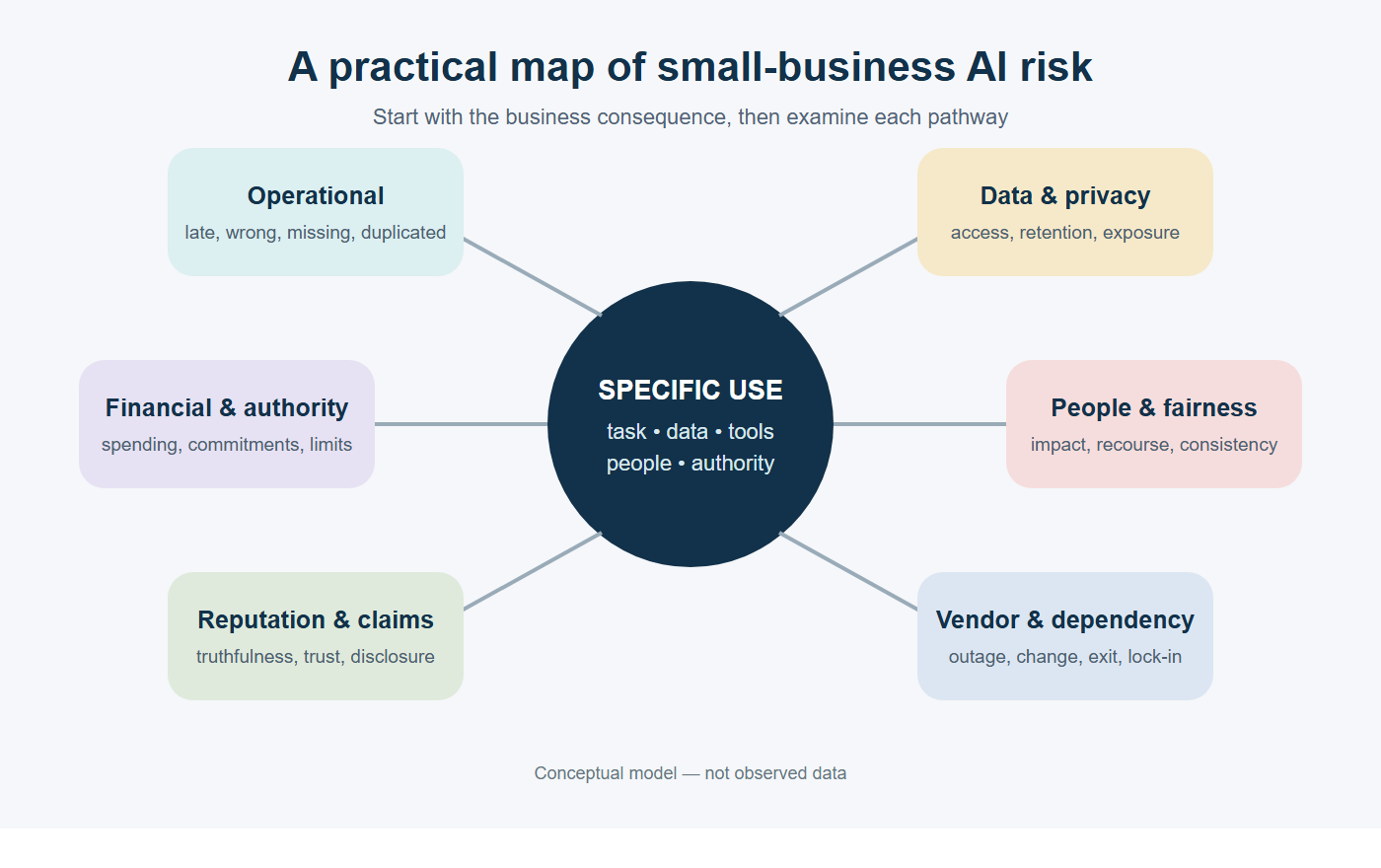
Six risk areas owners should examine
The categories overlap. A vendor outage can become an operational failure, a privacy incident, a financial loss, and a reputational problem. Separating them briefly helps prevent blind spots.
1. Operational risk: the work is late, wrong, or missing
Operational failures include incorrect outputs, lost requests, duplicate actions, stuck queues, expired credentials, broken integrations, and dependence on an unavailable vendor. The risk grows when no one knows the workflow is failing.
Ask:
- What happens if the answer is wrong but looks plausible?
- Can the same action run twice?
- Where do incomplete, uncertain, or failed cases go?
- How quickly would we notice a backlog or silent failure?
- Can the business continue manually for a day or a week?
The control is rarely “use a better prompt.” It may be input validation, a deterministic rule, an approval step, duplicate protection, monitoring, an exception queue, or a tested fallback. Our guide to documenting a workflow before automation shows how to expose the normal path and exceptions before selecting controls.
2. Data, privacy, and confidentiality risk
An AI tool can receive customer records, employee information, contracts, internal strategy, credentials, or regulated data. Risk exists even when the output is correct: information may be retained longer than expected, used to improve a vendor’s service, exposed to subprocessors, copied into logs, or made available to the wrong user.
The FTC advises businesses to know what personal information they hold, collect only what they need, limit access, protect information throughout its lifecycle, and oversee service providers. Translate that into five owner decisions:
- What exact data is necessary for the task?
- What data is prohibited?
- Who and what systems can access it?
- Where is it stored, for how long, and by whom?
- How will access or retained data be removed when the use ends?
Do not paste sensitive information into an unapproved public tool just because the interface feels conversational. Review why clean business data matters before AI and, for a focused access decision, what information an AI agent should be allowed to see when that article becomes available.
3. Financial and authority risk
Risk rises sharply when a system can spend money, issue credits, alter prices, commit inventory, enter contracts, or send instructions that employees treat as authoritative. A small error repeated at machine speed can become a large loss.
Set explicit boundaries:
- permitted actions and prohibited actions;
- per-action and daily financial limits;
- required approvals by amount or unusual condition;
- allowed customers, accounts, systems, and hours;
- a reliable identity for every person and system acting; and
- an immediate way to suspend credentials or disable the workflow.
Permissions should reflect the narrow job, not the maximum capability of the tool. A system that drafts a refund recommendation does not need permission to send the money. If approval is required, define what the reviewer must inspect; a button labeled “approve” is not meaningful oversight by itself.
4. Customer, employee, and fairness risk
AI-assisted decisions can affect who receives attention, an offer, an interview, a schedule, a service level, or an adverse outcome. Historical data may contain gaps or patterns that are inappropriate to repeat. Even a seemingly neutral rule can create unequal effects in its real context.
Identify affected people, not only the buyer and the software operator. Ask who can be disadvantaged, who can correct inaccurate information, and whether a person can contest or appeal an outcome. Test representative and difficult cases before launch and sample real cases afterward. Uses involving employment, credit, housing, health, education, insurance, biometric data, children, or other high-consequence areas deserve qualified advice and stronger scrutiny.
5. Reputation and truthfulness risk
Customers may reasonably assume a business stands behind what it sends. Incorrect claims, fabricated citations, undisclosed synthetic testimonials, impersonation, or confident promises that operations cannot honor can erode trust even when no database is breached.
The FTC has repeatedly emphasized that existing consumer-protection principles apply to AI-related claims. A business should be able to substantiate claims about what its product does and live up to privacy and confidentiality promises. Keep marketing language, product behavior, and internal controls aligned.
Decide when AI involvement should be disclosed, who approves public claims, and which communications require human review. Preserve the source material used for important statements. Do not allow a generated citation, quote, case study, or customer fact to pass simply because it looks polished.
6. Vendor and concentration risk
When a vendor supplies the model, application, storage, or integration, its choices become part of your operating risk. A provider can change prices, features, terms, model behavior, retention practices, or interfaces. It can experience an outage, acquisition, security incident, or service termination.
CISA’s small-business supply-chain guidance recommends identifying critical suppliers, avoiding single points of failure where practical, using qualification criteria, setting service expectations, monitoring performance, and planning contingencies. For an AI vendor, ask:
- What data is collected, retained, logged, and used for training?
- Which subprocessors and locations are involved?
- What authentication, access controls, encryption, and incident notices are offered?
- Can we export inputs, outputs, configuration, and audit history in a usable format?
- What service levels or support commitments actually appear in the contract?
- What breaks if this service is unavailable or the price changes?
- How will we remove access and verify deletion when we leave?
Treat a vendor questionnaire as evidence gathering, not proof. Compare answers with the contract, product settings, tests, and the importance of the workflow.
Prioritize instead of trying to control everything equally
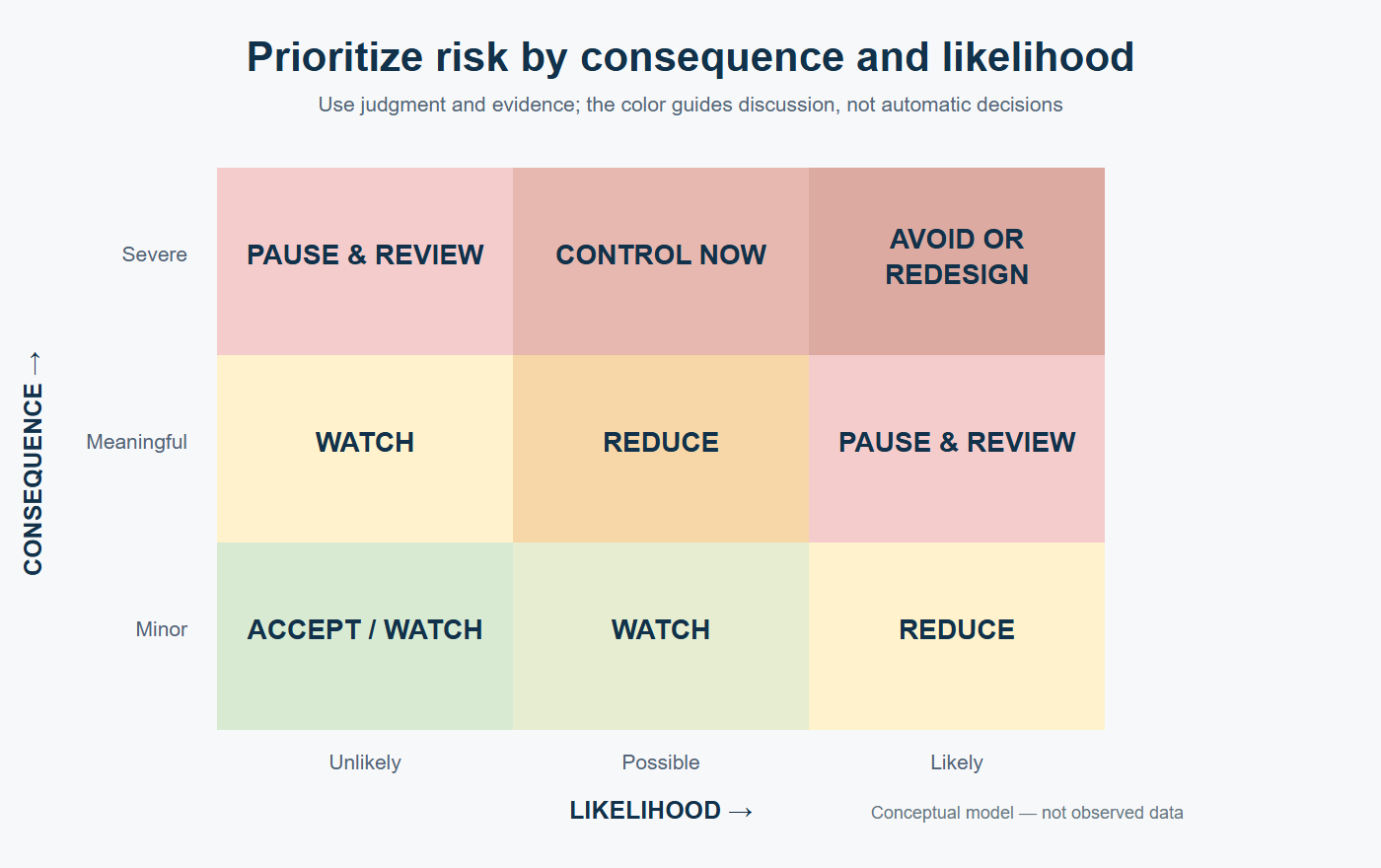
Use a simple qualitative scale for consequence and likelihood. The matrix above is a conceptual prioritization aid, not observed data and not a substitute for professional assessment.
Consequence considers the credible harm if the event occurs: small rework, customer impact, meaningful financial loss, exposure of sensitive information, interruption of a critical service, or harm that is difficult to reverse. Likelihood considers exposure, volume, complexity, historical failures, attacker interest, and control strength.
Do not let a numeric score hide judgment. A rare event with catastrophic or irreversible consequences may still be unacceptable. A frequent low-impact nuisance may deserve attention because it consumes staff time. State the decision that follows each rating:
- Accept: the remaining risk is within the owner’s tolerance.
- Reduce: add a control, narrow the use, or reduce authority.
- Transfer: use appropriate contracts or insurance while recognizing responsibility does not disappear.
- Avoid: do not deploy, or remove the risky capability.
NIST’s playbook notes that risk tolerance is a leadership decision and that systems can be assigned consistent risk levels. The value is not the color label; it is the clearer allocation of review, testing, and oversight.
Build a one-page risk register
A small business can begin with a spreadsheet or table. Keep it short enough to use and specific enough to drive action.
| Field | What to record |
|---|---|
| Use and owner | Exact workflow, business purpose, accountable person |
| Data and tools | Inputs, sensitive fields, connected systems, permissions |
| Risk event | What could happen, to whom, and how |
| Existing controls | Validation, limits, review, monitoring, fallback |
| Consequence and likelihood | Plain-language rating with rationale |
| Decision | Accept, reduce, transfer, avoid, or pause |
| Action and due date | Named owner, correction, evidence, deadline |
| Review trigger | Date, incident, vendor change, or performance threshold |
Avoid entries such as “AI may be inaccurate.” Write “the drafting tool could invent a delivery date; a service representative verifies dates against the order system before sending.” The second entry can be tested.
Keep the register connected to real operations. Link the vendor agreement, test record, access list, incident procedure, and approval rule. Record exceptions and temporary waivers rather than allowing them to become invisible practice.
Choose controls that interrupt the failure path
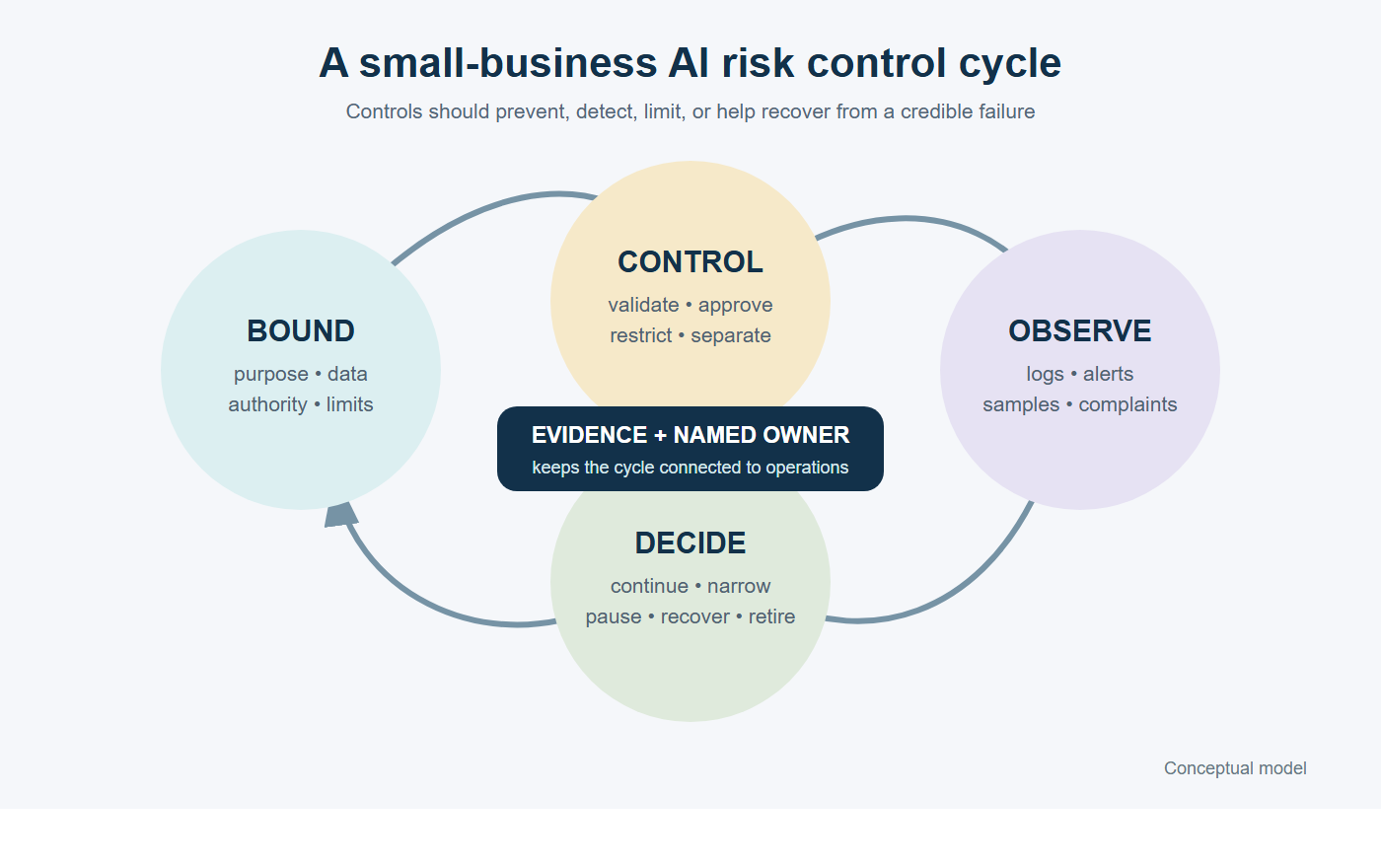
A useful control prevents a failure, detects it quickly, limits its effect, or supports recovery. Strong workflows usually combine several types:
- Scope controls: narrow purpose, allowed inputs, permitted users, and prohibited uses.
- Access controls: individual accounts, least privilege, multifactor authentication, secrets management, and timely removal.
- Input controls: required fields, format checks, malware screening, source restrictions, and data minimization.
- Action controls: approvals, spending limits, allowlists, rate limits, duplicate protection, and separation between drafting and execution.
- Output controls: fact checks against approved sources, deterministic calculations, content rules, confidence or completeness checks, and human review.
- Detection controls: logs, alerts, reconciliations, quality samples, cost thresholds, backlog monitoring, and customer feedback.
- Recovery controls: pause switch, credential revocation, rollback, backup, manual fallback, notification plan, and retained evidence.
Controls should be independent where the consequence is high. Asking the same model that created an answer to declare it correct may help with formatting, but it is not equivalent to checking the claim against an authoritative system or a knowledgeable reviewer.
For a deeper view of purposeful oversight, read what human-in-the-loop actually means. If a task cannot be bounded or verified economically, it may be better left to rules or people.
Define launch, pause, and stop criteria
Before real use, write the conditions for proceeding. A practical launch gate might require:
- a named business and technical owner;
- approved purpose, users, data, tools, and permissions;
- representative tests plus difficult and failure cases;
- verified logs, alerts, approvals, and exception routing;
- documented vendor, privacy, security, and contractual review appropriate to the use;
- a tested manual fallback and pause mechanism; and
- baseline measures for quality, intervention, cost, and customer impact.
Also define pause criteria. Examples include an unexplained error spike, access outside the approved scope, an exposed credential, missing logs, a vendor incident, runaway cost, a material change in terms, or a serious customer complaint. A predetermined threshold helps the team act before optimism or schedule pressure takes over.
Stopping a workflow is not necessarily failure. It is evidence that risk management worked. The business can narrow the task, improve data, change the control design, select another vendor, or decide the benefit is not worth the residual risk.
Review risk as the system changes
AI risk is not settled on launch day. Inputs change, employees find new uses, integrations are updated, vendor models change, attackers adapt, and business stakes grow. Review high-consequence workflows more often than low-impact drafting aids.
At each review, ask:
- Is the purpose still the same?
- Are the data, users, tools, and permissions still within scope?
- What errors, exceptions, complaints, incidents, or near misses occurred?
- Did the controls work, and what evidence shows that?
- Has the vendor, model, contract, price, or operating context changed?
- Is the benefit still large enough to justify the cost and residual risk?
- Should the business continue, narrow, redesign, pause, or retire the use?
NIST describes risk management as continuous across the AI lifecycle. For a small business, continuity can be simple: a recurring owner review, a current risk register, evidence from the workflow, and clear decisions. The objective is not paperwork. It is to keep authority, exposure, and oversight aligned with the real work.
A practical first-week plan
Do not start by inventorying every theoretical AI concern. Select one live or proposed use and complete these actions:
- Name its business owner and write the intended purpose in one sentence.
- List the data, users, vendors, connected tools, and actions.
- Write the three most credible failure or misuse events as business consequences.
- Rate consequence and likelihood, including your reasoning.
- Identify the current preventive, detective, limiting, and recovery controls.
- Close any critical gap before expanding access or authority.
- Set launch, pause, and review conditions, then save the evidence.
This small record creates a better decision than a generic promise that the system is “enterprise grade” or “human supervised.” It also gives advisers enough context to address the questions that actually require their expertise.
Return to the Governance, Safety & Reliability hub for more practical controls. Owners evaluating whether the underlying business is prepared can also use Is Your Business Ready for AI Agents? and How to Calculate the ROI of AI Automation.
Readers who want the coordinated operating system can explore The AI Agent Entrepreneur, Volume I. The book’s guided implementation sequence and working materials go beyond this public risk overview and are not reproduced here.