 MEDIA

Build vs. Buy: Should You Customize an AI Agent or Use SaaS?
Most small businesses should start with a proven software-as-a-service tool or configurable platform, not a fully custom AI agent. Build custom components only when the business requirement is distinctive, the available products cannot meet it safely, and the company is prepared to own testing, security, monitoring, maintenance, and exit planning.
“Build or buy” is not a binary choice. The practical options form a spectrum: use a packaged application, configure a platform, connect products with integrations, add a bounded custom component, or own a complete custom system. The right position depends less on technical excitement than on business fit and long-term ownership.
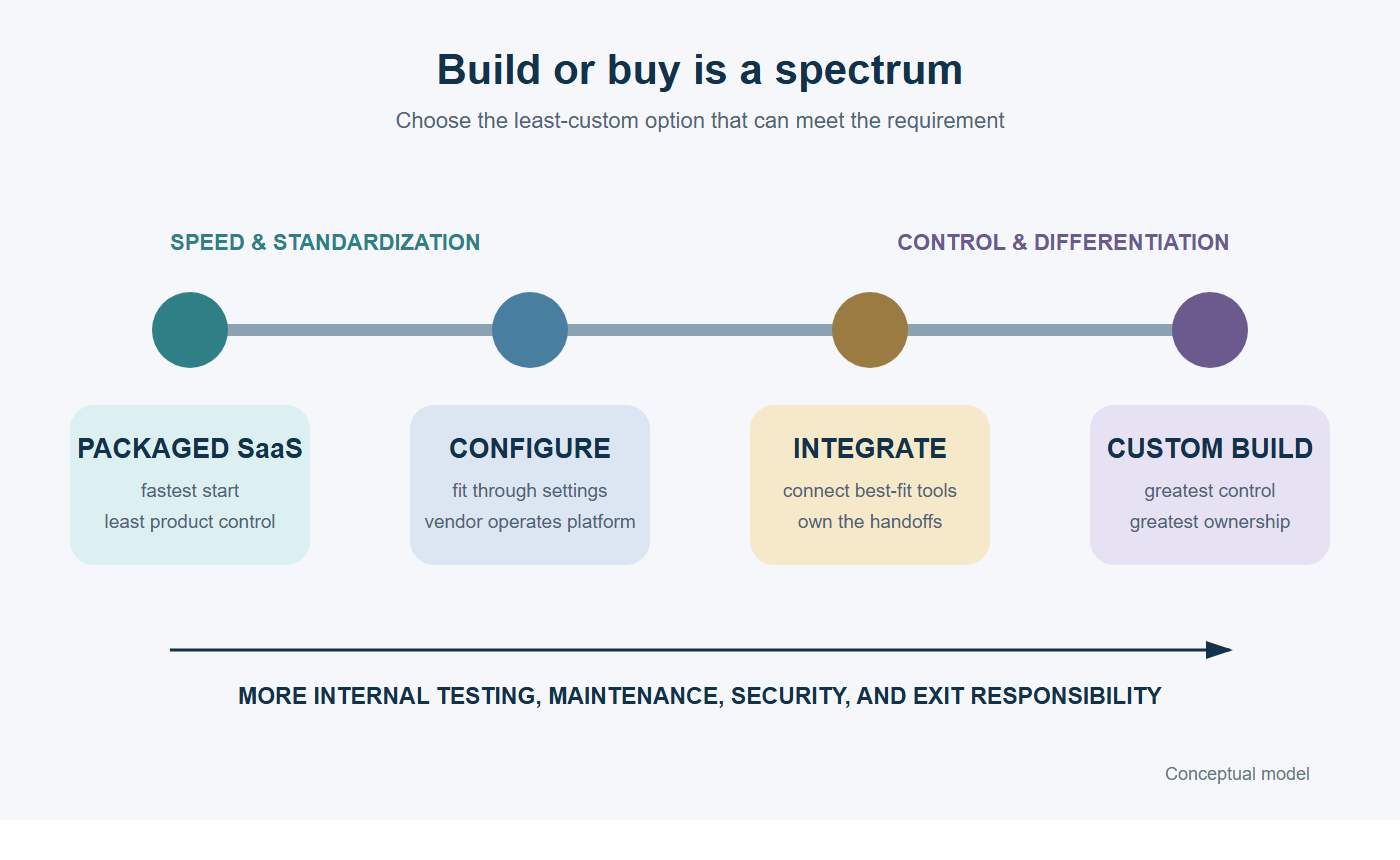
Four paths, not two
1. Packaged SaaS
A vendor supplies the interface, model access, hosting, updates, and common workflow. Examples include an approved support-drafting tool, meeting assistant, or document application with AI features.
This path is fastest when the job is common and the vendor’s design fits the business. It usually offers predictable setup, support, and security features. The tradeoff is limited control over behavior, data handling, product changes, and pricing.
2. Configurable platform
The business selects approved data sources, permissions, instructions, forms, routing, or review steps inside a vendor platform. Configuration can create meaningful fit without maintaining a full software product.
This is often the small-business sweet spot. It allows a defined workflow and company context while the vendor operates most infrastructure. Configuration still needs an owner: a complex collection of prompts, rules, connectors, and exceptions can become software even if no one calls it code.
3. Integrated or hybrid system
Existing products are connected through vendor integrations, an automation platform, or a small amount of custom code. Deterministic code may validate data and execute known actions, while an AI service handles an identified interpretation task and a person handles consequential exceptions.
Hybrid designs can avoid rebuilding commodity capabilities. They also introduce handoffs, credentials, version changes, and multiple vendors. Each connection needs monitoring and a clear failure path.
4. Custom agent or application
The business owns the workflow logic, application code, integrations, evaluation, deployment, and operational evidence. It may still rely on third-party models, hosting, libraries, and data. “Custom” rarely means independent of vendors; it means the company owns more of the assembly and its consequences.
Custom development can support a distinctive process, exact controls, deep integration, or a customer-facing product. It also creates a durable product-management obligation, not a one-time project.
Buy when the work is common and speed matters
Favor SaaS or a configurable platform when:
- many businesses perform essentially the same task;
- the vendor already supports required systems and identity controls;
- a short, reversible trial can test representative work;
- standard configuration covers most requirements;
- the process does not create a competitive advantage;
- vendor support and updates reduce internal burden; and
- the business can export its data and continue through an outage or exit.
The U.S. Small Business Administration’s software-selection checklist emphasizes fit for similar businesses, manageable complexity, integrations, upgrade paths, vendor stability, trials, and low-risk terms. Those principles apply directly to AI tools. An impressive feature list is less valuable than a product the team can operate and verify.
Buying does not outsource accountability. NIST’s AI Risk Management Framework notes that third-party systems can improve efficiency and scalability while adding complexity and opacity. The customer still needs to define acceptable use, test the system in its context, document dependencies, monitor outcomes, and plan contingencies.
Build when ownership creates a real advantage
Custom work becomes more defensible when several conditions are true:
- the workflow is genuinely distinctive and important to the business model;
- no vendor meets the necessary controls, integration, data location, or evidence needs;
- the system must coordinate proprietary processes or interfaces unavailable in packaged products;
- volume or economics support ongoing engineering and operations;
- the business can define correct behavior and representative tests;
- a named team can maintain the system after the original builder leaves; and
- control, portability, or product differentiation is worth the additional cost.
Do not build simply to avoid a subscription. A custom system still uses employee or contractor time, hosting, model usage, monitoring, incident response, documentation, upgrades, and security work. It may also depend on the same model or cloud vendors hidden beneath a SaaS product.
The strongest case for custom development is not “we want flexibility.” It is a specific requirement tied to a measurable outcome: for example, an exact approval boundary that packaged products cannot enforce, or a proprietary workflow whose improved cycle time changes customer value.
Compare total ownership, not the first invoice

The diagram is a conceptual comparison, not observed cost data. Build an estimate for your use with the following categories.
| Cost or constraint | SaaS / configurable platform | Custom or hybrid build |
|---|---|---|
| Initial work | Evaluation, configuration, migration, integration | Discovery, design, development, testing, deployment |
| Recurring cost | Subscription, usage, premium controls, connectors | Hosting, model/API use, engineering, monitoring, support |
| Change | Vendor roadmap and release cadence | Internal backlog and available maintainers |
| Security | Vendor controls plus customer configuration | Shared vendor dependencies plus owned application controls |
| Reliability | Vendor service and documented integrations | Owned monitoring, incident response, retries, recovery |
| Exit | Exports, contract terms, migration limits | Code, documentation, dependency replacement, data migration |
For both paths, include employee review, exception handling, training, quality sampling, and downtime. Our AI automation ROI guide explains how to separate subscription price from total operating cost.
Run a representative proof, not a polished demo
Create a bounded trial using realistic but properly protected data. Include normal cases, missing information, conflicting instructions, unusual formats, permission limits, vendor downtime, and cases that should reach a person.
Measure:
- correct and acceptable outcomes;
- errors and unsupported claims;
- human intervention and correction time;
- elapsed time and backlog effects;
- usage and integration cost;
- traceability of inputs, actions, and approvals; and
- recovery when a component is unavailable.
Use the same test set for the leading packaged option and any proposed custom prototype. Otherwise, the business may compare a curated vendor demonstration with an unfinished internal build—or a flexible prototype with a production product—and learn very little.
Ask who owns each layer
Before choosing, create a responsibility map. Name the owner of:
- the business outcome and acceptable-use boundary;
- data quality, access, retention, and deletion;
- vendor review and contract renewal;
- configuration, prompts, rules, and integrations;
- testing and change approval;
- monitoring, exception handling, and incident response;
- documentation, training, and support; and
- export, decommissioning, and migration.
If every answer is “the vendor,” the company has not identified its responsibilities. If every answer is one contractor, the custom design has a concentration risk. NIST recommends documenting third-party components, testing them, monitoring changes, and verifying contingency processes for mission-critical uses.
Protect the exit before committing
For a vendor product, verify export formats, API access, retention, deletion, pricing changes, service termination, and what happens to configurations or derived records. CISA’s small-business vendor guidance stresses due diligence for cloud-hosted services and understanding the risk environment of potential providers.
For custom work, require the business to control the repositories, deployment accounts, documentation, credentials, domain names, and essential vendor relationships. Define handoff requirements and test whether another qualified maintainer can operate the system.
An exit plan is not pessimism. It is how the business preserves negotiating power and operating continuity.
A practical decision rule
Choose the least-custom option that can meet the requirement with acceptable evidence and risk. Then add custom work only around the gaps that matter.
- Define the exact workflow, outcome, data, authority, and controls.
- Test whether a packaged tool meets the requirement through a reversible trial.
- Evaluate configuration before adding custom code.
- Integrate existing systems instead of rebuilding stable commodity functions.
- Build a bounded component only when the remaining gap has measurable value.
- Reassess as volume, vendor capability, risk, and business strategy change.
This approach preserves speed without surrendering deliberate control. It also prevents a prototype from quietly becoming an unsupported production system.
Start with How to Choose Your First Business Process to Automate and The Small-Business Guide to AI Risk. For continuing ownership, read The Hidden Maintenance Work Behind Reliable Automation when available, or return to the Growth, Teams & Economics hub.
Readers building a coordinated operating system can explore The AI Agent Entrepreneur, Volume I. The book’s implementation materials go beyond this public procurement decision and are not reproduced here.
Preserve an exit path in every option
Whichever route you choose, document how the business will export records, revoke credentials, replace the component, and continue essential work during a transition. Exit readiness is not pessimism; it is leverage. It also exposes hidden lock-in before a pilot becomes an operating dependency.


