 MEDIA
How Much Does It Cost to Run an AI Agent Business?
A small AI agent business can begin with a few hundred dollars per month, but a dependable production operation usually costs more because the model bill is only one layer. A useful starting budget includes core software, model usage, workflow execution, data and storage, monitoring, human oversight, maintenance, and a contingency reserve. Price the business by a successful outcome—not by a token or tool subscription alone.
For planning, three illustrative monthly ranges are more useful than a single promise:
- Lean pilot: $100–$500. One narrow workflow, modest volume, mostly founder-operated, simple monitoring, and limited integrations.
- Operating system: $500–$2,500. Several dependable workflows, paid automation and business applications, stronger observability, routine review, and scheduled maintenance.
- Scaled agent operation: $2,500–$10,000+. Higher volume, multiple environments or customers, premium data and software, formal support, security work, and paid technical ownership.
These are planning bands, not vendor quotes. Your actual cost depends on volume, context size, output length, model choice, retries, tool calls, data retention, service levels, and how much expert attention exceptions require.
Separate startup cost from monthly run cost
A monthly budget does not include everything required to reach production. Treat discovery, workflow documentation, data cleanup, integration, testing, policy design, and launch training as one-time or project costs. A system assembled by the founder may require little cash but substantial opportunity cost. A contractor-built workflow may require several thousand dollars before the first live case. Either can be economical if the work creates a reusable, supportable asset.
Create two ledgers:
- Build cost: process design, configuration or code, initial data work, tests, documentation, security review, and launch.
- Run cost: subscriptions, usage, infrastructure, monitoring, oversight, support, maintenance, and contingency.
Amortize build cost over a conservative useful life when comparing alternatives. If a $6,000 implementation is expected to remain useful for 24 months, allocate $250 per month before adding run cost. Shorten that period when the workflow depends on a fragile vendor feature or rapidly changing process.
Also budget for exit. Data export, credential transfer, documentation, and replacement testing reduce the cost of changing providers later. A low launch quote that creates permanent lock-in may be more expensive than a slightly higher build cost with clear ownership and portability.

The seven-layer cost model
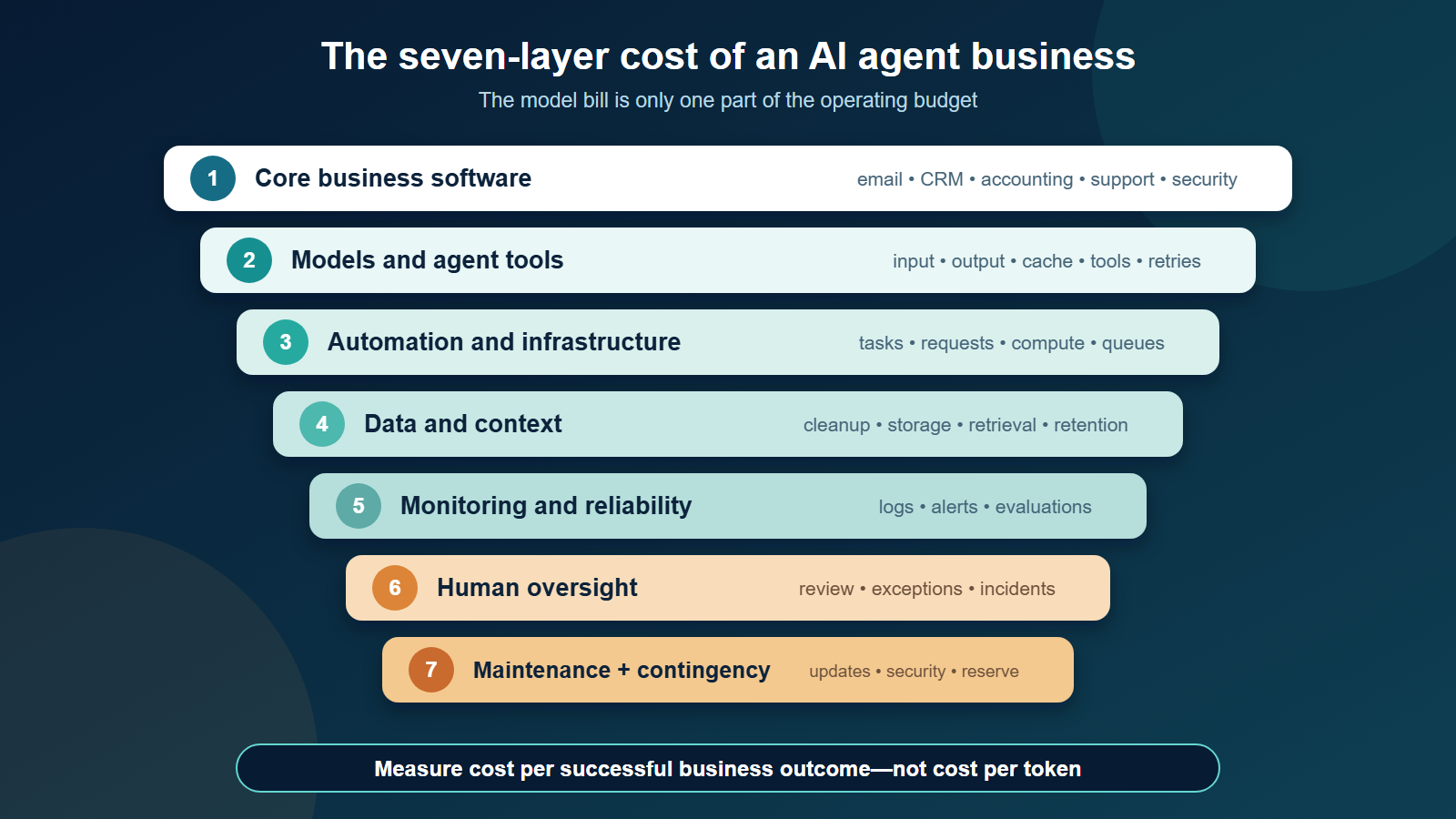
1. Core business software
Start with the tools the company would need even without agents: email, documents, project or customer management, accounting, support, and security. Add only software that removes a defined constraint. A low model bill cannot compensate for five overlapping subscriptions.
Classify each subscription as required, volume-dependent, or optional. Review optional tools quarterly and use the same discipline described in how to consolidate an AI tool portfolio.
2. Model and tool usage
Model providers commonly charge separately for input, cached input, and output. Agent systems may also incur charges for web search, file retrieval, images, audio, containers, or other tools. The cost of a run is therefore more than prompt tokens:
AI run cost = model input + model output + reasoning or cache charges + tool calls + retries
Long histories, oversized retrieved documents, verbose outputs, and repeated failed attempts can quietly multiply usage. Track the tokens and tools consumed by representative jobs. Provider prices change, so keep rates in a configurable cost table rather than hard-coding them into the business case.
3. Automation and infrastructure
An agent usually relies on schedulers, webhooks, queues, databases, storage, and application connectors. No-code platforms may bill by task; cloud services may bill by requests, execution time, storage, data transfer, and logs. At low volume, many infrastructure items are inexpensive. Complexity and poor controls are often more costly than raw compute.
Count every successful action and every attempted run. An eight-step workflow that retries twice can create far more billable activity than its number of completed customer cases suggests.
4. Data and context
Useful agents need governed information. Budget for data cleanup, document ingestion, storage, retrieval, backups, retention, licensing, and deletion. Include the work required to keep sources current and remove obsolete material. Business data should be prepared for its task, not dumped into an ever-growing context window.
5. Monitoring and reliability
Logs, traces, dashboards, alerts, evaluation sets, and incident records are operating costs. They reveal failures before customers do, but they also consume storage and attention. Cloud monitoring commonly bills by volume, so log intentionally: enough to reconstruct decisions and diagnose failure, without retaining every payload forever.
This layer also includes backups, recovery tests, status checks, and a runbook. The maintenance cycle for reliable automation is part of the product, not an optional cleanup project.
6. Human oversight and exception work
Human time is often the largest hidden cost. Measure minutes spent reviewing outputs, correcting records, handling exceptions, answering customer questions, and investigating incidents. Include the fully loaded hourly cost of founders, employees, contractors, or specialists.
If a workflow saves ten hours but creates six hours of review and rework, its gross time savings are misleading. The agent’s job is not merely to produce output; it is to produce acceptable outcomes with less total effort and risk.
7. Maintenance, security, and contingency
APIs change. Credentials expire. Vendors alter limits. Prompts and policies drift away from new business rules. Reserve capacity for testing, upgrades, access reviews, vulnerability work, and vendor replacement. Add a contingency line for usage spikes and unexpected support.
A sensible early reserve is often 10–25% of forecast operating cost, with the higher end used when volume or reliability is uncertain. The reserve should shrink as measurement improves; it should not hide uncontrolled spending.
Build the budget from units of work
Do not forecast “AI usage” as one monthly number. Start with a business event such as a qualified lead, reconciled invoice, support case, completed report, or approved campaign. Then estimate the activity needed per event.
| Budget input | Example planning question |
|---|---|
| Monthly volume | How many cases should enter the workflow? |
| Runs per case | Does one case trigger one agent run or several? |
| Model cost per run | What do representative inputs, outputs, and tools cost? |
| Automation actions | How many billable steps and retries occur? |
| Human minutes | How much review and exception handling is required? |
| Fixed allocation | What share of software, monitoring, and maintenance belongs here? |
| Failure allowance | What percentage is retried, escalated, or reworked? |
Use this formula:
Monthly workflow cost = fixed allocation + (successful cases × variable cost per case) + oversight + maintenance + contingency
Then calculate cost per successful outcome, not cost per attempted run. The FinOps Foundation recommends moving beyond cost per token toward measures such as cost per assist, action, or case. That makes technology spend comparable to business value.
An illustrative monthly budget
Suppose a founder operates three modest workflows handling 1,000 total cases per month. An example—not a quote—might look like this:
| Cost layer | Monthly plan |
|---|---|
| Core software and automation | $300 |
| Models and agent tools | $180 |
| Infrastructure, data, and monitoring | $120 |
| Human review: 10 hours at $50 | $500 |
| Maintenance: 4 hours at $75 | $300 |
| 15% contingency | $210 |
| Total | $1,610 |
At 900 successful outcomes, the unit cost is about $1.79 per outcome. If the previous process cost $4.50 per outcome at comparable quality, the system may be attractive. If only 500 outcomes pass review, the real unit cost rises to $3.22 and the team should investigate failure, scope, and oversight before scaling.
This is why ROI for AI automation must include quality and adoption, not just minutes theoretically saved.
Five controls that prevent cost surprises
- Set a budget per workflow. Give each owner a monthly target and an alert threshold.
- Cap loops, retries, context, and output. An agent should have explicit termination conditions.
- Route by task difficulty. Use deterministic code or a lower-cost model when the job does not need expensive reasoning.
- Measure exception rate. Rising review and failure costs are early warnings of weak inputs or expanding scope.
- Review unit economics monthly. Compare cost, success rate, quality, cycle time, and business value together.
Do not optimize the cheapest line item in isolation. A stronger model that prevents rework may reduce total cost; a cheap model that triggers extra reviews may increase it. Similarly, deleting all logs may lower storage expense while making incidents longer and more expensive.
Explore more practical guidance in the Growth, Teams & Economics hub.
Sources and further reading
- FinOps Foundation: Total Cost of Ownership and unit economics
- FinOps Foundation: Unit Economics capability
- OpenAI API pricing
- Zapier task usage rates
- AWS Lambda pricing
- Amazon CloudWatch pricing
Budget for the business you can operate
The right cost target is not “as little as possible.” It is the lowest total cost that produces a reliable, governable outcome customers will value. Start with one unit of work, expose all seven cost layers, and scale only after the successful-outcome cost is understood.
Agentrepreneur: Building Your AI Agent Business in 28 Days goes deeper into designing the operating system around agent-enabled work. This article provides the cost model; the book helps connect economics to the larger business.


