MEDIA

How to Design an AI Workflow That Fails Safely
An AI workflow fails safely when an error becomes a contained, visible, recoverable event—not a chain reaction. The design should validate inputs before action, place deterministic controls around model judgment, limit authority, make retries safe, stop when uncertainty or exposure crosses a threshold, preserve durable evidence, and provide a tested route to recovery.
That standard matters because failure is not exceptional. APIs time out, records arrive incomplete, vendors change formats, instructions conflict, models misinterpret edge cases, and people approve the wrong item. The useful question is not whether a workflow can fail. It is whether the business can detect the failure before it causes disproportionate damage.
Start with the possible harm
Before choosing tools, identify what a bad outcome could affect:
- money, credit, inventory, or contractual commitments;
- customer or employee communications;
- private, confidential, or regulated information;
- production systems and authoritative business records;
- the company’s reputation or legal position;
- downstream automations that trust the output; and
- the time available to detect and correct an error.
Then rate each action by consequence and reversibility. Drafting an internal summary is low exposure and easy to discard. Sending a customer notice, updating a ledger, deleting a record, changing access, or ordering inventory carries greater consequences. The stronger the consequence and the harder the reversal, the tighter the validation, approval, and containment should be.
This is why a blanket promise that a workflow has “human oversight” is insufficient. Define the actual control. Human-in-the-loop can mean review, approval, exception handling, or escalation, and those are not interchangeable.
Separate judgment from execution
Models are useful when the work requires interpretation: classifying an unusual request, extracting meaning from an email, comparing ambiguous evidence, or drafting a response. They should not be used to imitate deterministic operations such as checking a required field, enforcing a spending limit, calculating a date, polling a job status, or applying a fixed authorization rule.
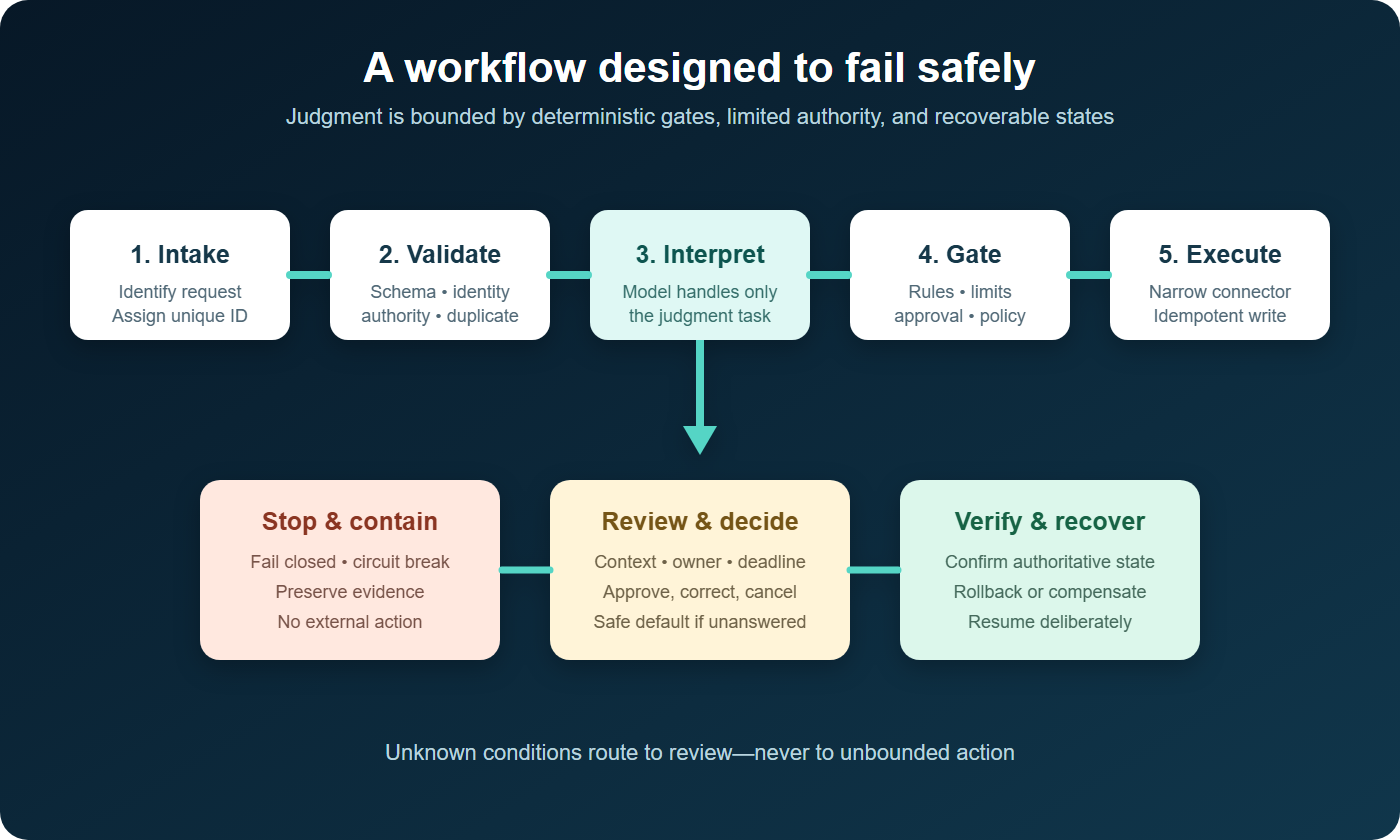
A safer pattern separates the workflow into layers:
- Intake: receive the event and assign a unique correlation identifier.
- Deterministic validation: verify format, required fields, identity, permissions, limits, and duplicates.
- Interpretation: use a model only for the judgment the task genuinely requires.
- Policy gate: test the proposed outcome against explicit rules outside the model.
- Approval: obtain a person’s authorization when consequence, uncertainty, or novelty requires it.
- Execution: perform a narrowly scoped, idempotent action through a controlled connector.
- Verification: confirm the authoritative system reached the intended state.
- Evidence: record what happened, why, under which versions and authority.
This architecture prevents a fluent model response from becoming permission to act. It also allows the deterministic portions to keep working when model access is disabled. For the planning discipline behind this separation, see How to Document a Workflow Before You Automate It.
Validate twice: before judgment and before action
Input validation should reject malformed, incomplete, unauthorized, stale, or suspicious requests before they reach the model. Examples include an unknown customer identifier, a missing invoice, an expired approval, an attachment of the wrong type, or an amount outside the workflow’s range.
Output validation should examine the model’s proposal before execution. Depending on the task, that can include:
- required fields and allowed values;
- numeric and date constraints;
- source availability and citation checks;
- policy and permission rules;
- confidence or ambiguity thresholds;
- prohibited content or destinations;
- comparison with the current authoritative record; and
- confirmation that the proposed action is still relevant.
Do not ask the same model to be the sole judge of its own output. A model can help explain an exception, but fixed controls—schemas, permission checks, limits, allowlists, and record comparisons—should execute as code.
Define explicit states
Long-running work becomes safer when every item has a visible state rather than a vague “in progress” flag. A practical sequence is:
received → validated → proposed → approved → executing → succeeded
Add terminal or holding states such as failed, needs review, cancelled, and compensating. Define which transitions are allowed and who or what may cause them.
For example, an item should not move from proposed directly to succeeded; execution and verification must occur. A rejected approval should not silently re-enter the queue. An item in needs review should have an owner and deadline. State transitions also give an operations dashboard something reliable to count.
Make retries bounded and idempotent
Retries are appropriate for transient failures such as rate limits, temporary network errors, or a service that is briefly unavailable. They are dangerous when the request is invalid, authority is missing, or the previous attempt may already have succeeded.
Use a retry policy that specifies:
- which error types are retryable;
- the maximum number of attempts;
- exponential backoff and jitter to avoid synchronized traffic;
- an overall time limit;
- what evidence is recorded for each attempt; and
- where the item goes when attempts are exhausted.
An idempotent operation produces the same intended result when the same request is submitted more than once. Give each action a unique idempotency key, store the result of the first accepted request, and check it before repeating a write. This is essential for charges, messages, record creation, order placement, and any operation where a timeout leaves the caller uncertain about success.
Never blind-retry a non-idempotent action. First query the authoritative system using the correlation or transaction identifier. If the outcome remains ambiguous, stop and route the item for review.
Contain the blast radius
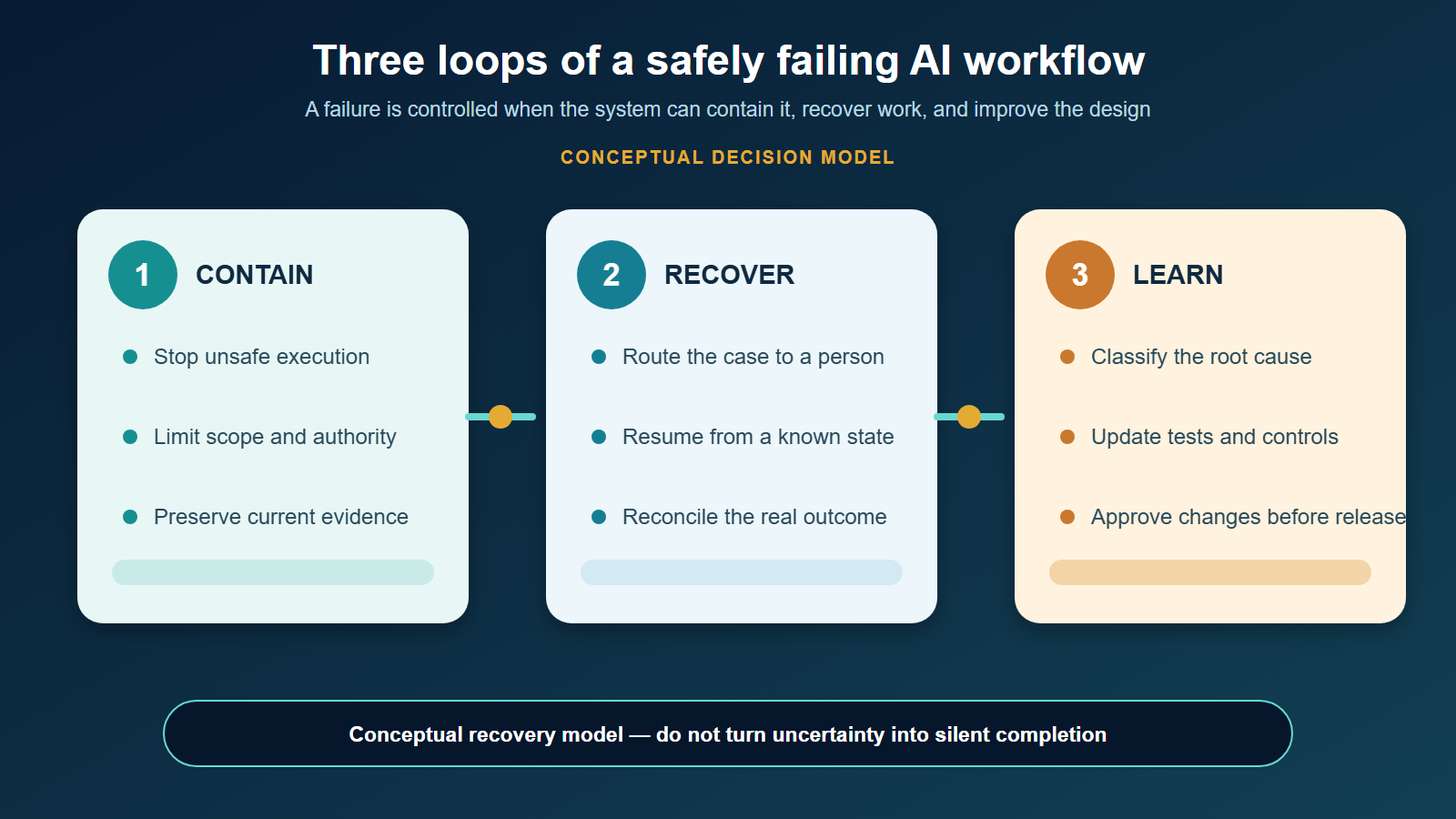
Containment limits how much damage one defect, compromised credential, or mistaken decision can cause. Useful controls include:
- a dedicated identity with the minimum required access;
- separate read, draft, approve, send, update, and delete permissions;
- transaction, daily, customer, or inventory limits;
- allowlists for recipients, accounts, data sources, and actions;
- time-limited credentials and approvals;
- quotas and rate limits;
- a sandbox or staging destination for unproven workflows;
- a circuit breaker that pauses execution after an error threshold; and
- an emergency stop that an accountable person can use immediately.
An agent should not inherit the broad permissions of the person who configured it. Scope information access to the approved task and use approval rules matched to reversibility and exposure.
Match each failure to a control
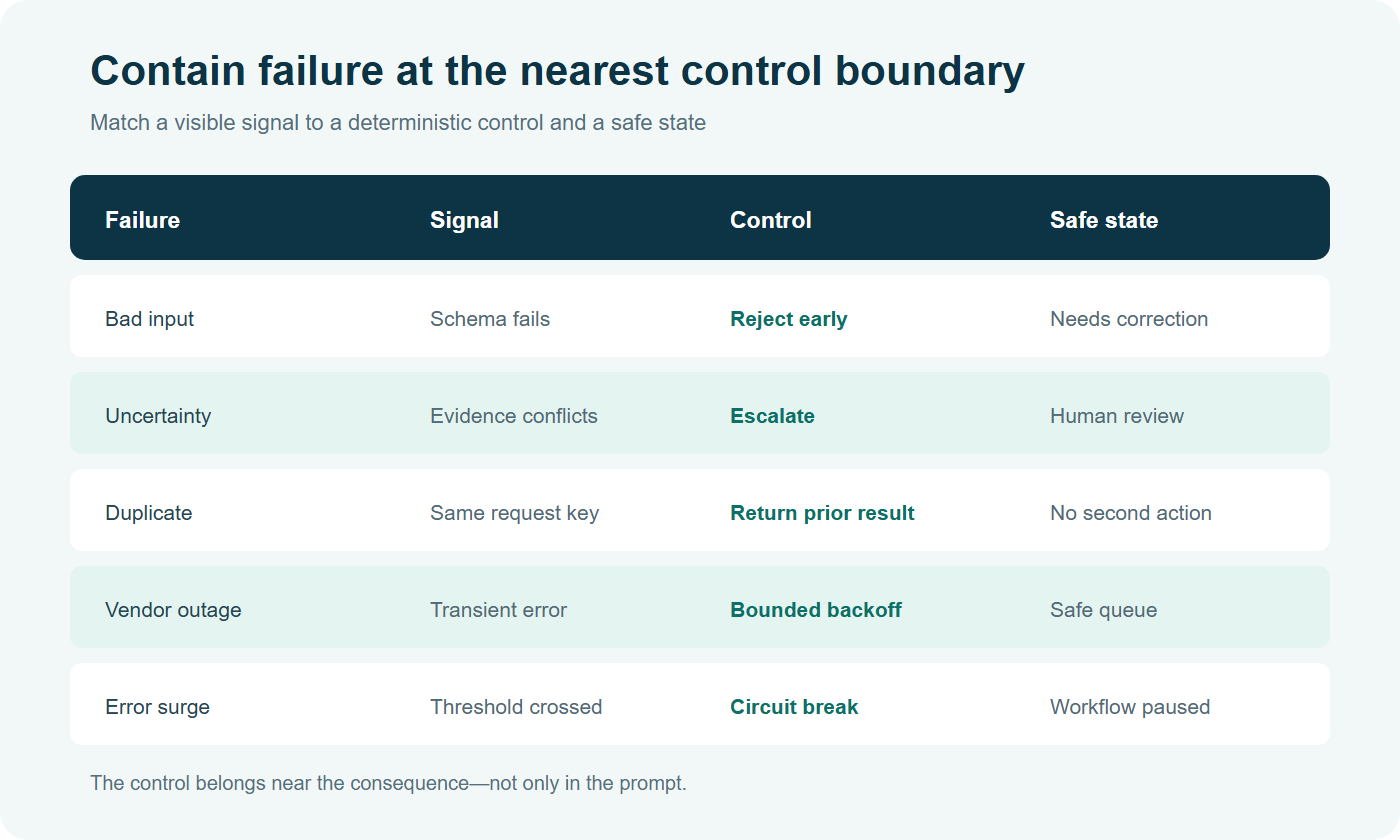
| Failure mode | Early signal | Primary control | Safe outcome |
|---|---|---|---|
| Missing or malformed input | Schema or required-field failure | Reject before model use | Request correction |
| Ambiguous interpretation | Low confidence or conflicting evidence | Escalation threshold | Human decision |
| Policy violation | Deterministic rule fails | Block execution | Record reason and owner |
| Duplicate request | Matching idempotency key | Return prior result | No second action |
| Temporary vendor failure | Retryable error code | Bounded backoff | Retry, then queue safely |
| Partial completion | Verification differs from intended state | Reconcile or compensate | Restore a known state |
| Error surge | Rate or failure threshold exceeded | Circuit breaker | Pause the workflow |
| Lost authority | Expired token or approval | Fail closed | Renew deliberately |
| Unknown condition | No defined transition | Default to needs review |
No external action |
The control belongs as close as possible to the consequence. A spending cap should be enforced at the payment connector, not merely written in a prompt. A recipient allowlist should be checked at the sending boundary. Access rules should be enforced by identity and permissions, not by hoping the agent remembers them.
Plan for rollback—and for what cannot be rolled back
Rollback returns a system to a prior known state. It can work for a software release, a document version, or a staged database change. Many business actions, however, are not truly reversible. A sent email can be corrected but not unsent; a disclosed secret cannot be made secret again; a shipped order can be returned but not made unshipped.
For every consequential action, define one of three recovery paths:
- Rollback: restore the previous version or state.
- Compensation: perform a new action that offsets the first, such as a refund or correction notice.
- Containment and response: revoke access, stop downstream work, notify affected people, and investigate.
Store the information needed for recovery before execution: prior values, transaction identifiers, affected records, approval evidence, and the compensation owner. Test the path in a nonproduction setting. A recovery plan that has never been exercised is an assumption.
Escalate with enough context to decide
“Something went wrong” is not an actionable escalation. A review item should include:
- the requested outcome and current state;
- the input and relevant source references;
- the model’s proposal, if one exists;
- the rule, threshold, or error that stopped execution;
- actions already attempted;
- the consequence of waiting;
- the permitted decisions; and
- the deadline and safe default if nobody responds.
Assign the queue to a role, not an informal hope that someone notices. Measure age, volume, resolution time, repeat causes, and overdue items. If review volume becomes unmanageable, narrow the workflow or fix the recurring cause rather than silently lowering the threshold.
Preserve evidence independently
The workflow should create an audit trail that the model cannot rewrite. Record:
- the correlation and idempotency identifiers;
- request time, source, and accountable user or system;
- relevant input references, not unnecessary sensitive copies;
- model, prompt, policy, and workflow versions;
- validation results and approval evidence;
- attempted actions and authoritative system responses;
- retries, errors, state transitions, and timestamps; and
- final outcome, reviewer, and recovery action.
Keep operational evidence separate from conversational memory. Logs should have appropriate access, integrity protection, retention, and deletion rules. Evidence is useful only if the business can retrieve it during an incident and understand what it means.
Monitor outcomes, not just uptime
A green health check can coexist with poor business results. Monitor both technical and outcome signals:
- success and verified completion rates;
- blocked, failed, and escalated items;
- duplicate prevention events;
- latency and queue age;
- retries by cause and provider;
- human correction and override rates;
- financial or customer impact; and
- unusual access or action patterns.
Set thresholds that trigger an alert, reduced authority, or automatic pause. NIST’s AI Risk Management Framework playbook specifically points organizations toward post-deployment monitoring, incident response, recovery, the ability to bypass or deactivate systems, and backup or manual processes when systems fail.
Practice recovery before production
Run failure drills using representative cases:
- remove a required field;
- send an unauthorized or out-of-range request;
- return a malformed model output;
- simulate a timeout after the external action succeeds;
- make a vendor unavailable;
- expire a credential;
- overload the review queue; and
- trigger the circuit breaker.
Verify that the workflow stops where expected, creates a useful review item, prevents duplicates, preserves evidence, and resumes without losing or repeating work. Include the manual continuity process. CISA’s safe software deployment guidance similarly emphasizes staged recovery, rollback planning, learning from failures and near misses, and root-cause analysis rather than treating restoration as the end of the incident.
After any meaningful incident, ask what condition allowed the failure to travel as far as it did. Improve the control, test, documentation, or ownership—not just the prompt.
A pre-launch safe-failure checklist
Before activating an AI-assisted workflow, confirm:
- the outcome, owner, authority, and consequence are documented;
- deterministic checks run directly in code;
- model judgment is bounded by policy and validation gates;
- states and allowed transitions are explicit;
- external writes are idempotent or have duplicate protection;
- retries are limited to known transient failures;
- permissions, amounts, destinations, rates, and time are constrained;
- approvals are required where consequence warrants them;
- unknown conditions fail closed into a named review queue;
- rollback, compensation, or incident response is defined;
- logs are independent and sufficient to reconstruct events;
- monitoring can pause the workflow automatically;
- manual continuity is available; and
- failure and recovery drills have passed.
A reliable workflow is not one that never produces an exception. It is one that turns exceptions into bounded operating work. Design the stopping points, evidence, and recovery path before increasing autonomy.
For the broader maintenance burden behind this discipline, read The Hidden Maintenance Work Behind Reliable Automation. To connect workflow risk with business-level decisions, see The Small-Business Guide to AI Risk—Without the Legal Jargon.
Exercise failure before customers discover it
Schedule a short failure drill before commissioning the workflow and after material changes. Use a safe environment or controlled test records, and work through several conditions:
- the source system is unavailable or returns stale data;
- a credential expires or a permission is removed;
- the model returns an uncertain, unsupported, or malformed answer;
- the workflow receives a duplicate, conflicting, or incomplete request;
- an external action succeeds but the confirmation is lost; and
- the primary operator is unavailable during an exception.
For each condition, observe the actual state transition. Confirm that retries are bounded, duplicate actions are prevented, the item reaches the correct queue, evidence is preserved, and the owner can pause or reduce authority. Then run the manual or reduced-mode path long enough to prove that essential work can continue.
Record the expected behavior, observed behavior, gap, owner, and retest date. A written fallback that has never been exercised is a hypothesis. A successful drill creates operating evidence and gives employees the confidence to stop unsafe automation instead of improvising around it.
Pair the drill with the AI incident response checklist and include the results in the weekly AI operating report.
Explore more practical guidance in the AI Operations & Command Centers hub.
Sources and further reading
- NIST AI Risk Management Framework Playbook: Manage
- NIST AI Risk Management Framework Core
- CISA: Safe Software Deployment
- AWS Well-Architected Framework: Make all responses idempotent
- AWS Prescriptive Guidance: Retry with backoff pattern
Build the operating discipline behind your agents
Agentrepreneur: Building Your AI Agent Business in 28 Days helps business owners move from scattered AI experiments toward a managed operating system with clear roles, controls, visibility, and accountability. The book goes deeper into the implementation discipline; this article gives you a public safe-failure lens for evaluating any workflow.