 MEDIA
Is Your Business Ready for an AI Operating System? A Practical Readiness Audit
A business is ready for an AI operating system when it can connect AI-assisted work to a valuable outcome, a sufficiently stable process, usable data, accountable owners, proportional controls, measurable performance, and ongoing operating capacity. Readiness is not the number of tools you own or how enthusiastically the team uses chat. It is the organization’s ability to build, govern, measure, and maintain a dependable business capability.
You do not need perfect scores before starting. You do need to know which gaps would make the proposed use case unreliable, unsafe, or uneconomic. Use this audit to decide whether to proceed, run a limited pilot, repair foundations first, or choose a simpler solution.

What an AI operating system means here
An AI operating system is not a single software product. It is the managed combination of people, workflows, deterministic software, models, data, permissions, evidence, and review routines that produces business outcomes. A chatbot or agent may sit inside it, but the operating system also includes everything that makes the capability accountable and sustainable.
This framing matters because a convincing model response can hide weak foundations. A demo may succeed with hand-picked inputs and an expert watching every step. Production work has missing fields, unusual customers, changing policies, expired credentials, vendor outages, competing priorities, and people who interpret exceptions differently.
NIST’s AI Risk Management Framework organizes responsible AI work around four continuous functions: govern, map, measure, and manage. Its guidance emphasizes clear roles, documented context, testing, monitoring, incident response, and lifecycle decisions. Those are not enterprise-only concerns; a small business can apply them proportionally.
How to score the audit
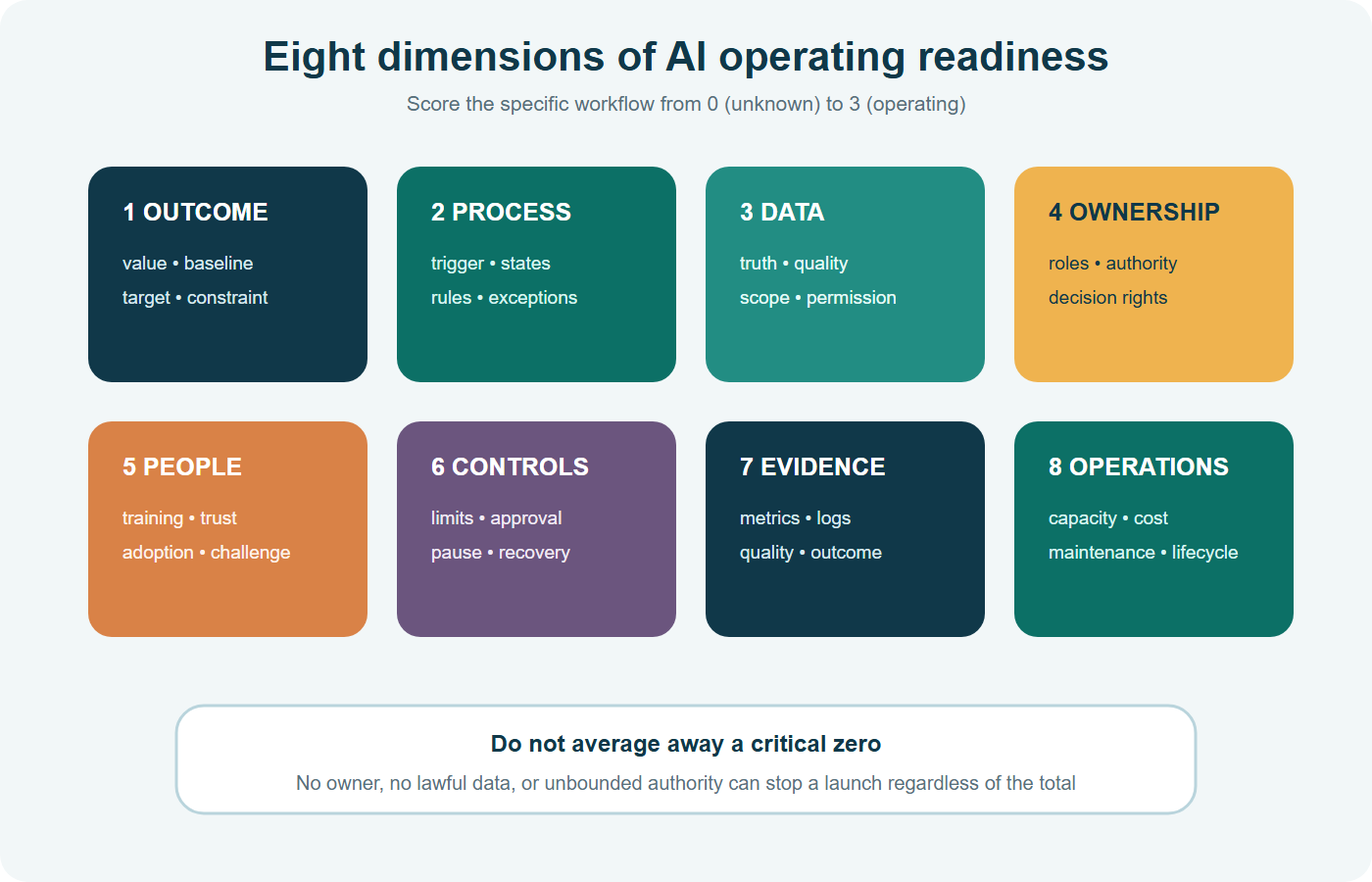
Rate each dimension from 0 to 3:
- 0 — Unknown: the business cannot answer the core questions.
- 1 — Informal: knowledge exists in people’s heads or inconsistent habits.
- 2 — Defined: the essential process, owner, rule, or measure is documented and usable.
- 3 — Operating: it is tested, followed, measured, and improved in real work.
Score the specific workflow you want to enable, not the company’s aspirations. A company can be ready for low-risk proposal drafting and unready for autonomous refunds. Consequence and reversibility change the required standard.
1. Outcome readiness
Core question: Can you state the business result, baseline, target, and constraint?
A useful outcome describes what improves for the customer or company. “Use AI for marketing” is an initiative. “Reduce the time from an approved campaign brief to a compliant first draft from two days to four hours, while maintaining the current approval rate” is measurable.
Check whether you have:
- a specific customer or operating problem;
- a current baseline for time, cost, volume, quality, or risk;
- a target and review date;
- a named beneficiary and accountable owner;
- constraints the system must respect; and
- a reason AI is preferable to process repair or conventional automation.
If value cannot be measured, tool activity will become a substitute for progress. Before building, compare the AI option with a form, clearer policy, database rule, integration, staffing change, or removal of unnecessary work.
2. Process readiness
Core question: Is the workflow stable enough to describe, test, and improve?
The process does not have to be perfect. It must be visible. Identify the trigger, required inputs, normal path, decision points, exceptions, approvals, outputs, system of record, and final state. Ask experienced employees where the written process differs from real work.
Low readiness signs include “everyone handles it differently,” no agreement on completion, exceptions mixed into the normal queue, or a workflow that changes every week. Automating that ambiguity can make inconsistency faster and less visible.
Use How to Document a Workflow Before You Automate It to create the current-state map. Then separate fixed operations from judgment. Calculations, required-field checks, schedules, permissions, and status polling should run deterministically in code; models belong only in identified interpretation tasks.
3. Data and context readiness
Core question: Can the system obtain the minimum correct, current, permitted information needed for the task?
Inventory authoritative sources and the people who maintain them. Test representative records for completeness, duplication, inconsistent terminology, stale values, and access restrictions. Do not treat a shared drive full of documents as a governed knowledge base.
Check whether the workflow has:
- named sources of truth;
- clear ownership and update frequency;
- common identifiers across systems;
- permissions aligned with the task;
- rules for sensitive, confidential, licensed, or customer data;
- retention and deletion requirements; and
- a method to identify the version or source behind an output.
Broad access does not fix poor context. It increases exposure. Start with clean, task-fit business data and scope agent access to what the approved workflow requires.
4. Ownership and decision-rights readiness
Core question: Does every important outcome, exception, and permission have a human owner?
Name a business owner, an operational owner, and the people authorized to approve changes. In a small company, one person may hold several roles, but the decisions should still be explicit.
Define who can:
- approve the use case and its risk tolerance;
- change instructions, rules, connectors, or data sources;
- grant and revoke access;
- review high-consequence actions;
- resolve exceptions and customer complaints;
- pause or retire the workflow; and
- accept residual risk after testing.
NIST’s governance guidance places responsibility with leadership and calls for documented roles and lines of communication. “The vendor manages it” is not an accountability structure. Vendors manage parts of a service; the deploying company still owns its purpose, configuration, access, use, and response.
5. People and adoption readiness
Core question: Can the affected people use, challenge, and support the new division of labor?
Readiness includes more than a training session. Employees should understand what the system does, where it is limited, how their responsibilities change, how to recognize a poor result, and where to report a problem. Reviewers need enough time and context to make real decisions rather than rubber-stamp a queue.
Look for:
- a credible workflow sponsor;
- participation from people who perform the current work;
- documented human review duties;
- training based on realistic cases and failures;
- a feedback channel with response ownership;
- protection for employees who question unsafe or unreliable behavior; and
- a manual continuity process.
Resistance can reveal a design problem, a trust problem, a workload problem, or fear about roles. Treat it as evidence to investigate, not a communications obstacle to suppress.
6. Control and risk readiness
Core question: Are authority and exposure limited in proportion to the possible harm?
List what the system may read, infer, draft, recommend, send, update, purchase, delete, or disclose. Rate each action by consequence and reversibility. Then place controls at the point of action rather than relying on a prompt to remember them.
Controls can include schemas, allowlists, access roles, transaction caps, approval gates, recipient restrictions, validation rules, rate limits, idempotency keys, circuit breakers, audit logs, and an emergency stop. Unknown conditions should fail into a named review state.
The phrase “human in the loop” is insufficient without a named decision, reviewer, deadline, and safe default. See what human-in-the-loop actually means and how to design a workflow that fails safely.
7. Measurement and evidence readiness
Core question: Can you prove both what the system did and whether it improved the business outcome?
Establish a baseline before the pilot. Measure verified completion, quality, time, cost, exceptions, corrections, overrides, customer impact, and reliability. Model usage and task counts describe activity; they do not prove value.
The evidence trail should preserve the request, relevant source references, versions, validation results, approvals, actions, authoritative responses, errors, and final outcome. Logs should be independent enough that a model cannot rewrite its own history.
Compare performance with the prior process, a simpler alternative, and a human baseline where appropriate. NIST’s measure guidance similarly recommends relevant benchmarks, regular testing, documentation, monitoring, and feedback from the people supporting deployed systems.
8. Operating-capacity readiness
Core question: Can the business maintain the system after the launch team moves on?
Budget for subscriptions, usage, integrations, security, review time, exception handling, testing, documentation, vendor changes, and incident response. Confirm that someone has time to review performance and maintain credentials, connectors, knowledge sources, and policies.
Ask what happens when:
- a vendor changes a model or interface;
- the source data format changes;
- volume doubles;
- a credential or approval expires;
- an employee with key knowledge leaves;
- monitoring shows a quality decline;
- a customer disputes an AI-assisted action; or
- the system must be replaced or decommissioned.
These are ordinary lifecycle events. The hidden maintenance work behind reliable automation should be part of the investment case, not an unpleasant surprise.
Interpret the score without false precision

With eight dimensions scored from 0 to 3, the maximum is 24. Use the total as a discussion aid, not a certification.
| Score | Interpretation | Recommended action |
|---|---|---|
| 0–8 | Foundations are mostly unknown or informal | Define the outcome and repair process, data, and ownership before an AI build |
| 9–15 | Promising but materially exposed | Run discovery or a low-risk, read-only pilot while closing named gaps |
| 16–20 | Ready for a bounded production pilot | Limit scope and authority, test representative cases, and monitor closely |
| 21–24 | Strong operating foundation | Proceed proportionally; readiness still requires lifecycle review and controls |
Do not average away a critical zero. A high overall score cannot compensate for no owner, unlawful or unavailable data, unbounded financial authority, or an inability to detect harm. Establish non-negotiable gates for the specific use case.
Readiness depends on the use case
Consider three examples:
- Internal meeting-summary drafts: low consequence, easy to discard, but still requires consent, information handling, and accuracy expectations. A limited pilot may be appropriate at a modest score.
- Customer refund recommendations: higher financial and trust impact. The business needs authoritative transaction data, explicit policy, reviewer authority, evidence, and safe handling of exceptions.
- Autonomous account closure: difficult to reverse and potentially consequential. This demands strong identity, authorization, validation, approval, incident response, and legal review; the better decision may be not to automate execution.
The question is not “Are we ready for AI?” in the abstract. It is “Are we ready for this capability, with this information and authority, in this operating context?”
Readiness red flags that should pause the build
Some gaps are not items to fix after launch. Pause and resolve them before the system touches production work when:
- nobody can identify the authoritative record or policy;
- the proposed benefit depends on eliminating review that is legally, contractually, or operationally required;
- the system would use customer, employee, confidential, or licensed information without a clear permitted basis;
- success is defined only by generated volume or time saved, with no quality or outcome measure;
- a vendor requires broader access than the workflow needs and cannot limit it;
- reviewers are expected to approve more items than they can examine meaningfully;
- the workflow has no safe state for ambiguity, missing data, or conflicting instructions;
- the business cannot determine whether an external action actually succeeded;
- errors could propagate into payments, customer communications, permissions, or authoritative records without containment; or
- the project has launch funding but no owner or budget for ongoing operation.
These conditions do not necessarily prohibit all AI use. They often point toward a narrower, read-only, draft-only, or internal use case while the business repairs its foundation. For example, the system might summarize an approved document for a trained employee without writing to a customer record. Evidence from that limited use can inform the next decision without pretending the organization is ready for greater authority.
Also watch for a subtler red flag: a team trying to preserve a broken process by adding AI around it. If the largest delay comes from conflicting policy, unnecessary approvals, unclear service ownership, or duplicate systems, address that source first. AI can help interpret work; it cannot resolve a management decision the business has avoided making.
Turn the audit into a 30-day readiness plan
Choose no more than three gaps that block a bounded pilot. For each one, define an observable deliverable, owner, and date. Examples include:
- approve a one-sentence outcome and baseline;
- map the current workflow and top ten exceptions;
- identify the source of truth for five required fields;
- create a permission matrix for read, draft, approve, and execute;
- write escalation rules for incomplete, ambiguous, and high-consequence cases;
- assemble a representative test set with expected results;
- define five outcome and reliability measures; or
- assign a weekly review owner and incident contact.
Then reassess. If the business cannot close a foundational gap, reduce the scope or choose a simpler design. A conventional automation with one bounded AI interpretation step often creates more value than an ambitious agent attached to weak operations.
A final readiness gate
Proceed to a production pilot only when you can say:
- the outcome, baseline, target, and owner are documented;
- the workflow and exceptions are visible;
- minimum authoritative data is available and permitted;
- fixed rules and validation execute deterministically;
- model judgment has a narrow, testable purpose;
- permissions and approvals match consequence;
- affected people are trained and can challenge the system;
- evidence can reconstruct decisions and actions;
- business and reliability measures are reviewed on a schedule;
- safe pause, recovery, manual continuity, and retirement are defined; and
- the business has budget and capacity for ongoing operation.
Readiness is not a finish line. It is the ability to make a controlled commitment, learn from evidence, and adjust before increasing scope or authority.
Explore more practical guidance in the AI Entrepreneurship & Strategy hub.
Sources and further reading
- NIST AI Risk Management Framework Core
- NIST AI RMF Playbook
- NIST AI RMF: Govern
- NIST AI RMF: Map
- NIST AI RMF: Measure
- NIST AI RMF: Manage
- OECD SME AI Readiness Tool
Build from readiness, not enthusiasm
Agentrepreneur: Building Your AI Agent Business in 28 Days goes deeper into the implementation discipline for turning AI capabilities into a managed business. This independent audit helps you decide where the foundation is strong and where to repair it before the build.


