 MEDIA

AI Tool Sprawl: How Many Platforms Does a Small Business Need?
A small business needs enough AI platforms to support distinct, valuable workflows with acceptable control—not one tool for every feature, experiment, employee, or polished demonstration. The right number is the smallest portfolio that meets business requirements without creating hidden gaps in capability, data access, continuity, or ownership.
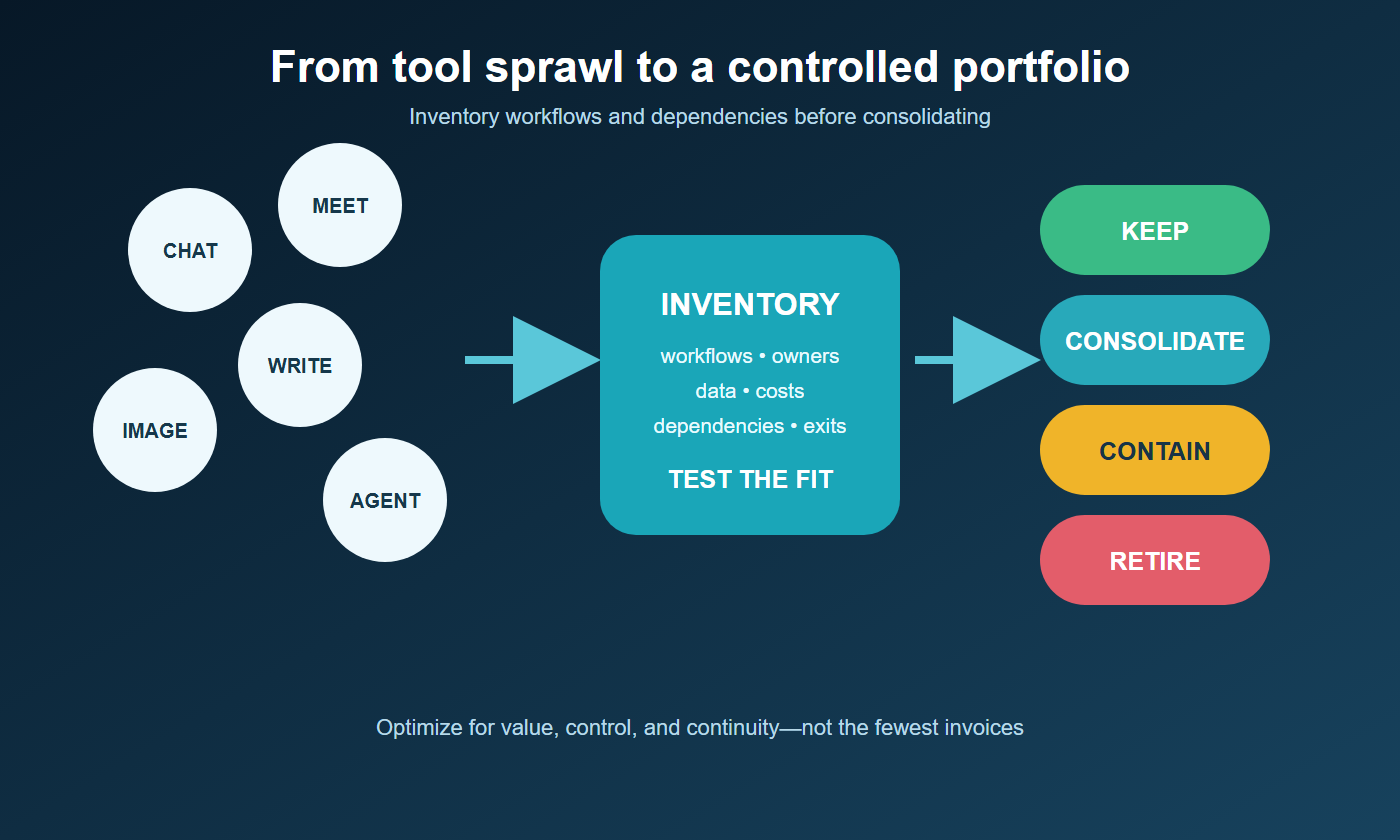
Tool sprawl is not merely a subscription problem. Each additional platform can introduce accounts, permissions, contracts, data copies, integrations, training, support, logs, model behavior, renewal dates, and exit work. Consolidation can reduce that burden, but removing a tool without mapping dependencies can also break a workflow the business relies on.
First, define what counts as a tool
Inventory more than products marketed as “AI agents.” Include:
- standalone chat, writing, image, video, coding, research, meeting, and analysis applications;
- AI features embedded in office, CRM, accounting, support, marketing, and project platforms;
- automation and integration services that call models;
- model or API accounts used by internal or customer-facing applications;
- browser extensions, mobile apps, plugins, and add-ons;
- custom agents, retrieval collections, and contractor-built workflows; and
- free or trial accounts that receive business information.
NIST describes an AI system inventory as an organized record that supports maintenance, incident response, and an organization-wide view of deployed systems. A partial list limited to paid invoices will miss shadow tools, embedded features, and technical dependencies.
Build the inventory before choosing a number
For each tool, record:
| Field | Why it matters |
|---|---|
| Business purpose and workflows | Reveals duplication and orphaned experiments |
| Owner and users | Establishes accountability and adoption |
| Cost and renewal | Shows committed and variable expense |
| Data and connected systems | Identifies exposure and migration work |
| Capabilities actually used | Separates value from feature lists |
| Dependencies and downstream consumers | Prevents accidental breakage |
| Access and administrator account | Supports control and offboarding |
| Evidence of value | Enables keep, combine, or retire decisions |
| Export and deletion path | Protects continuity and exit |
| Risk and consequence | Determines review depth and fallback needs |
Use account records, identity and expense systems, browser or extension inventories where appropriate, integration settings, vendor lists, employee interviews, and workflow documentation. Do not treat monitoring employee activity as permission to collect more personal information than necessary; keep discovery focused on business systems and approved work.
Look for five kinds of overlap
Duplicate capability
Several tools may summarize documents, draft messages, transcribe meetings, or create images. Similar feature names do not prove equivalence. Compare representative work, quality, data controls, integrations, and review time.
Duplicate workflow
Two departments may perform the same process in separate platforms. This can fragment records and training even if the tools have different feature sets.
Duplicate data
Multiple products may copy the same customer files, email, meeting recordings, or knowledge base. Every copy creates another access, retention, and deletion obligation.
Duplicate infrastructure
Custom workflows may call separate model providers, vector stores, automation services, and monitoring products when a shared approved platform could meet the need.
Duplicate contracts and administration
Monthly plans purchased by individuals can hide seat waste, inconsistent terms, missing admin controls, and renewals that no one owns. A consolidated plan may help—but only if it provides the required controls at a sensible total cost.
Score each tool on value, fit, and burden
Use a simple evidence-based score rather than a popularity contest.
Value
Does the tool improve cycle time, capacity, quality, revenue, customer experience, or risk? Is the result measured or merely reported? How many people and completed workflows benefit?
Fit
Does it support the real workflow, approved data, identity controls, integrations, accessibility, export, and review process? Can the team learn and operate it without excessive complexity?
Burden
Count subscription and usage charges, configuration, training, review, monitoring, credentials, incidents, integration maintenance, vendor administration, and migration difficulty. The AI automation ROI guide explains why the invoice is not total operating cost.
Dependency
Would removing the tool stop a customer process, erase evidence, break another system, or leave no fallback? High dependency does not guarantee the tool should stay; it means retirement needs a controlled migration.
Use four portfolio decisions

- Keep: distinctive value, acceptable risk, active ownership, and a workable exit.
- Consolidate: another approved platform can meet the requirement with less total burden.
- Contain: the tool is temporarily necessary, but access, data, users, or new adoption should be limited while an alternative is prepared.
- Retire: weak value, unacceptable risk, abandoned ownership, or duplicate capability with a verified replacement.
Avoid making “standardize on one vendor” the answer before testing. A broad suite may reduce administration while creating concentration risk, weaker specialist capability, expensive premium tiers, or a difficult exit. Conversely, a collection of best-of-breed products can become an integration and governance project. The portfolio decision should make the tradeoff visible.
Consolidate by workflow, not feature count
Create a short list of required workflows: for example, internal knowledge search, customer-support drafting, meeting capture, marketing production, data analysis, and software development. Define the outcome, users, data, actions, controls, and evidence for each.
Then test whether the proposed standard platform covers the representative cases. Include exceptions and migration. A vendor’s checklist may say that both products “summarize,” while one preserves citations, permissions, structured fields, or review history that the workflow needs.
The Small Business Administration’s software-selection guidance emphasizes fit for similar businesses, manageable complexity, integration, upgrade paths, vendor stability, trials, and low-risk terms. Consolidation should improve those factors, not only reduce the number of invoices.
Retire tools without losing data or continuity
Before cancellation:
- identify every user, integration, automation, and downstream report;
- export source, configuration, output, and evidence records;
- verify the export can be used outside the service;
- migrate or archive records according to policy;
- disable new data entry and communicate the cutover;
- revoke integrations, tokens, and user access;
- confirm retention and deletion behavior;
- preserve required contract, invoice, and incident records; and
- monitor the replacement or manual fallback after transition.
Our guide to who owns the data AI tools create provides a deeper export and termination checklist.
Establish a lightweight portfolio rhythm
For a small company, governance can be practical:
- require a named owner before any tool receives business data;
- use an approved-tool list with defined purposes and limits;
- route new requests through a short value, data, access, and overlap review;
- review renewals at least 30 to 60 days before commitment;
- reconcile the inventory with expenses, accounts, and integrations quarterly;
- sample actual use and outcomes rather than counting licenses alone; and
- retire experiments with no owner, evidence, or next decision date.
NIST recommends inventorying AI systems and third-party components, tracking owners and dependencies, and decommissioning systems that exceed risk tolerances. CISA’s vendor guidance adds due diligence for cloud services and logical access. The small-business application is simple: know what you use, why it exists, what it touches, what it costs, and how it leaves.
A practical answer to “how many?”
There is no universal ideal number. The portfolio is healthy when every tool has a distinct or intentionally shared role, an accountable owner, approved data access, verified value, understood dependencies, a maintenance plan, and an exit path.
If two tools serve the same workflow, keep both only when the added resilience or capability is worth the burden. If one tool serves many workflows, verify that concentration does not create unacceptable lock-in or outage exposure. Optimize the portfolio for operating clarity, not the smallest possible count.
Start with Five Questions to Ask Before Buying an AI Agent Tool and Build vs. Buy. For ongoing administration, read The Hidden Maintenance Work Behind Reliable Automation or return to the Growth, Teams & Economics hub.
Readers building a coordinated operating system can explore The AI Agent Entrepreneur, Volume I. The book’s implementation materials go beyond this public portfolio framework and are not reproduced here.
Run a quarterly tool-consolidation review
Review the register with finance, operations, security, and the people who actually use the tools. For each product, ask:
- Which active workflow and business outcome does it support?
- Who owns the account, configuration, data, and renewal decision?
- Does another approved tool provide the same capability?
- Are integrations, credentials, exports, and deletion procedures documented?
- What would stop working if the subscription ended next week?
Classify each tool as keep, consolidate, restrict, replace, or retire. Assign an owner and date to every change. Consolidation should reduce duplicated cost and access without removing a capability that an operating workflow genuinely needs.
Use the AI vendor security checklist for products that remain and the AI Operations & Command Centers hub to connect the inventory with recurring management.
After consolidation, verify that retired tools no longer hold active credentials, integrations, scheduled work, or retained business records. A canceled subscription is not the same as a completed exit.


