MEDIA

Who Owns the Data Your AI Tools Create?
Your business may own the customer records, prompts, and documents it puts into an AI tool, but that does not automatically mean it controls every output, activity log, embedding, summary, label, or improvement produced around them. “Who owns the data?” is too broad. The useful questions are: What information exists, what may each party do with it, what can you retrieve, how long is it kept, and what happens when the relationship ends?
Treat ownership, permitted use, practical access, portability, retention, and deletion as separate contract and operating questions. A vendor can say “you own your data” while limiting export formats, keeping de-identified or aggregated information, retaining security logs, or reserving rights needed to operate and improve the service. Those terms may be reasonable, unacceptable, or negotiable depending on the workflow. The business must identify the difference before connecting important records.
This article is a practical due-diligence framework, not legal advice. Contract language, privacy obligations, intellectual-property rules, and industry requirements vary. Ask qualified counsel to review terms when the data or business consequence warrants it.
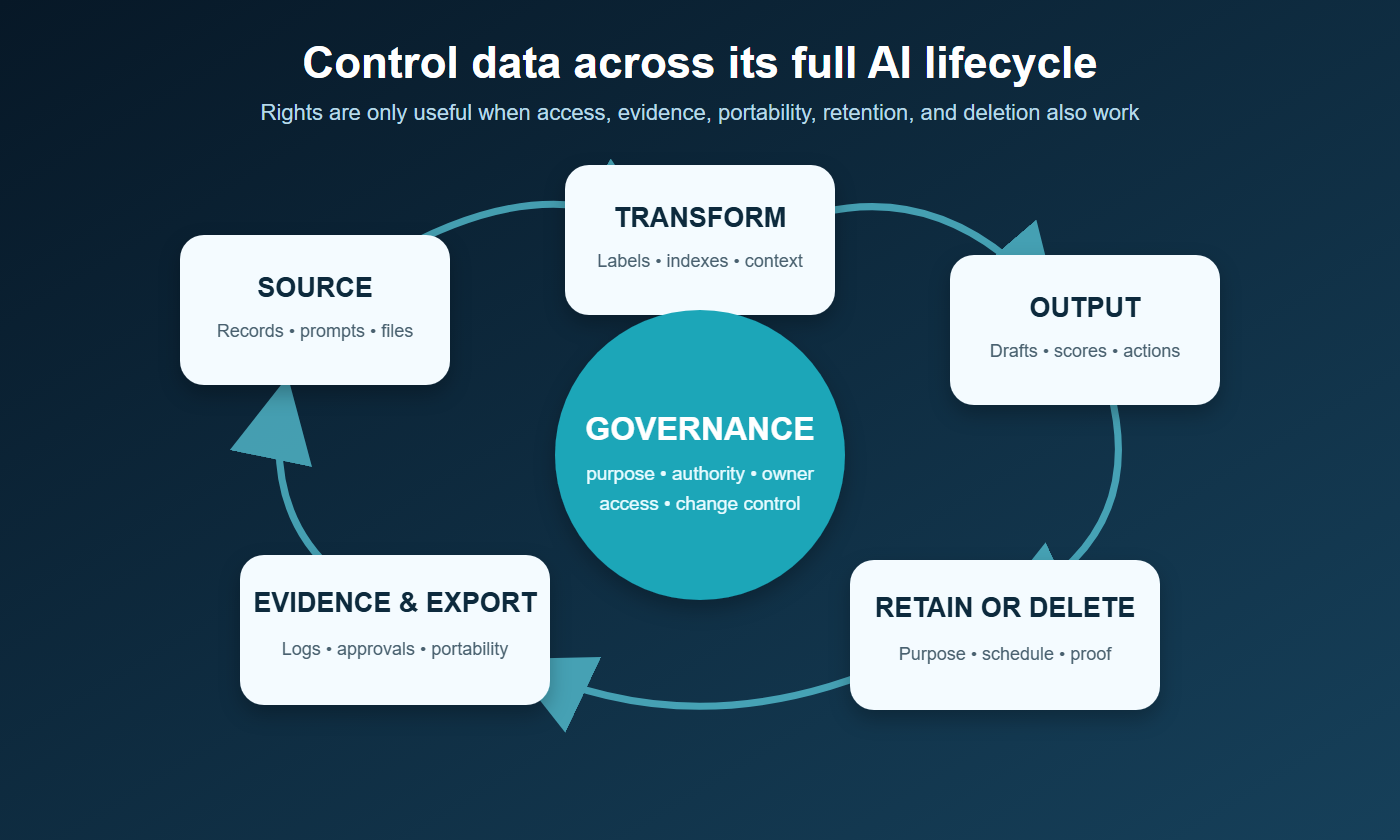
Start by separating six kinds of information
A single AI workflow can create several data layers with different risks and rights.
1. Source data
This is information the business or its users supply: customer records, emails, documents, call transcripts, product data, employee material, images, database fields, and instructions. It may include information the business owns, licenses, holds under a customer agreement, or processes under a legal obligation.
Do not assume possession equals unrestricted rights. A customer may allow use to deliver a service but not to train an unrelated model. A licensed database may restrict copying or derivative use. An employee record may be subject to retention and access rules. Before evaluating vendor terms, establish what authority the business has over the source.
2. Prompts, configurations, and workflow context
Instructions, templates, examples, retrieval collections, taxonomies, routing rules, and configured approval boundaries often contain business know-how. They may be stored as ordinary account data even when the team thinks of them as “the setup.”
Ask whether these assets can be exported in a reusable form. A PDF of prompts may preserve words but not connectors, permissions, variables, evaluations, or routing logic. Practical portability requires enough context to reconstruct the workflow.
3. Generated outputs
Drafts, summaries, recommendations, classifications, images, code, forecasts, and structured fields are the visible product of the tool. The agreement may give the customer rights in outputs, but the business still needs to evaluate whether an output contains protected, personal, confidential, or inaccurate material.
Contractual rights do not establish factual accuracy, originality, or fitness for a particular use. Maintain human review and provenance appropriate to the consequence. See What Human-in-the-Loop Actually Means for a control-oriented review model.
4. Operational evidence
Activity logs, timestamps, approvals, exceptions, model or version identifiers, cost records, tool calls, error messages, and evaluation results show what happened. These records can be essential for customer support, incident review, billing disputes, quality monitoring, and safe change management.
They are easy to overlook because they are not the headline output. Verify which logs the vendor creates, which are visible to administrators, how long they remain available, and whether they survive export or termination.
5. Derived and transformed data
An AI service may create embeddings, extracted entities, labels, scores, profiles, indexes, summaries, analytics, or other representations derived from supplied information. These artifacts can be valuable because they organize business knowledge or power downstream workflows.
Ask whether derived data is treated as customer data, service metadata, or vendor technology. Can it be exported? Can it be reused outside the service? Is it deleted when the source record is deleted? If a vendor says a representation is irreversible or de-identified, ask what that means operationally and whether the representation can still be linked, searched, or used to influence a result.
6. Aggregated learning and service improvements
Providers may collect telemetry, performance statistics, feedback, or aggregated patterns to secure, operate, analyze, or improve a service. The important questions are what is collected, whether it is connected to the business or individuals, whether customers can opt out, and whether the vendor uses customer content to train or tune models.
Avoid reducing this to a single “training: yes or no” checkbox. Security monitoring, abuse detection, product analytics, human review, model evaluation, and model training are different activities. Ask for each purpose separately.
Ownership is only one column in the decision

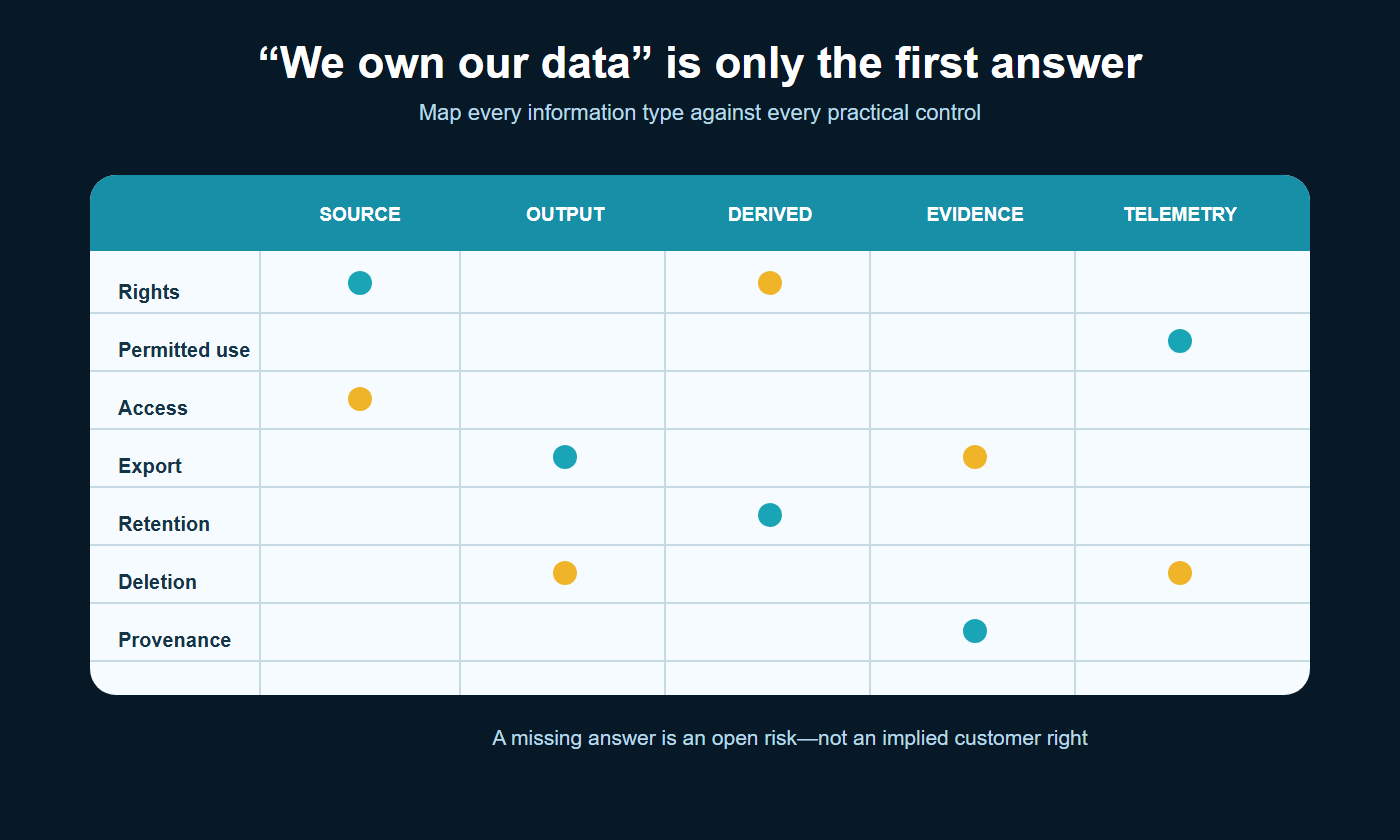
The matrix is a conceptual due-diligence tool, not a statement about any vendor. For every information type, record the following:
| Question | What to establish |
|---|---|
| Title or rights | Who claims ownership, license, or other rights? |
| Permitted purpose | What may the provider, customer, subcontractors, and users do? |
| Access | Who can view or retrieve it during normal operation and support? |
| Portability | Can it be exported in a complete, documented, machine-readable form? |
| Retention | How long is it kept in active systems, logs, backups, and archives? |
| Deletion | What triggers deletion, what exceptions apply, and is confirmation available? |
| Provenance | Can the business trace source, transformations, approvals, and versions? |
| Change control | Can terms, subprocessors, locations, or uses change, and how is notice provided? |
This prevents a comforting ownership sentence from obscuring a weak operating position. A business may technically own an output yet be unable to retrieve the inputs, evidence, or derived records needed to use it elsewhere.
Assign an internal steward for the whole record
Vendor review often becomes fragmented: the business owner reads pricing, IT checks security, a user tests features, and legal counsel reviews selected terms. Assign one internal steward to assemble the complete operating record and track unresolved questions. The steward does not need to make every decision, but should know where the authoritative evidence lives and who owns each follow-up.
At minimum, the record should contain the approved purpose, data classes, system owner, vendor and subprocessors, access roles, signed terms, security evidence, export test, retention schedule, incident contacts, renewal date, and exit procedure. Record important limitations explicitly—for example, “approval history cannot be exported” or “security logs remain for 90 days after deletion.” A visible limitation can be managed; a forgotten assumption cannot.
Revisit the record when the workflow, plan, integration, model provider, data type, or vendor terms materially change. A review completed for a standalone drafting tool does not automatically cover the same product after it receives access to customer email, financial systems, or an automated action channel.
Read the whole document set, not one privacy page
Relevant terms can be spread across the master agreement, order form, product terms, privacy notice, data-processing addendum, acceptable-use policy, security documentation, service-level terms, subprocessors list, model-provider terms, API terms, and help articles.
Build a simple evidence file with the document name, URL or signed copy, effective date, product and plan, reviewer, important provisions, and next review date. Save the version that applied at purchase. Web pages change; a bookmark alone does not preserve the decision record.
Look for definitions. “Customer Data,” “Content,” “Input,” “Output,” “Usage Data,” “Service Data,” “Confidential Information,” and “De-identified Data” may have different scopes. Trace each defined term through license, confidentiality, security, retention, suspension, termination, indemnity, and limitation sections.
The Federal Trade Commission advises small businesses to put vendor security expectations in writing and address how vendors may use, share, sell, retain, and delete data. NIST’s AI Risk Management Framework also recommends policies, documentation, testing, and monitoring for third-party AI systems and data.
Ask these questions before connecting business data
Send questions in writing and attach material answers to the decision record.
Use and disclosure
- What information does the service collect from content, integrations, users, devices, and activity?
- For which purposes may the provider and its subprocessors use each type?
- Is customer content used for human review, evaluation, tuning, or training? What controls or opt-outs apply?
- May information be used to develop other products, benchmarks, or aggregated insights?
- Under what conditions is information disclosed to affiliates, subprocessors, authorities, or other customers?
Security and location
- Where is information processed and stored, including backups and support systems?
- Which subprocessors and model providers receive it?
- What access controls, authentication, encryption, logging, and incident-notification practices apply to our plan?
- Can support personnel access content, and is that access approved and logged?
- How are tenant separation and integration credentials handled?
Export and continuity
- Which source, configuration, output, derived, and log records can administrators export?
- Are exports complete, documented, machine-readable, and available without professional services?
- Does an API expose the same information as the interface?
- Are attachments, relationships, timestamps, approvals, identifiers, and version history preserved?
- How long is export access available after cancellation, suspension, or nonpayment?
Retention and deletion
- What is the default and configurable retention period for each data type?
- What remains in backups, security logs, legal holds, and fraud-prevention systems after deletion?
- Do deletion requests propagate to derived records and subprocessors?
- What schedule applies after account termination?
- Will the provider supply confirmation or evidence of deletion when appropriate?
Product and contract changes
- How are customers notified of new subprocessors, material changes, or new data uses?
- Can the business object, opt out, or terminate before a change takes effect?
- What happens to the data if the provider is acquired, discontinues the product, or becomes insolvent?
- Which commitments are contractual, and which are only current product behavior?
Test portability before you need it
Do not treat an “Export” button as proof of portability. Run a small exit drill during the trial or early subscription.
- Create representative records, files, outputs, approvals, and errors.
- Export through the administrator interface and any promised API.
- Open the files without the vendor’s application.
- Check counts, identifiers, relationships, dates, permissions, and attachments.
- Reconstruct one workflow or customer history in a neutral system.
- Record what is missing and the labor needed to make the export useful.
- Confirm deletion behavior on a nonessential test record.
A CSV containing final text may be sufficient for a drafting aid. It is not sufficient for a system whose value depends on linked records, evidence, and approval history. Judge portability by the business capability that can be restored, not the number of files downloaded.
For the broader technology choice, use Build vs. Buy: Should You Customize an AI Agent or Use SaaS?.
Define retention from business purpose, not storage convenience
Keeping everything feels safe, but unnecessary retention expands breach impact, discovery burden, privacy exposure, and migration cost. Deleting everything immediately can also destroy evidence, customer history, or records the business must preserve.
Create a schedule by data class and purpose. Identify the accountable owner, minimum and maximum period, triggering event, archive needs, deletion method, exceptions, and evidence of disposition. Apply the schedule across the source system, AI tool, integration platform, analytics store, logs, backups, and exports.
The FTC recommends keeping sensitive information only while there is a legitimate business need and maintaining a written retention policy when records must be preserved. NIST emphasizes provenance—including origin, transformations, dependencies, and metadata—because useful governance depends on knowing how a data asset came to exist and changed.
Plan termination as an operating procedure
Before adoption, write the steps for a normal exit, urgent suspension, and vendor failure. Include:
- who can authorize termination;
- how new processing will be stopped;
- how exports will be requested and verified;
- which integrations and credentials will be revoked;
- how the business will continue the workflow;
- how users and affected customers will be informed when necessary;
- how retention or legal-hold obligations will be preserved; and
- how deletion and account closure will be documented.
Do not delete the old service until the export is verified and the replacement or manual fallback works. Do not leave access open indefinitely after migration. Treat the transition as a controlled change with a start, evidence checks, and a named completion decision.
A practical data-control rule
For every AI tool, the business should be able to state:
We know what information enters and is created, the authority and purpose for each use, who can access it, what evidence we retain, how we export it, how long it remains, and how we leave.
If one part is unknown, mark it as an open risk rather than filling the gap with assumption. Low-consequence tools may justify a lightweight answer. Systems involving sensitive records, consequential decisions, customer commitments, or operational dependence need stronger contractual language, technical evidence, and professional review.
Start with Five Questions to Ask Before Buying an AI Agent Tool and How to Clean Business Data Before Adding AI. Continue with What Information Should an AI Agent Be Allowed to See? when available, or return to the Data, Context & Business Memory hub.
Readers building a coordinated business operating system can explore The AI Agent Entrepreneur, Volume I. The book’s implementation assets are distinct from this public due-diligence framework and are not reproduced here.
Add ownership to the offboarding checklist
When a tool, employee, contractor, or vendor relationship ends, confirm who must export business records, preserve required evidence, transfer administrative control, revoke access, and verify deletion. Record the date, responsible person, destination, and any material gaps. This turns “we own our data” from a contract phrase into an operating capability that can survive a real transition.
Test one export before renewal, not only during an emergency. Confirm that the files are complete, intelligible, attributable to stable identifiers, and usable without the vendor’s interface. An export that cannot support continuity, audit, correction, or migration is not meaningful portability.
Sources and further reading
- Federal Trade Commission: Cybersecurity for Small Business—Vendor Security
- Federal Trade Commission: Protecting Personal Information—A Guide for Business
- NIST AI RMF Playbook: Govern—Third-Party Systems and Data
- NIST AI RMF Playbook: Manage—Data Provenance and Third-Party Resources
- NIST Research Data Framework, Version 2.0
- CISA: Using Cloud Apps for Business