 MEDIA

Should You Hire an Employee, Use a Contractor, or Automate the Work?
Hire an employee when the business needs durable ownership, frequent collaboration, accumulated company knowledge, and direction over how work is performed. Use a contractor for a bounded outcome, specialized expertise, or variable capacity that can operate independently. Automate work that is stable, repetitive, rules-based, measurable, and inexpensive to verify. Many real jobs require a combination: a person owns the outcome, a specialist handles a defined project, and software removes repeatable steps.
The decision should begin with the work—not with a preferred tool or the apparent hourly price. Map the outcome, workload, judgment, risk, response time, knowledge, and control the business actually requires.
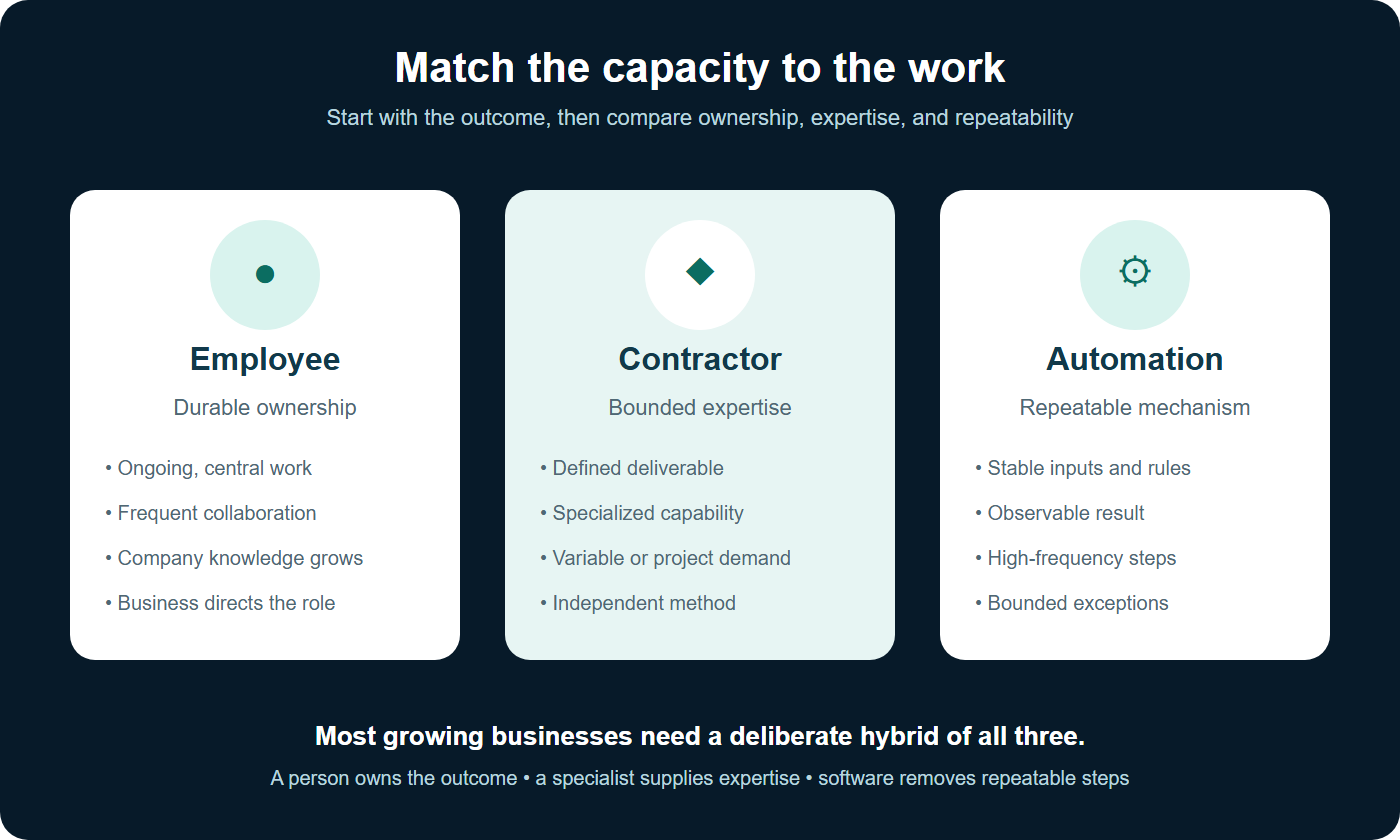
Ask what kind of capacity is missing
“We need help” can describe several different constraints:
- Volume: the team cannot complete enough work.
- Capability: the business lacks a skill or credential.
- Continuity: work needs an accountable owner every week.
- Speed: requests wait too long for attention.
- Consistency: repeated work varies unnecessarily.
- Coverage: evenings, absences, or seasonal demand create gaps.
- Attention: qualified people spend time on low-value administration.
Each constraint points toward a different answer. Automation may relieve volume and consistency problems but cannot create accountable leadership. A contractor may supply expertise quickly but may not retain everyday operating context. An employee can build continuity but is a poor solution for a three-week specialty project.
Before adding capacity, document the workflow and remove steps that should not exist. Hiring or automating a confused process makes the confusion more expensive.
Choose an employee for durable ownership
An employee is usually the strongest fit when the work:
- is central and ongoing rather than project-based;
- requires frequent reprioritization and close coordination;
- depends on relationships with customers, partners, or teammates;
- accumulates valuable company-specific knowledge;
- requires the business to direct when, where, and how it is performed;
- carries responsibility that should remain inside the organization; or
- offers enough consistent work to justify a long-term role.
Do not compare salary alone with a contractor invoice or software subscription. Include recruiting, payroll taxes, benefits, equipment, management, training, coverage, and the time required to reach proficiency. Then count the value an employee can create through ownership, judgment, learning, and improvement—not merely completed transactions.
Use a contractor for bounded expertise or flexible capacity
A contractor can be appropriate for a defined deliverable, specialized skill, independent professional service, temporary surge, or uncertain workload. Good contractor work has a clear result, scope, acceptance criteria, schedule, access boundary, and owner inside the business.
Examples include a brand redesign, security assessment, tax project, migration, research engagement, or short-term production overflow. A contractor should not become an indefinitely managed employee under a different label.
Worker classification is a legal and tax determination based on the real relationship, not the title in an agreement. The IRS examines behavioral control, financial control, and the relationship of the parties. The Department of Labor applies separate employment-law analysis, and its guidance has changed over time. State tests may differ again. If the facts are unclear, obtain qualified employment and tax advice before structuring the relationship.
Automate stable, observable work
Automation is strongest when inputs are structured enough to validate, the steps and exceptions can be described, the action is bounded, and the result can be checked. Candidates include:
- copying approved data between systems;
- routing requests by explicit attributes;
- producing scheduled reports from authoritative records;
- generating drafts for human review;
- checking required fields and fixed thresholds;
- sending reminders under defined conditions; and
- monitoring queues, deadlines, or failures.
Do not automate merely because a task is repetitive. High-consequence, ambiguous, rare, rapidly changing, or relationship-sensitive work may belong with a person. Review When Not to Use AI and how to evaluate a task for automation before assigning judgment to a model.
Automation also creates ownership work: design, testing, permissions, monitoring, exception handling, vendor management, and maintenance. The subscription price is not the total cost. Calculate automation ROI using verified time, error, throughput, and maintenance evidence.
Compare the options across seven dimensions
| Dimension | Employee | Contractor | Automation |
|---|---|---|---|
| Best for | Ongoing ownership | Bounded expertise or capacity | Stable repeatable steps |
| Judgment | Broad, contextual | Specialized and scoped | Narrow and constrained |
| Workload | Sustained | Variable or project-based | High-frequency or event-driven |
| Direction | Business directs role | Provider controls method within scope | Code follows designed rules |
| Knowledge | Accumulates internally | Must be transferred deliberately | Encoded in logic, data, and documentation |
| Scaling | Requires hiring and management | Add or reduce engagements | Marginal volume may be inexpensive |
| Main risk | Fixed cost or role mismatch | Dependency or misclassification | Hidden failure, drift, or weak oversight |
No column is universally cheaper. The best choice is the lowest total cost that can meet the required service level and risk tolerance.
Use a simple decision sequence

- Define the outcome. What must be true when the work is complete?
- Measure demand. How often does it occur, how variable is it, and how quickly must it be handled?
- Separate steps from responsibility. Which actions repeat, and who must own the result?
- Rate judgment and consequence. What ambiguity exists, and what happens when the decision is wrong?
- Identify knowledge needs. Does value grow as someone learns customers, products, and company history?
- Determine control. Does the business need to direct the manner of work, or can it specify an independent deliverable?
- Calculate total cost. Include setup, management, tools, oversight, error correction, maintenance, and exit.
- Test the smallest reversible choice. Run a bounded pilot with success and stop criteria.
If workload is uncertain but ownership will likely become permanent, a project or carefully structured contractor engagement can clarify the role. If a repetitive portion is slowing a valuable employee, automate that portion instead of replacing the role. If automation needs continuous judgment, appoint a human owner rather than pretending the workflow is autonomous.
Design the hybrid, not just the category
Consider a customer onboarding process. An employee may own the relationship and resolve unusual needs. A contractor may redesign the onboarding materials or integrate a new platform. Deterministic automation can validate forms, create records, schedule reminders, and surface exceptions. AI may draft a welcome message, but a policy gate and human review should control sensitive or unusual cases.
That hybrid preserves accountability while using each form of capacity where it is strongest. It also makes growth more resilient: software absorbs routine volume, contractors add specialized bursts, and employees retain decisions and knowledge that matter to the business.
A final screen before you commit
Choose an employee when you need a role. Choose a contractor when you need an independently delivered result. Choose automation when you need a repeatable mechanism. Pause when you cannot define the outcome, the worker relationship, the authority, the exception path, or the way success will be measured.
Review the decision after 30, 60, and 90 days. Compare actual cost, quality, cycle time, supervision, exceptions, and knowledge gained with the original assumptions. Capacity decisions are operating hypotheses, not permanent truths.
Commission the work in stages
Avoid making the final payment milestone “the automation is installed.” Use evidence-based stages that separate configuration from an operating result:
- Discovery accepted: the current workflow, owners, data, exceptions, risks, and finish condition are documented and approved.
- Design accepted: authority, permissions, architecture, records, tests, fallback, support, and exit responsibilities are explicit.
- Shadow results accepted: representative cases run without live authority and meet agreed quality, safety, and reliability thresholds.
- Limited pilot accepted: a narrow live scope produces verified outcomes with functioning approvals, queues, monitoring, and stop controls.
- Handoff accepted: documentation, credentials, source files, exports, training, support contacts, and recovery procedures are complete and tested.
Tie payments and change control to these milestones. Preserve a decision record for scope changes so urgency does not quietly expand access or remove testing. Require the contractor to demonstrate the failure and recovery paths, not only the happy path.
The business owner should retain administrative control of core accounts, domains, repositories, data stores, and vendor relationships. Contractors can perform technical work without becoming the only people capable of operating or exiting the system. Use the AI vendor security checklist for third-party dependencies and the build, buy, or integrate guide to clarify lifecycle responsibility.
Keep an internal acceptance owner separate from the contractor performing the work. The person judging completion needs authority to reject incomplete evidence and require a retest.
Explore more practical guidance in the Growth, Teams & Economics hub.
Sources and further reading
- IRS Topic 762: Independent Contractor vs. Employee
- IRS Publication 15-A (2026): Employer’s Supplemental Tax Guide
- U.S. Department of Labor: Small Entity Compliance Guide
- U.S. Small Business Administration: Hire and Manage Employees
Build a business that assigns work deliberately
Agentrepreneur: Building Your AI Agent Business in 28 Days helps owners define roles, operating controls, and visibility before adding more people or automation. The book provides the deeper implementation path; this article gives you a practical capacity decision lens.


